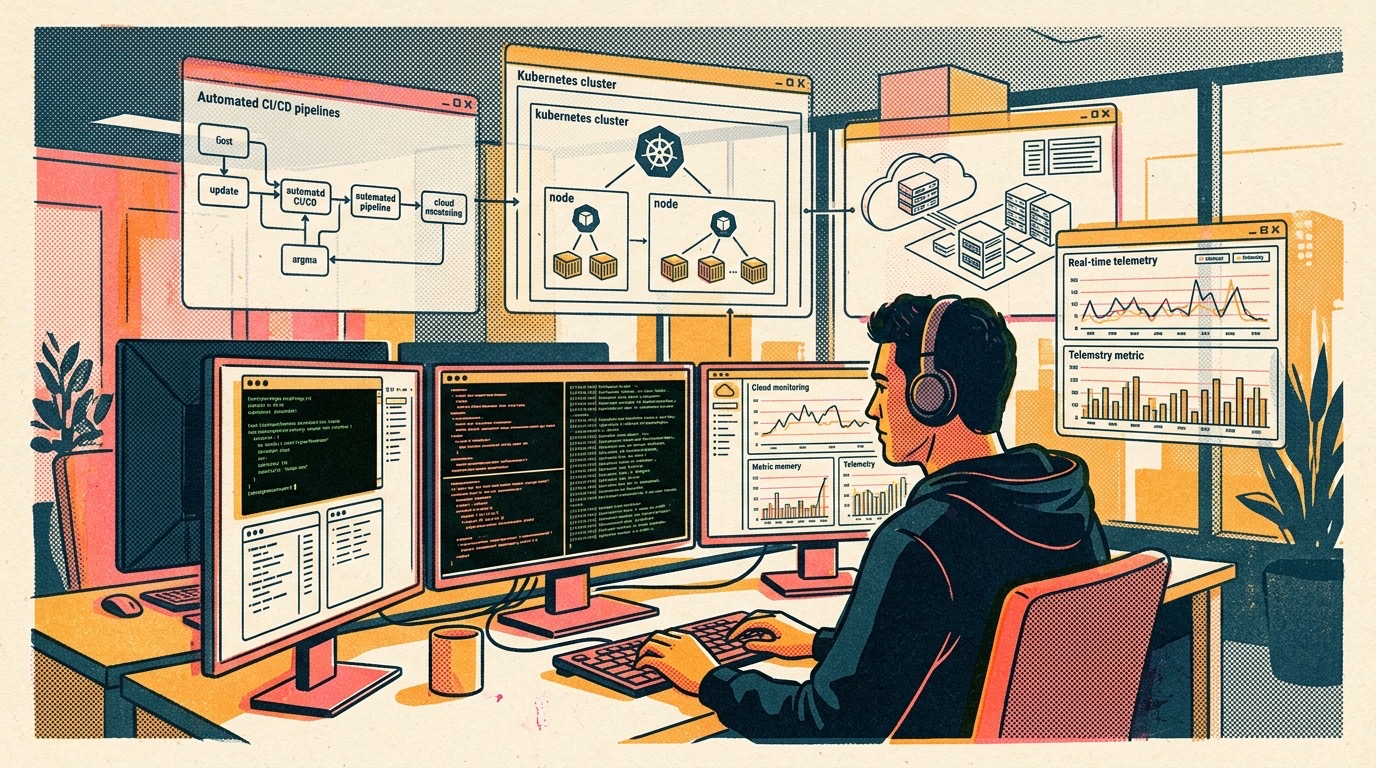
The role of the DevOps engineer has evolved dramatically over the last few years. The days when writing a bash script to rsync tarballs onto a staging server qualified as modern deployment automation are long gone. Today, engineering organizations expect DevOps and Platform engineers to design resilient distributed systems, enforce automated policy-as-code guardrails, architect self-healing container clusters, and maintain seamless developer experience (DevEx) across multi-cloud environments.
When you walk into a senior devops engineer interview, hiring managers and principal platform architects are not merely quizzing you on flags for grep or systemctl. Instead, they evaluate how you reason about failure domains, automate operational toil, ensure zero-downtime continuous deployment, and balance velocity against security.
In this comprehensive guide, we unpack the highest-signal devops interview questions asked at high-growth startups and enterprise tech giants in 2026. Review these architectural trade-offs, code samples, and battle-tested responses to articulate your infrastructure expertise with confidence. For a broader overview of technical interview frameworks, explore our comprehensive guide to technical interview prep.
The Modern DevOps Hiring Landscape
Before diving into specific questions, it is crucial to recognize how interviewers evaluate candidates across modern platform engineering tracks:
- Automation Over Manual Interventions: Can you replace repetitive manual steps with reproducible code?
- Resilience & Fault Isolation: When third-party dependencies crash, how does your infrastructure absorb shocks?
- Observability & Feedback Loops: How quickly can your deployment systems detect regressions and initiate automated rollbacks?
- Security by Design (DevSecOps): Do you integrate vulnerability scanners, secrets management, and least-privilege RBAC into pipelines early (shifting left)?
Whether you are preparing for platform engineering, cloud operations, or site reliability engineering, pairing this guide with our Docker and Kubernetes interview questions will ensure complete coverage of runtime primitives.
Core CI/CD Pipeline Architecture & Automation
CI/CD automation sits at the heart of any DevOps organization. In any ci cd pipeline interview round, interviewers look for deep understanding of artifact immutability, automated gating, and deployment strategies.
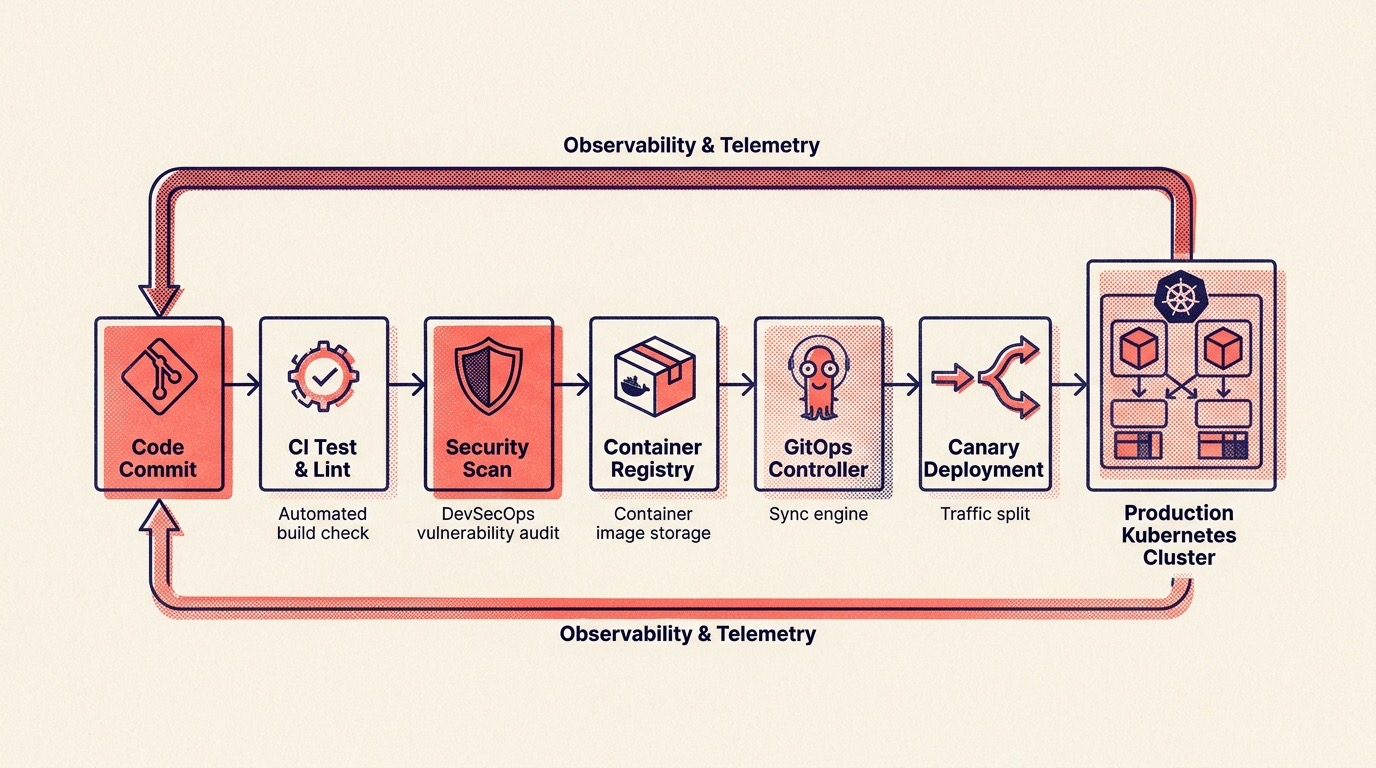
Question 1: How do you design a zero-downtime continuous deployment pipeline?
What the Interviewer Is Really Asking: Can you architect an automated delivery pipeline that prevents service degradation, validates application health in real time, and isolates rollouts across multiple environments?
Ideal Answer Framework: A resilient zero-downtime deployment pipeline rests on four architectural pillars:
- Immutable Build Artifacts: The CI stage compiles binaries or packages Docker container images once. The exact same SHA-256 digest container image is promoted across Dev, Staging, and Production. Changing environment variables or configuration at runtime is handled via externalized config stores (Kubernetes ConfigMaps and Secrets), never by rebuilding the image.
- Automated Verification Gates: Before deployment, the pipeline enforces static analysis (SonarQube, ESLint), unit tests, dependency vulnerability scans (Trivy, Snyk), and container image signing (Cosign/Sigstore).
- Safe Progressive Rollouts: Rather than replacing all instances simultaneously, production deployments leverage Blue-Green or Canary strategies:
- Canary Deployments: Direct 5% of production traffic to the new revision using a service mesh (Istio, Linkerd) or Kubernetes Ingress (Argo Rollouts, Flagger).
- Automated Analysis: Analyze real-time Prometheus metrics (HTTP 5xx error rate, p99 latency) for 10 minutes. If error thresholds stay below 0.1%, automatically ramp traffic to 25%, 50%, and 100%. If anomalies are detected, the pipeline aborts and rolls back immediately without human intervention.
- Database Migration Strategy: Decouple schema migrations from application code deployments using the Expand-Contract pattern (adding backward-compatible columns first, deploying code, and dropping deprecated columns in a follow-up release).
Question 2: What is the difference between GitOps and traditional push-based CI/CD pipelines?
What the Interviewer Is Really Asking: Do you understand the security, auditing, and reconciliation advantages of pull-based declarative infrastructure?
Key Comparison Points:
| Dimension | Push-Based CI/CD (e.g., Jenkins, GitHub Actions) | GitOps Pull-Based (e.g., ArgoCD, Flux) |
|---|---|---|
| Execution Trigger | CI server pushes manifests via kubectl apply | In-cluster agent pulls from Git repository |
| Credentials & Security | CI runner must store sensitive cluster admin credentials | Cluster credentials remain inside the target VPC/cluster |
| State Reconciliation | Fire-and-forget; drift is undetected until next run | Continuous reconciliation loop automatically corrects drift |
| Disaster Recovery | Requires re-running pipeline workflows or manual restores | Re-apply Git repository manifests to stand up clean cluster |
| Audit Trail | Fragmented across pipeline execution logs | Pure Git commit history serves as the single source of truth |
Follow-Up Tip: Mention that in modern architectures, push-based pipelines still excel at artifact building and unit testing, while GitOps operators handle deployment and continuous state reconciliation in target clusters.
Infrastructure as Code (IaC) & Immutable Infrastructure
Interviewers frequently probe your experience with Terraform, OpenTofu, Pulumi, and CloudFormation to test your ability to manage enterprise cloud estates safely.
Question 3: How do you manage state and prevent drift in Terraform?
What the Interviewer Is Really Asking: Do you understand the concurrency risks of state management and how to scale IaC across multidisciplinary engineering teams?
Comprehensive Answer: Terraform state maps your declarative code to real-world cloud resources. Managing it effectively requires strict conventions:
- Remote State Backends with Concurrency Locks: Store state files in encrypted remote object storage (such as AWS S3 with KMS or Google Cloud Storage) paired with a distributed locking mechanism (DynamoDB or native object locking). This prevents concurrent executions from corrupting the state file.
- State Segregation by Domain & Environment: Never maintain a single monolithic state file for an entire infrastructure. Partition state boundaries into independent modules (e.g.,
networking-vpc,data-persistence,compute-k8s) and environments (staging,prod). A blast radius in one module will not jeopardize unrelated infrastructure. - Automated Drift Detection: Schedule recurring CI jobs (e.g., nightly
terraform plan -detailed-exitcode) or employ drift-detection engines (Spacelift, env0). If an engineer modifies a security group manually via the cloud console, the drift detection alert fires immediately, and automated GitOps triggers can overwrite unauthorized changes back to the Git baseline. - State Manipulation Hygiene: Never edit
.tfstatefiles manually. Useterraform state mv,terraform state rm, orimportblocks with code review approvals.
Question 4: How do you design Infrastructure as Code for Multi-Region Failover?
In senior infrastructure as code interview questions, you will often be asked how to design zero-data-loss failover. You should address:
- Abstracting region parameters into map variables or workspaces.
- Deploying global load balancing (Cloudflare, AWS Route 53 latency routing) with health checks pointing to regional endpoints.
- Replicating asynchronous data layers (e.g., Amazon Aurora Global Databases, Cross-Region DynamoDB Global Tables) while accounting for replication lag during split-brain events.
- Structuring infrastructure alongside decoupled services, a topic covered deeply in our microservices interview questions and system design patterns.
Container Orchestration & Kubernetes Patterns
Container orchestration is a core pillar of modern infrastructure. Interviewers test whether you understand container lifecycles, resource management, and failure recovery beyond the basics.
Question 5: How do Kubernetes readiness and liveness probes prevent cascading failures?
Core Concept Breakdown:
A frequent mistake candidates make is confusing the responsibilities of livenessProbe, readinessProbe, and startupProbe:
- Startup Probe: Determines whether the application process has finished initialization (e.g., warming caches, loading large machine learning models, or executing database migrations). While the startup probe is active, liveness and readiness checks are disabled.
- Liveness Probe: Checks if the container process is alive and responsive. If the liveness probe fails consecutively past the configured threshold, kubelet kills the container and triggers a restart according to the
restartPolicy.- Caution: Never configure a liveness probe to verify external dependencies (such as an external PostgreSQL database or Redis cache). If the database experiences a temporary spike in latency, all web pods will fail their liveness checks and enter a synchronized restart loop, turning a minor database slowdown into a catastrophic full-cluster outage.
- Readiness Probe: Checks whether the container is ready to accept incoming user traffic. If a readiness probe fails, the pod is NOT restarted; instead, the endpoints controller removes the pod's IP from the corresponding Kubernetes Service and Ingress endpoints.
- Best Practice: Use readiness probes for graceful degradation, rate limiting, and shedding load when worker queues become saturated.
# Example production-grade Kubernetes health check configuration
apiVersion: apps/v1
kind: Deployment
metadata:
  name: order-service
spec:
  replicas: 3
  template:
    spec:
      containers:
      - name: app
        image: ghcr.io/org/order-service:v2.4.1@sha256:7f...
        ports:
        - containerPort: 8080
        startupProbe:
          httpGet:
            path: /healthz/startup
            port: 8080
          failureThreshold: 30
          periodSeconds: 2
        livenessProbe:
          httpGet:
            path: /healthz/liveness
            port: 8080
          initialDelaySeconds: 5
          periodSeconds: 10
          timeoutSeconds: 2
        readinessProbe:
          httpGet:
            path: /healthz/readiness
            port: 8080
          initialDelaySeconds: 2
          periodSeconds: 5
          timeoutSeconds: 2
For more hands-on cloud scenarios, review our AWS interview questions for cloud engineers and explore container networking models.
Observability, SRE Principles & Incident Triage
A top candidate demonstrates that their job does not end when code reaches production. You must know how to observe system behavior and react decisively when production breaks.
Question 6: How do you differentiate between SLIs, SLOs, and SLAs?
Interviewers evaluate whether you think in terms of measurable reliability contracts:
- SLI (Service Level Indicator): A quantifiable metric measured in real time that reflects service performance.
- Example: The proportion of successful HTTP requests (
status < 500) served in under 250 milliseconds over a 30-day rolling window:
- Example: The proportion of successful HTTP requests (
SLI = (Successful Requests (< 250ms)) / (Total Valid Requests) × 100%
- SLO (Service Level Objective): The target reliability threshold agreed upon between engineering, product, and business stakeholders.
- Example: 99.9% of all user requests must meet the SLI criteria over any rolling 30-day window.
- SLA (Service Level Agreement): The formal legal contract with customers outlining financial or contractual penalties (such as service credits) if the service fails to meet the specified SLO.
- Example: If uptime falls below 99.5% in a billing cycle, affected enterprise customers receive a 15% billing credit.
To dive deeper into production debugging and incident post-mortems, check out our dedicated guide on Site Reliability Engineer (SRE) interview questions.
Question 7: How do you troubleshoot a Kubernetes Pod stuck in CrashLoopBackOff?
Systematic Debugging Workflow: When asked this question, avoid shouting random commands. Lay out a disciplined, structured diagnosis path:
- Inspect High-Level Status: Run
kubectl describe pod <pod-name>to examine events at the bottom of the output. Look for failed mounts, missing ConfigMaps or Secrets, probe failures, or OOMKilled exits. - Retrieve Current & Previous Logs:
kubectl logs <pod-name>: Checks logs from the currently running or recently stopped container.kubectl logs <pod-name> --previous: Crucial for crashes that wipe the container environment before logs can be streamed.
- Check Resource Constraints (OOMKilled): If the pod event shows
Exit Code 137, the container was terminated by the Linux Out-Of-Memory (OOM) killer because its memory usage exceeded the definedresources.limits.memory. - Examine Misconfigurations & Entrypoints: If
Exit Code 127occurs, the specified command or shell binary in the Docker entrypoint was not found inside the container image. - Debug Networking and DNS: If logs reveal timeout errors connecting to backing services, verify DNS resolution within the cluster:
kubectl run debug-curl --rm -it --image=curlimages/curl -- nslookup order-database.production.svc.cluster.local - Version Control Audit: If the failure occurred immediately after a deployment, inspect recent commits in your Git repository using techniques from our guide on Git interview questions.
Security & Secrets Management (DevSecOps)
Securing modern delivery pipelines requires moving away from hardcoded secrets toward automated identity brokering.
Question 8: How do you manage secrets across CI/CD and multi-tenant Kubernetes clusters?
Key Best Practices to Articulate:
- Never Store Secrets in Git: Even encrypted secrets (like git-crypt) can introduce rotation difficulties when keys change.
- External Secrets Operators: Use tools like External Secrets Operator (ESO) or HashiCorp Vault to dynamically fetch secrets from cloud-native vaults (AWS Secrets Manager, GCP Secret Manager, Azure Key Vault) directly into in-memory Kubernetes secrets at runtime.
- Short-Lived Ephemeral Credentials: For CI/CD runners accessing cloud environments, eliminate long-lived API tokens (
AWS_ACCESS_KEY_ID). Instead, adopt OpenID Connect (OIDC) federation. GitHub Actions or GitLab CI assumes an IAM role via temporary STS tokens validated against the repository's cryptographic identity. - Automated Secrets Rotation: Implement automatic rotation mechanisms so database passwords and third-party API keys expire regularly without human intervention.
Behavioral & Operational Scenarios: Leading Through Outages
DevOps interviews inevitably include behavioral questions designed to evaluate how you handle high-stress production incidents:
- "Describe a time a deployment caused a severe production outage. How did you react?"
- "How do you handle disagreement with software developers who want to bypass security scans to ship a critical feature?"
When answering these questions, structure your narrative using the STAR framework (Situation, Task, Action, Result). Focus on how you maintained transparent incident communication, prioritized customer mitigation over root-cause investigation, and facilitated blameless post-mortems that improved automated guardrails. If you encounter an unfamiliar scenario during an interview, remember our strategic advice for handling questions gracefully when you don't know the answer.
How to Practice DevOps Interviews with AI
Mastering DevOps architecture is not merely about reading theory—it requires articulating trade-offs out loud under time pressure. The fastest way to build muscle memory is through realistic mock interview simulations.
With totop.app, you can paste your target job description and practice with AI interviewers tuned specifically for Cloud, DevOps, and Site Reliability Engineering roles. The platform evaluates your responses in real time, scoring your technical accuracy, system design trade-offs, and communication clarity while surfacing actionable suggestions to refine your explanations before your high-stakes onsite.
Summary Checklist for DevOps Candidates
Before your next technical screen, verify that you can explain each of the following concepts clearly:
- Blue-Green vs. Canary vs. Rolling deployment mechanics and automated rollback triggers.
- Push-based CI/CD vs. Pull-based GitOps workflows and state reconciliation loops.
- Terraform state locking, workspace isolation, and automated drift detection.
- Kubernetes
startupProbe,livenessProbe, andreadinessProbelifecycle differences. - SLI, SLO, and SLA definitions and error budget management strategies.
- Systematic pod troubleshooting workflows for
CrashLoopBackOffandOOMKilledincidents. - OIDC credential federation and dynamic secret injection via HashiCorp Vault or External Secrets Operator.
Deploying automated, scalable infrastructure is an art that combines software engineering discipline with operational empathy. Use this guide, practice your reasoning, and approach your next DevOps interview ready to demonstrate real engineering leadership.
Practice DevOps Specialist Questions Live with AI Mock Interviews
Turn any job description across Engineering, DevOps, Data, Marketing, Sales, Finance, or HR into a personalized test and live voice or text AI mock interview on totop.app, or test your speed right now in the 60-Second DevOps Specialist Blitz.
Play 60s DevOps Specialist Blitz (Free, No Login) | Start 14-Day Free Trial | Browse All Interview Guides