In senior data engineering and distributed systems interview loops, hiring managers frequently look beyond basic SQL transforms. Modern enterprise platforms operate at petabyte scale, where ingestion latency, state persistence, and compute economics dictate architectural survival. Interviewers routinely test candidates with open-ended scenarios: "Our fraud detection pipeline processes 50,000 transactions per second. Operations requires sub-second anomaly alerts, while financial auditing demands immutable, exactly-once daily aggregations. Would you deploy a Lambda architecture, an Apache Flink stream job over Apache Kafka, or a scheduled Spark micro-batch job? Defend your trade-offs."
How a candidate frames this decision reveals the depth of their engineering maturity. Inexperienced engineers often reflexively label batch processing as legacy or assume every modern pipeline requires millisecond streaming. Senior platform architects, by contrast, recognize that continuous stream processing incurs substantial operational overhead, state management complexity, and infrastructure expense.
Excelling in your streaming vs batch etl kafka flink interview requires an authoritative grasp of stream-batch dualities, distributed state persistence, watermark propagation, and failure recovery. This guide delivers the architectural frameworks, code patterns, evaluation rubrics, and trade-off matrices necessary to ace senior and staff data engineering interviews.
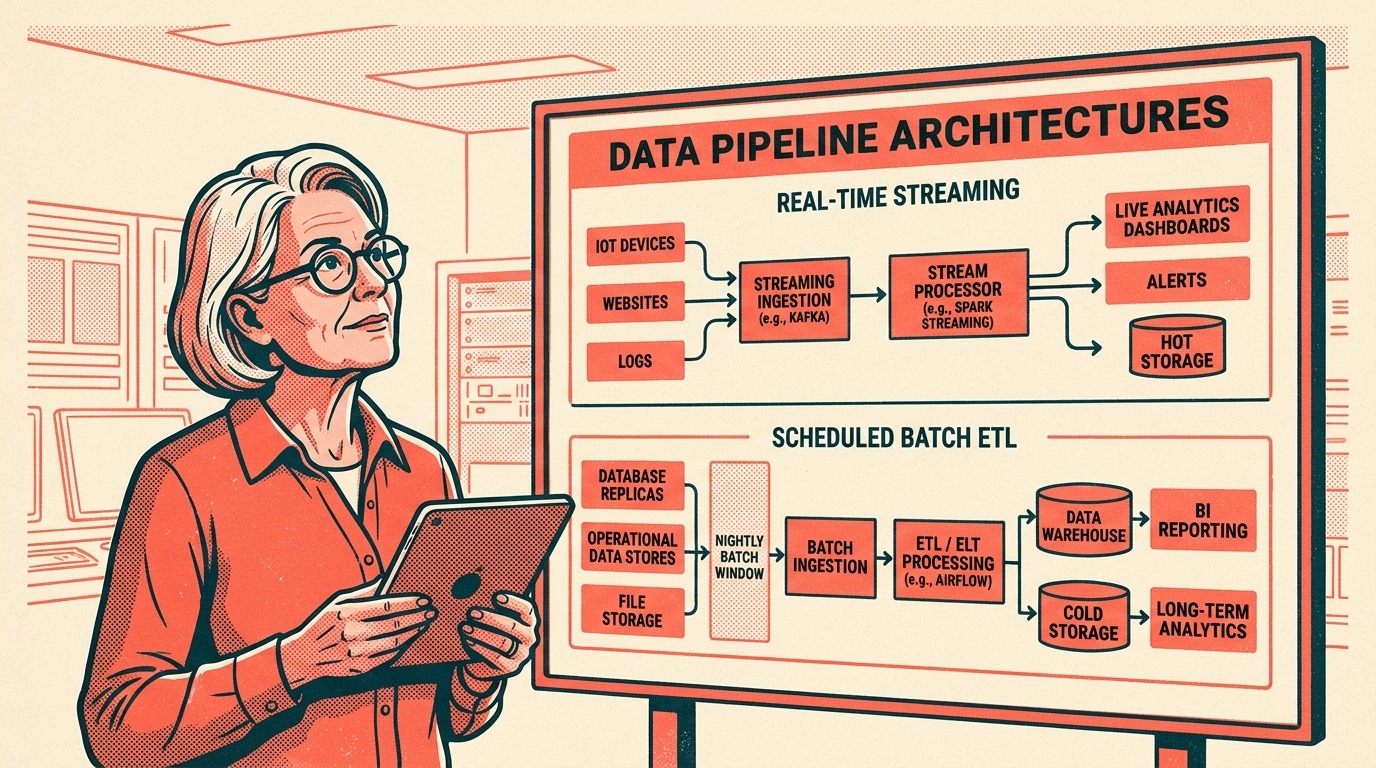
The Paradigm Shift: Bounded vs Unbounded Data
To navigate technical interview rounds effectively, candidates must articulate the philosophical and mechanical distinctions between bounded and unbounded datasets. In distributed data architecture, processing models are fundamentally defined by how time and boundaries are handled:
1. Batch ETL (Bounded Data)
Batch pipelines collect records into static, bounded partitions over fixed intervals (e.g., hourly, nightly). Engines like Apache Spark, Trino, and traditional data warehouses process these static datasets from start to completion. The primary optimization vectors are batch throughput, disk I/O efficiency, and query parallelism. If a batch run encounters an issue such as an Apache Spark out of memory error, the entire partition or failed task can be deterministically re-executed from immutable checkpoints.
2. Stream Processing (Unbounded Data)
Streaming architectures treat data as a continuous, infinite sequence of events. Instead of waiting for a batch window to close, engines consume events incrementally as they arrive. The primary design targets shift from raw aggregate throughput to low latency (sub-second to low millisecond), event-time correctness, and incremental state maintenance. Re-execution requires replaying immutable commit logs from distributed message brokers while managing state snapshots.
When building a comprehensive technical interview preparation plan, data engineers must understand that streaming and batch are complementary. As the unified streaming model demonstrates, batch is simply a special case of streaming where the stream is bounded and time is fixed.
Deconstructing the Stack: Kafka and Flink in Production
A common pitfall in system design interviews is treating Apache Kafka and Apache Flink as competing technologies. In production pipelines, Kafka and Flink operate symbiotically:
+-----------------------------------------------------------------------------------+
|                           STREAM INGESTION & PROCESSING                           |
|                                                                                   |
|  [ IoT / Apps ] ---> ( Apache Kafka ) ---> [ Apache Flink ] ---> ( Sink / Lake )  |
|                       Distributed Log        Stream Engine        Iceberg Table   |
|                       Ordered Partitions     RocksDB State        Lakehouse Sync  |
|                       Retention: 7 Days      Watermarks & CEPS                    |
+-----------------------------------------------------------------------------------+
Apache Kafka: The Distributed Storage Backbone
Apache Kafka acts as an immutable, fault-tolerant, distributed event log. It organizes events into partitioned topics, providing strict sequential ordering within each partition and decoupled multi-subscriber retention. While Kafka provides lightweight stream transformations through Kafka Streams, it is primarily a durable transport and storage layer. Candidates who have explored Kafka vs RabbitMQ system design trade-offs understand that Kafka's pull-based consumer model enables horizontal replayability, which is vital for fault-tolerant stream recovery.
Apache Flink: The Stateful Distributed Compute Engine
Apache Flink is a true event-driven, stream-first distributed compute engine designed for low-latency stateful calculations over unbounded and bounded data. Unlike micro-batch engines that slice streams into artificial temporal mini-batches, Flink processes records pipelined one by one. Flink manages internal application state (such as rolling user balances or session windows) directly within worker heap or embedded RocksDB state stores, continuously checkpointing this state asynchronously without blocking pipeline execution.
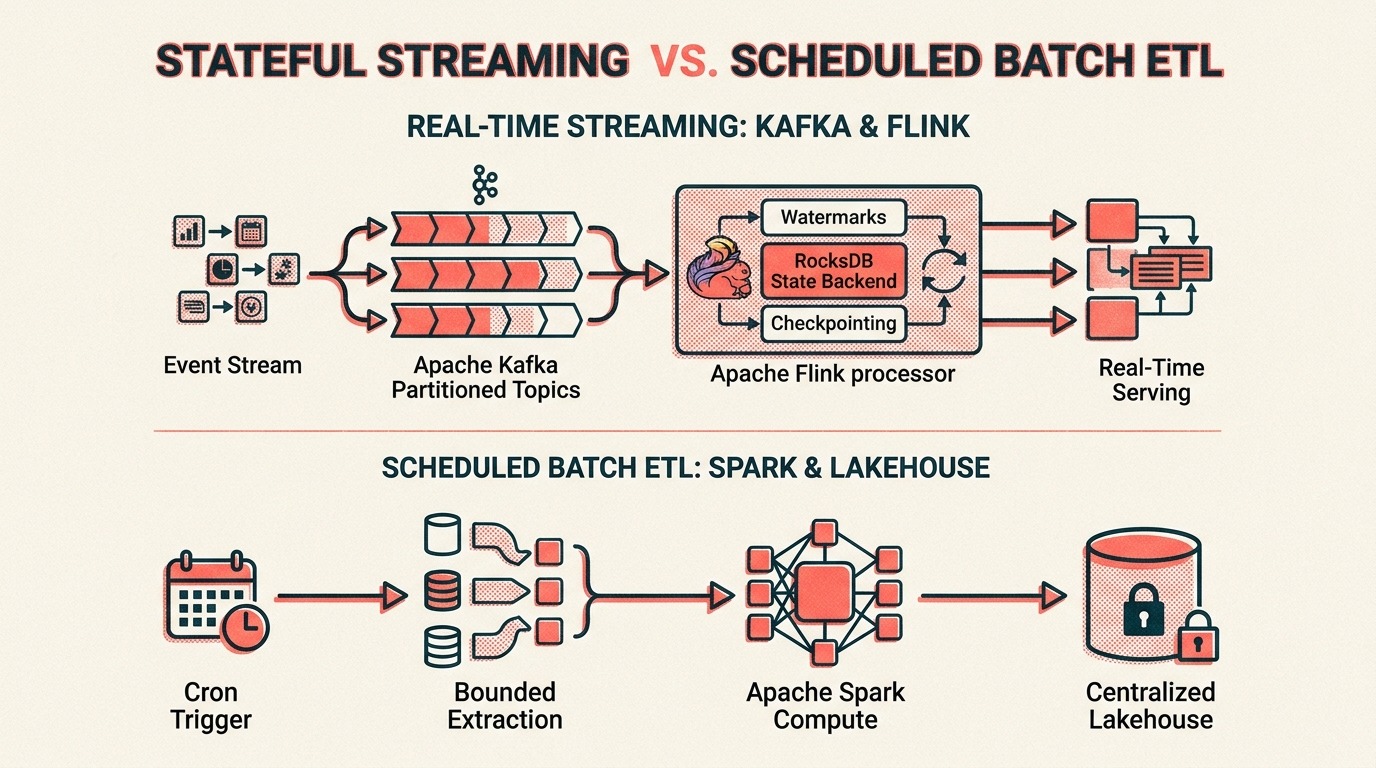
Architectural Blueprints: Lambda vs Kappa vs Unified Lakehouse
When interviewers ask you to design a modern analytical pipeline, they look for your ability to critique classic architectures and justify contemporary design patterns.
The Lambda Architecture: Dual Pipeline Complexity
Introduced by Nathan Marz, the Lambda architecture routes incoming data simultaneously down two distinct paths:
- The Speed Layer (Streaming): Processes live data via Kafka and Flink to provide approximate, low-latency views for real-time operational alerts.
- The Batch Layer (Batch ETL): Ingests raw data into distributed object storage (S3/GCS), executing nightly batch jobs (Spark) to compute precalculated batch views, correcting any discrepancies from the speed layer.
- The Serving Layer: Blends both views at query time to deliver unified results.
Interview Critique: While Lambda provided fault tolerance in early big data deployments, it introduces severe maintenance friction. Engineers must implement, test, and synchronize identical business logic across two separate codebases. Schema migrations, code drifts, and reconciliations become operational burdens.
The Kappa Architecture: Stream-First Simplification
Proposed by Jay Kreps, the Kappa architecture eliminates the duplicate batch processing pipeline. All data flows through an immutable, high-retention streaming log (Kafka), and all analytics are executed by a single stream processor (Apache Flink). When historical reprocessing is required, engineers start a second instance of the Flink stream job configured with auto.offset.reset = earliest, replaying historical events from offset zero into a new table.
The Unified Lakehouse Architecture
In modern data engineering loops, candidates earn staff-level marks by discussing the convergence of streaming storage formats—such as Apache Iceberg and Apache Paimon—with unified engines. These storage layers enable Flink to stream write raw changelogs directly into lakehouse tables with ACID guarantees, allowing batch engines like Trino or Snowflake to query up-to-the-minute historical snapshots. This pattern complements modern Snowflake vs Databricks data architecture strategies by bridging real-time event capture with columnar lakehouse storage.
Core Streaming Mechanics: Event Time, Watermarks, and Windows
The most technical phase of a streaming data interview centers on temporal correctness when network latency and mobile disconnects scramble message arrival orders.
The Three Notions of Time
- Event Time: The timestamp attached to the event at its point of origin (e.g., sensor or mobile app). This is the only reliable metric for deterministic, reproducible analytics.
- Ingestion Time: The timestamp assigned when the event is appended to Kafka broker partitions.
- Processing Time: The local wall-clock time of the Flink task manager machine executing the transformation. While simple, processing time produces non-deterministic results upon replay.
Watermarks: Quantifying Event-Time Progress
A watermark is a stream control record carrying timestamp T, asserting: "The system assumes that no subsequent events with an event timestamp t ≤ T will arrive."
In Apache Flink, watermarks are generated with bounded out-of-orderness:
Watermark = max(EventTime) - AllowedLateness
When a watermark passes a window boundary, the window evaluates its aggregation and emits results downstream. Late-arriving events falling behind the current watermark are either routed to a Dead Letter Queue (Side Output) or used to trigger incremental window updates.
Windowing Strategies
- Tumbling Windows: Fixed-size, non-overlapping intervals (e.g., 5-minute tumbling aggregations for transaction volumes).
- Sliding (Hopping) Windows: Fixed-size, overlapping intervals (e.g., 10-minute moving average calculated every 1 minute).
- Session Windows: Dynamically sized intervals delimited by periods of inactivity (e.g., user sessions closing after 15 minutes of silence).
Stateful Stream Processing and Fault Tolerance
Senior interviewers will drill into distributed state reliability: "If a worker node crashes mid-stream, how does Flink ensure that downstream financial aggregations produce zero duplicated records?"
State Backends: Memory vs Embedded RocksDB
Flink maintains state locally on TaskManager nodes to avoid remote database round-trips:
- HashMap State Backend: Stores state objects in JVM heap memory. Yields ultra-low latency, but total state size is bounded by available cluster RAM.
- Embedded RocksDB State Backend: Stores state out-of-core in an embedded RocksDB key-value engine on local NVMe SSDs. State footprint scales to terabytes per node without triggering JVM garbage collection stalls or executor heap exhaustion.
Fault Tolerance via Asynchronous Barrier Snapshotting
Flink achieves exactly-once processing using a variant of the Chandy-Lamport distributed snapshotting algorithm:
- Checkpoint Barriers: The JobManager injects barrier markers into the Kafka consumer input streams.
- Barrier Alignment: As barriers flow through task operators alongside records, operators align multiple upstream input partitions.
- Asynchronous State Snapshotting: Once barriers align, the operator writes an incremental snapshot of its local state (RocksDB SST files) to durable remote storage (S3/GCS) asynchronously, continuing to process incoming records without pausing the pipeline.
- Two-Phase Commit Sinks (2PC): Downstream sinks implement a Two-Phase Commit protocol coordinated with Flink checkpoints to ensure pre-committed records only finalize once the global checkpoint succeeds.
Architectural Comparison Matrix: Streaming vs Batch ETL
When presenting trade-offs in an interview, structuring comparisons into clear architectural categories demonstrates executive-ready communication.
| Architectural Dimension | Scheduled Batch ETL (e.g., Spark, dbt) | Micro-Batch Streaming (e.g., Spark Streaming) | Native Stateful Streaming (e.g., Flink) |
|---|---|---|---|
| Ingestion Latency | Hours to Days | Seconds to Minutes (100ms–5s) | Sub-second (10ms–100ms) |
| Data Boundary | Strictly Bounded Datasets | Dynamically Sliced Micro-Batches | Continuous Unbounded Event Streams |
| State Management | Externalized to Data Warehouse/Lake | In-Memory Micro-Partition State | Distributed Embedded RocksDB State |
| Time Semantics | Ingestion / Partition Date | Processing Time / Micro-Batch Window | Event Time with Dynamic Watermarking |
| Compute Cost Profile | Burst compute (ephemeral clusters) | Continuous baseline cluster allocation | Continuous baseline with auto-scaling |
| Reprocessing Model | Deterministic re-run of partitions | Offset rewind over Kafka window | Full historical replay via savepoints |
| Operational Overhead | Low to Moderate (Job Orchestration) | Moderate (Memory & Spark Drivers) | High (State checkpointing, lag monitoring) |
| Primary Use Cases | Financial closing, dimensional modeling | Near real-time analytics, daily CDC | Fraud detection, algorithmic alerting, CEP |
Practical Implementation: Stateful Sliding Window with Watermarks
In technical rounds, candidates who can write idiomatic stream definitions demonstrate real-world credibility. Below is an Apache Flink streaming implementation using Python (PyFlink) and Flink SQL, demonstrating event-time extraction, bounded watermarking, and sliding window aggregations over financial transaction streams.
from pyflink.table import EnvironmentSettings, TableEnvironment

# 1. Initialize Streaming Table Environment
env_settings = EnvironmentSettings.in_streaming_mode()
table_env = TableEnvironment.create(env_settings)

# 2. Define Kafka Source with Event Time and Bounded Watermarking
table_env.execute_sql("""
    CREATE TABLE transaction_stream (
        transaction_id VARCHAR,
        account_id VARCHAR,
        merchant_category VARCHAR,
        amount DECIMAL(10, 2),
        transaction_time TIMESTAMP(3),
        WATERMARK FOR transaction_time AS transaction_time - INTERVAL '5' SECOND
    ) WITH (
        'connector' = 'kafka',
        'topic' = 'financial.transactions.v1',
        'properties.bootstrap.servers' = 'kafka-broker.internal:9092',
        'properties.group.id' = 'fraud-detection-engine',
        'scan.startup.mode' = 'latest-offset',
        'format' = 'json'
    )
""")

# 3. Define Stateful Lakehouse Sink
table_env.execute_sql("""
    CREATE TABLE rolling_anomaly_aggregates (
        account_id VARCHAR,
        window_start TIMESTAMP(3),
        window_end TIMESTAMP(3),
        txn_count BIGINT,
        total_velocity DECIMAL(12, 2),
        PRIMARY KEY (account_id, window_end) NOT ENFORCED
    ) WITH (
        'connector' = 'print'
    )
""")

# 4. Execute Sliding Window Aggregation (10-minute window sliding every 1 minute)
table_env.execute_sql("""
    INSERT INTO rolling_anomaly_aggregates
    SELECT
        account_id,
        window_start,
        window_end,
        COUNT(transaction_id) AS txn_count,
        SUM(amount) AS total_velocity
    FROM TABLE(
        HOP(
            TABLE transaction_stream,
            DESCRIPTOR(transaction_time),
            INTERVAL '1' MINUTE,
            INTERVAL '10' MINUTE
        )
    )
    GROUP BY
        account_id,
        window_start,
        window_end
""")
Key Technical Talking Points for Candidates
- Bounded Out-of-Order Watermark: The clause
WATERMARK FOR transaction_time AS transaction_time - INTERVAL '5' SECONDensures Flink delays window closure by 5 seconds to gracefully capture late network transit events without dropping data. - HOP Table-Valued Function: The
HOPfunction cleanly expresses sliding windows in standard ANSI SQL, avoiding complex low-level KeyedProcessFunction boilerplate while maintaining deterministic event-time evaluation.
Common Interview Scenarios and Evaluation Rubrics
Hiring managers evaluating senior data engineers use situational problem prompts to evaluate architectural judgment. Below are three common interview questions, what interviewers evaluate, and effective response blueprints.
Scenario 1: "We need to ingest 20 TB of CDC logs from PostgreSQL into Snowflake. Operations wants streaming, but budget is constrained. What do you recommend?"
What the Interviewer Evaluates: Cost-benefit literacy, cloud data warehouse pricing models, and pragmatic data platform design.
Candidate Response Strategy:
- Analyze Compute Economics: Continuous streaming ingestion into Snowflake maintains persistent compute workers and high micro-partition churn. If business stakeholders only query analytical dashboards once an hour, sub-second ingestion is an unnecessary expense.
- Propose Hybrid Micro-Batching: Capture PostgreSQL WAL logs via Debezium into Kafka. Write raw changelog files into S3 in compressed Parquet format. Run scheduled dbt or Snowflake COPY transformations every 30 to 60 minutes to batch-merge changes into the core star schema dimensional model.
- Establish an SLA Gate: Define a strict Service Level Agreement (SLA). Only critical operational use cases warrant dedicated streaming sinks; broad analytical reporting thrives on cost-effective hourly micro-batches.
Scenario 2: "Your streaming Flink job experiences severe consumer lag during Black Friday traffic spikes. How do you triage and resolve the bottleneck?"
What the Interviewer Evaluates: Production debugging methodology, Kafka partitioning, JVM profiling, and state backend bottlenecks.
Candidate Response Strategy:
- Isolate the Bottleneck Layer: Check Flink Web UI backpressure indicators to determine if the slowdown is in the Kafka source reader, intermediate stateful operators, or the downstream external sink.
- Examine Kafka Partition Alignment: Flink Kafka consumer parallelism is bounded by topic partition counts. If the topic has only 12 partitions, scaling Flink consumer parallelism to 24 results in 12 idle workers. Verify partition key distributions to rule out partition skew caused by a single hot merchant ID.
- Inspect State Backend and Checkpoint Times: If RocksDB write buffers are thrashing local disk I/O, tune write buffer sizes and block cache parameters. If checkpoint alignment times exceed timeout thresholds, transition to unaligned checkpoints to prevent barriers from getting stuck behind dense data queues.
Scenario 3: "A data pipeline produces duplicate records in downstream analytics after an unexpected cluster restart. How do you identify the cause?"
What the Interviewer Evaluates: Grasp of processing guarantees (At-Least-Once vs Exactly-Once) and sink idempotency.
Candidate Response Strategy:
- Differentiate Engine Semantics from End-to-End Guarantees: Explain that Flink's internal checkpointing guarantees exactly-once processing internally, but downstream sinks will observe duplicates if the sink connector is not strictly idempotent or does not participate in a two-phase commit transaction.
- Audit Sink Mechanics: If the sink is an append-only relational table without primary key upsert logic, any pipeline restart that replays events from the last valid checkpoint will re-insert records that were emitted between the checkpoint and the crash.
- Implement Idempotency: Enforce deterministic deduplication keys or upsert tables (e.g., Kafka compacted topics, Apache Iceberg upserts, or Redis atomic writes) so that duplicate deliveries overwrite rather than inflate downstream aggregations.
Architectural Pitfalls to Avoid in Final Rounds
When interviewing for staff or principal data roles, avoid these recurring candidate errors:
- Defaulting to Streaming as a Silver Bullet: Pitching Flink and Kafka for scenarios where batch ETL is simpler, cheaper, and more reliable. Always challenge the business requirement: "Does the stakeholder genuinely act on this data in under two seconds, or are they checking a dashboard once every morning?"
- Ignoring State Size Evolution: Designing stateful stream jobs with indefinite retention windows without configuring State Time-To-Live (TTL). Without state expiration, RocksDB state footprints grow monotonically until disks fill and the cluster fails.
- Treating Kafka as a Database: Proposing to use Kafka topics as the primary analytical query storage for historical joins. Kafka is an append-only log optimized for sequential streaming reads, not ad-hoc multi-dimensional filtering.
- Overlooking Data Reprocessing Requirements: Forgetting that production code always contains bugs. If an algorithm changes, your architecture must have a concrete, testable strategy for replaying six months of historical data without taking down live production alerts.
Elevate Your Data Engineering Interview Preparation
Mastering the trade-offs between continuous stream processing and scheduled batch architectures requires rigorous, out-loud verbal practice. Formulating cohesive answers regarding watermarking, distributed state backends, and fault tolerance under interview pressure builds true technical fluency.
Prepare for your upcoming system design and data architecture rounds with specialized tools designed to build interview mastery:
- Test your instant recall and problem-solving instincts with the free 60-Second Job Blitz, featuring rapid-fire distributed systems, data engineering, and architectural challenge questions.
- Accelerate your readiness with comprehensive voice and text mock simulations on our Pricing Plans, offering tailored Socratic evaluation rubrics, real-time technical feedback, and system design roleplays modeled after tier-1 engineering standards.
Practice Staff Backend Engineer Questions Live with AI Mock Interviews
Turn any job description across Engineering, DevOps, Data, Marketing, Sales, Finance, or HR into a personalized test and live voice or text AI mock interview on totop.app, or test your speed right now in the 60-Second Staff Backend Engineer Blitz.
Play 60s Staff Backend Engineer Blitz (Free, No Login) | Start 14-Day Free Trial | Browse All Interview Guides