20 SQL Interview Questions for Data Engineers: The Ultimate 2026 Guide
Are you preparing for a Data Engineer interview and feeling overwhelmed by the sheer volume of SQL concepts to master? You're not alone. SQL is the lifeblood of data engineering, and interviewers use it to gauge your ability to manipulate, transform, and optimize data at scale.
In this comprehensive guide, we will walk through the top 20 SQL interview questions specifically tailored for Data Engineers in 2026. From fundamental queries to complex window functions and performance tuning, this guide covers everything you need to ace your next technical screen.
The Core Concepts
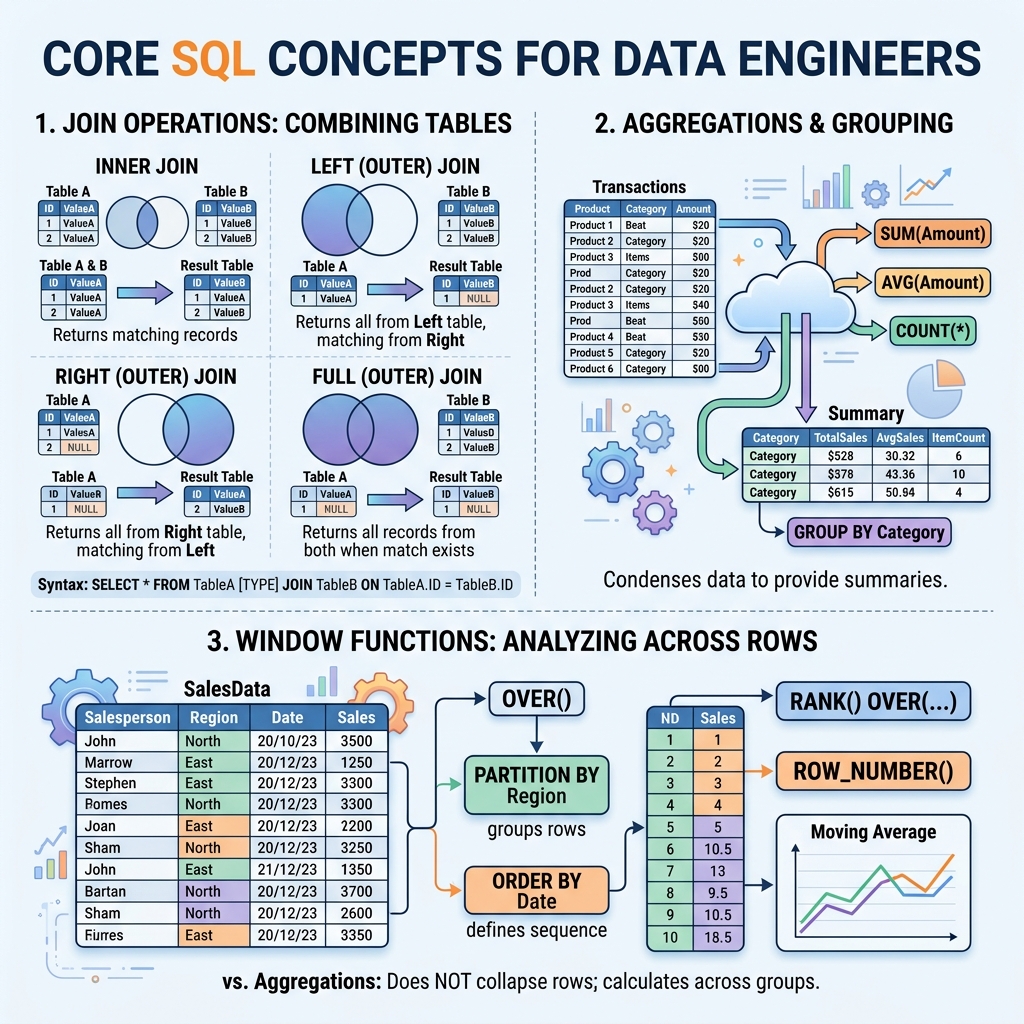
Before we dive into the questions, let's establish a solid understanding of the foundational concepts you'll be tested on.
Section 1: Basic to Intermediate Queries
1. What is the difference between WHERE and HAVING clauses?
- Answer: The
WHEREclause filters rows before any grouping occurs, while theHAVINGclause filters groups after theGROUP BYclause is applied. You cannot use aggregate functions in aWHEREclause, but you can in aHAVINGclause.
2. Explain the difference between INNER JOIN, LEFT JOIN, and FULL OUTER JOIN.
- Answer:
INNER JOINreturns only the rows that have matching values in both tables.LEFT JOINreturns all rows from the left table, and the matched rows from the right table. If there's no match, NULL values are returned for the right table's columns.FULL OUTER JOINreturns all rows when there is a match in either the left or right table. Unmatched rows will have NULLs for the missing side.
3. How do you find duplicate records in a table?
- Answer: You can use the
GROUP BYclause along withHAVING COUNT(*) > 1to identify duplicate records based on specific columns.
SELECT employee_id, COUNT(*)
FROM employees
GROUP BY employee_id
HAVING COUNT(*) > 1;
4. What is the difference between UNION and UNION ALL?
- Answer: Both combine the result sets of two or more
SELECTstatements. However,UNIONremoves duplicate rows between the sets, whereasUNION ALLincludes all duplicates, making it faster.
5. How does the COALESCE function work?
- Answer:
COALESCEreturns the first non-null value in a list of expressions. It is commonly used to substitute a default value when a column contains NULLs.
Section 2: Advanced Aggregations and Window Functions
6. What are Window Functions, and how do they differ from GROUP BY?
- Answer: Window functions perform calculations across a set of table rows that are somehow related to the current row. Unlike
GROUP BY, which collapses rows into a single summary row, window functions preserve the original rows while adding the aggregated calculation as a new column.
7. Differentiate between RANK(), DENSE_RANK(), and ROW_NUMBER().
- Answer:
ROW_NUMBER()assigns a unique, sequential integer to each row.RANK()assigns the same rank to duplicate values but leaves gaps in the ranking sequence (e.g., 1, 2, 2, 4).DENSE_RANK()assigns the same rank to duplicate values without leaving gaps (e.g., 1, 2, 2, 3).
8. How do you calculate a rolling average or cumulative sum?
- Answer: Using the
SUM()orAVG()window function combined withORDER BYandROWS BETWEEN.
SELECT date, sales,
       SUM(sales) OVER (ORDER BY date ROWS BETWEEN UNBOUNDED PRECEDING AND CURRENT ROW) as cumulative_sales
FROM daily_sales;
9. What is the LEAD and LAG function used for?
- Answer:
LAG()accesses data from a previous row in the same result set without the use of a self-join.LEAD()accesses data from a subsequent row. They are perfect for calculating year-over-year or month-over-month differences.
10. How would you identify the top 3 highest-paid employees in each department?
- Answer: Use the
DENSE_RANK()window function partitioned by department.
WITH RankedEmployees AS (
    SELECT employee_id, department_id, salary,
           DENSE_RANK() OVER (PARTITION BY department_id ORDER BY salary DESC) as rank
    FROM employees
)
SELECT * FROM RankedEmployees WHERE rank <= 3;
Section 3: Data Modeling and Architecture
11. What is the difference between an OLTP and an OLAP system?
- Answer: OLTP (Online Transaction Processing) systems are designed for fast, frequent, and reliable insert/update operations (e.g., a standard web app database). OLAP (Online Analytical Processing) systems are optimized for complex, read-heavy analytical queries over large historical datasets (e.g., a data warehouse).
12. Explain Star Schema vs. Snowflake Schema.
- Answer: Both are multidimensional data models. A Star Schema features a central fact table connected to denormalized dimension tables. A Snowflake Schema normalizes those dimension tables into multiple related tables, saving space but increasing query complexity.
13. What are Slowly Changing Dimensions (SCDs) and their types?
- Answer: SCDs handle data in dimension tables that change over time.
- Type 1: Overwrites old data with new data (no history).
- Type 2: Creates a new row for each change with effective dates (tracks full history).
- Type 3: Adds a new column to the existing row to track the previous value (limited history).
14. What is the purpose of partitioning and clustering in a database?
- Answer: Partitioning divides a large table into smaller, more manageable pieces based on a column (like date). Clustering sorts the data within those partitions or across the table based on specific columns, significantly speeding up query filtering.
Section 4: Performance Tuning and Optimization
15. How do you optimize a slow-running query?
- Answer: Steps include checking the execution plan using
EXPLAIN, ensuring appropriate indexes are used, avoidingSELECT *, filtering early withWHEREclauses instead ofHAVING, and minimizing the use of temporary tables or subqueries in theSELECTclause.
16. What is the difference between a Clustered and a Non-Clustered Index?
- Answer: A clustered index determines the physical order of data in a table (only one per table). A non-clustered index is a separate structure that contains pointers to the physical rows (multiple allowed).
17. Explain Common Table Expressions (CTEs) and when to use them.
- Answer: CTEs provide a temporary result set defined within the execution scope of a single
SELECT,INSERT,UPDATE, orDELETEstatement. They make complex queries much more readable and maintainable compared to nested subqueries.
18. Why should you avoid using functions on indexed columns in a WHERE clause?
- Answer: Applying a function to an indexed column (e.g.,
WHERE YEAR(date_col) = 2026) often prevents the database from using the index, leading to a full table scan. This is known as making the query "non-sargable".
Section 5: Scenario-Based Questions
19. How would you handle a situation where a daily ETL pipeline fails halfway through, leaving partial data in the target table?
- Answer: Implement idempotent operations using UPSERT (e.g.,
MERGEorINSERT ... ON CONFLICT) or use a staging table approach where data is swapped transactionally to ensure partial states are never exposed.
20. Imagine you need to find the first time a user performed a specific action. How do you query this efficiently?
- Answer: Use a window function
ROW_NUMBER()partitioned by user and ordered by time, then filter forrow_num = 1. Alternatively, aGROUP BY user_idwithMIN(timestamp)joined back to the main table works, but the window function is generally cleaner.

Acing the Interview
Technical knowledge is only half the battle. When answering SQL questions, remember to communicate your thought process. Talk through your approach before writing code, clarify edge cases (like handling NULLs or duplicates), and always consider query performance.
If you are looking to practice these concepts alongside broader distributed pipeline scenarios, explore our comprehensive guide to data engineering interview questions and try totop.app. Our platform provides interactive mock interviews tailored for Data Engineers, giving you the real-time feedback you need to build confidence and land your dream role.
Happy querying, and best of luck on your interview!