
When senior backend or data engineering interviews move past basic JOIN syntax, interviewers frequently introduce a semi-structured workload bottleneck: "An order-events table stores 120 million rows in PostgreSQL with a JSONB attributes column and a TIMESTAMPTZ created_at column. Queries filtering by attributes @> '{"region": "eu-west", "tier": "enterprise"}' take 14 seconds under peak load, yet adding a standard B-Tree index on attributes did not speed up the query. Why did the planner ignore the B-Tree index, and how do you redesign the indexing strategy without crippling write throughput?"
Candidates who casually reply "just put a GIN index on everything" fail the postgresql indexing btree vs gin query optimization discussion. Generalized Inverted Indexes (GIN) solve multi-valued containment queries brilliantly, yet they carry substantial write amplification, larger memory footprints, and periodic pending-list flush stalls that can degrade p99 insert latency under heavy ingestion.
Mastering PostgreSQL B-Tree vs GIN trade-offs signals real production ownership during technical interview preparation. This guide unpacks the storage internals, operator classes, EXPLAIN ANALYZE execution plans, and production failure modes interviewers test across data engineering and backend architecture loops.
Storage Internals: How B-Tree and GIN Diverge
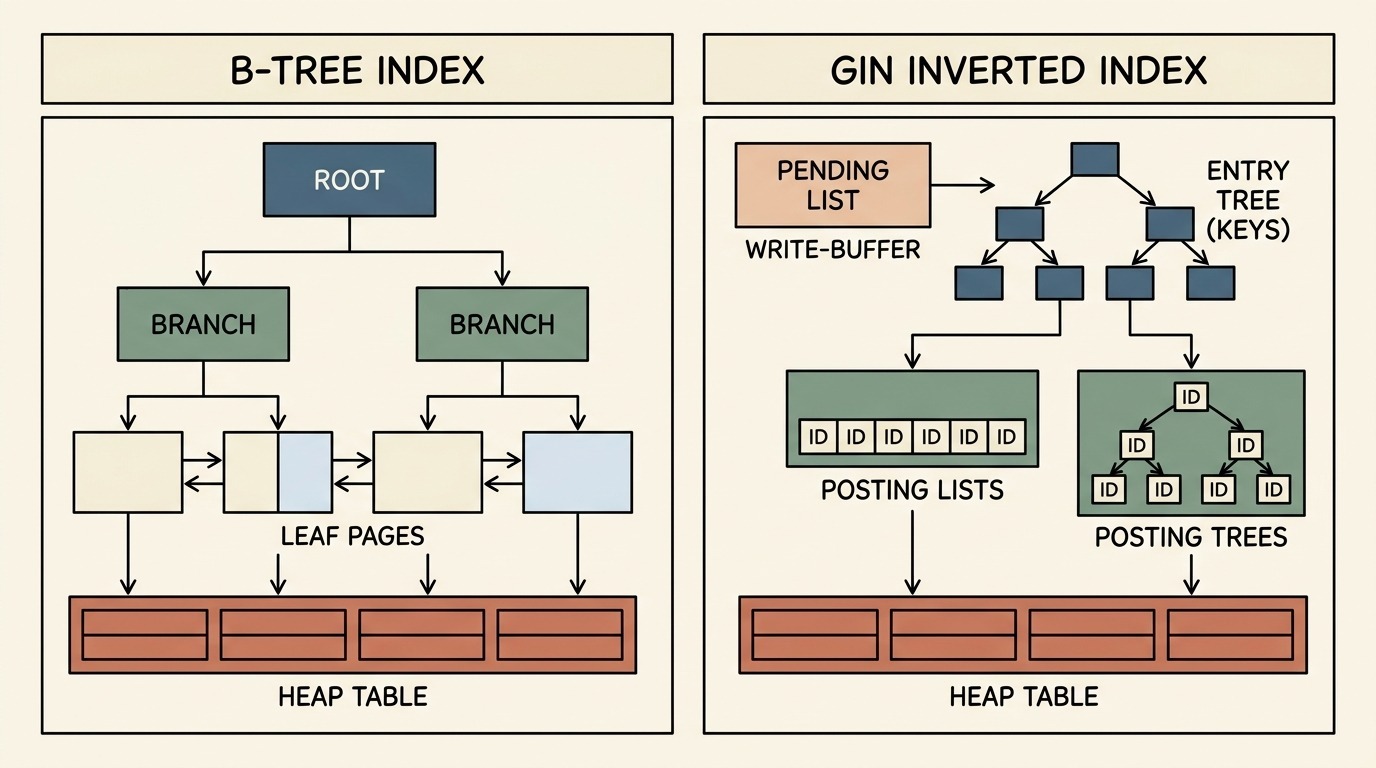
A reliable rule in database indexing interview questions is to explain how pages are laid out on disk before recommending an index type. PostgreSQL treats indexes as pluggable access methods, and B-Tree and GIN solve fundamentally opposite lookup problems.
How PostgreSQL B-Tree Indexes Work
PostgreSQL's default CREATE INDEX builds a Lehman-Yao high-concurrency B-Tree (specifically a B+-Tree variant where actual tuple pointers reside in leaf pages, and sibling leaf pages link bidirectionally).
- One Index Entry Per Row: Each heap row maps to a single key entry in the sorted tree (excluding deduplicated equal keys introduced in PostgreSQL 13).
- Strict Total Ordering: Keys must support standard comparison operators (
<,<=,=,>=,>). This makes B-Tree ideal for scalar equality, range scans (BETWEEN,>), prefix matching (LIKE 'ord_%'), andORDER BYsort elimination. - Covering Scans (
Index Only Scan): Because B-Tree stores the indexed column values directly alongsideINCLUDEpayload columns, PostgreSQL can satisfy queries directly from the index pages without touching the heap table—provided the visibility map marks those pages as all-visible.
How PostgreSQL GIN (Generalized Inverted Index) Works
A GIN index is designed for composite values where a single column contains many searchable elements—such as JSONB documents, TEXT[] arrays, or tsvector full-text search lexemes.
- Many Index Entries Per Row: Instead of indexing the whole column value as one opaque blob, GIN decomposes each row into atomic keys (for example, every JSON key and value) and stores them in an internal Entry Tree (itself a B-Tree over distinct extracted tokens).
- Posting Lists and Posting Trees: Each key in the Entry Tree points to a Posting List (a compressed sorted list of
ctidheap tuple pointers where that key appears) or, once the list grows large, a Posting Tree (a B-Tree ofctidpointers). - No
Index Only ScanSupport: Because GIN breaks values into inverted tokens rather than reconstructing the original tuple payload cleanly, PostgreSQL cannot perform anIndex Only Scanon a GIN index. Every GIN lookup resolves via a Bitmap Index Scan followed by a Bitmap Heap Scan (and a recheck when needed).
B-Tree vs. GIN Trade-Off Comparison Matrix
Structured comparisons help hiring panels quickly gauge architectural judgment. Use this rubric when defending SQL query tuning trade-offs in live system design or SQL interviews for data engineers:
| Evaluation Dimension | PostgreSQL B-Tree Index | PostgreSQL GIN Index |
|---|---|---|
| Best Data Types | Scalar integers, UUIDs, timestamps, short text | JSONB, arrays (TEXT[], INT[]), tsvector, hstore |
| Supported Operators | =, <, <=, >, >=, BETWEEN, IN, anchored LIKE 'abc%' | @>, <@, ?, `? |
Sort (ORDER BY) & MIN/MAX | Native; walks leaf pages in order without sorting | Unsupported; requires an explicit Sort node after heap fetch |
| Index-Only Scans | Supported (including INCLUDE covering columns) | Unsupported; always performs Bitmap Index Scan + Bitmap Heap Scan |
Write Amplification (INSERT/UPDATE) | Low; updates 1 leaf entry per index (unless HOT update applies) | High; decomposes documents into dozens of Entry Tree + Posting updates |
| Pending List / Burst Buffering | None; writes update B-Tree pages synchronously | Optional fastupdate = on buffers writes in Pending List until cleanup |
| Index Build & Disk Footprint | Compact; predictable size proportional to row count | Larger if jsonb_ops indexes every key/value; smaller with jsonb_path_ops |
| Primary Failure Mode | Planner falls back to Seq Scan due to low selectivity or functions | Tail-latency spikes during Pending List flushes; bloated work_mem bitmaps |
Why B-Tree Fails on JSONB Containment Queries
Returning to the opening interview scenario: why did adding CREATE INDEX idx_orders_attrs ON order_events (attributes); fail to accelerate attributes @> '{"region": "eu-west"}'?
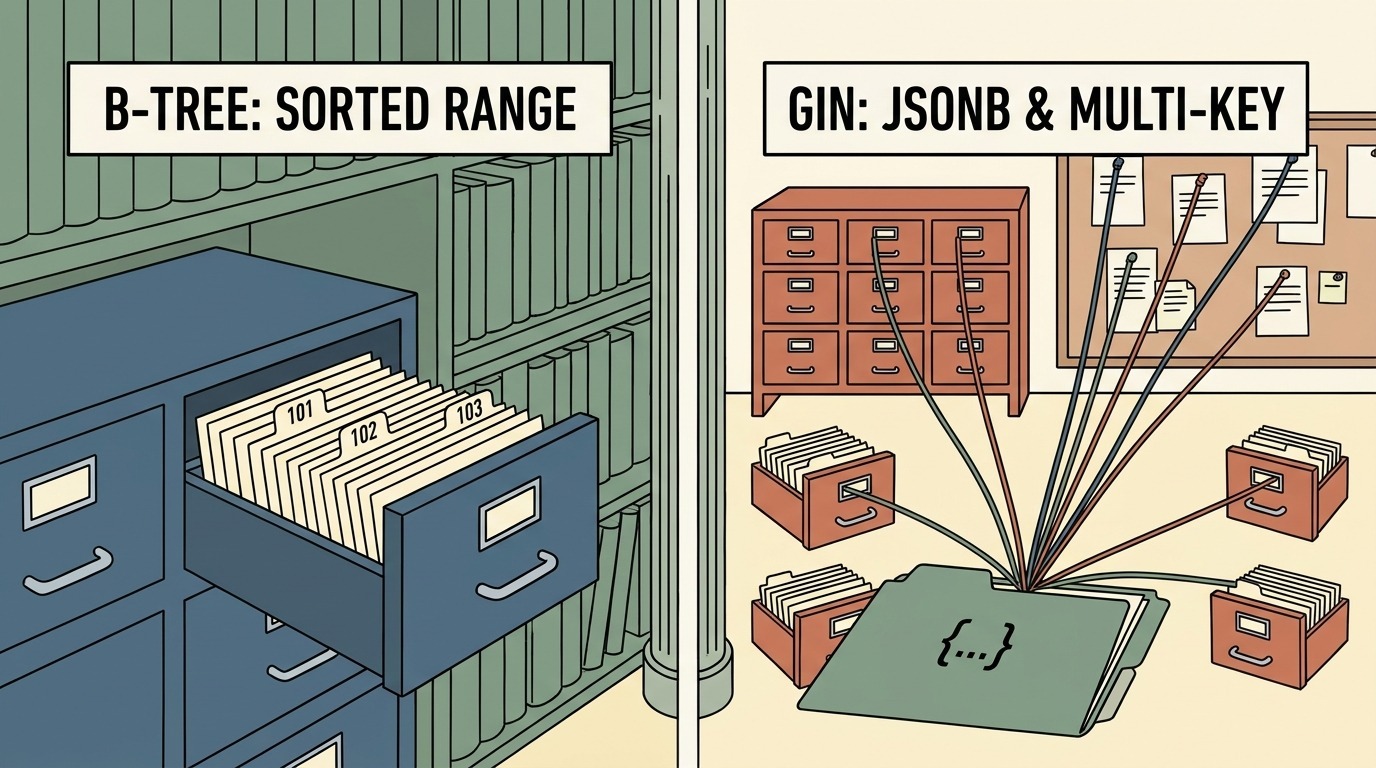
A B-Tree index on a raw JSONB column compares the entire serialized JSONB object byte-for-byte according to PostgreSQL's internal JSONB comparison rules. That supports exact equality (attributes = '{"region": "eu-west"}'), which is virtually useless when documents contain 15 other keys like request_id or timestamp. The containment operator @> is not part of the default jsonb_ops B-Tree operator family, so the query planner has no choice except to execute a full Sequential Scan.
Choosing the Right GIN Operator Class: jsonb_ops vs. jsonb_path_ops
In senior jsonb gin index performance follow-ups, interviewers expect candidates to distinguish PostgreSQL's two built-in GIN operator classes for JSONB:
-- Option A: Default jsonb_ops (supports @>, ?, ?|, ?&)
CREATE INDEX idx_events_attrs_default
    ON order_events USING GIN (attributes);

-- Option B: Compact jsonb_path_ops (supports @> only, much smaller & faster)
CREATE INDEX idx_events_attrs_path
    ON order_events USING GIN (attributes jsonb_path_ops);
Here is the architectural trade-off between the two:
jsonb_ops(Default): Creates separate index entries for every key and every value at every nesting level. This supports existence operators (attributes ? 'coupon_code',?|,?&) as well as containment (@>). However, indexing common keys like"region"or"status"creates massive posting lists and bloats index size.jsonb_path_ops: Hashes the full path from root to leaf value (such as"region":"eu-west") into a single 32-bit integer signature. Index size routinely shrinks by 30% to 60%, inserts update fewer distinct keys, and@>lookups become substantially faster. The strict trade-off is thatjsonb_path_opsdoes not support?,?|, or?&existence queries.
The Expression B-Tree Alternative for Predictable JSONB Keys
What if 95% of production queries filter only on attributes->>'region' and created_at? A seasoned engineer avoids GIN entirely in favor of a composite expression B-Tree index (or a generated column):
-- Fast, compact B-Tree targeting a specific extracted JSONB field + timestamp range
CREATE INDEX idx_events_region_created
    ON order_events ((attributes ->> 'region'), created_at DESC)
    WHERE attributes ? 'region';
This partial expression B-Tree eliminates GIN write amplification, supports ORDER BY created_at DESC LIMIT 50 without a separate sort step, and keeps the working set tightly packed in shared_buffers. Knowing when not to use GIN—and combining scalar filters alongside single-node table partitioning—separates staff-level candidates from surface-level practitioners.
Reading EXPLAIN (ANALYZE, BUFFERS) Like a Staff Engineer
Interviewers often paste an EXPLAIN ANALYZE snippet onto a shared screen and ask what is degrading latency. Knowing how B-Tree and GIN appear in query plans makes explain analyze query optimization concrete and verifiable.
Case 1: B-Tree Composite Scan with Sort Elimination
Suppose a query retrieves the 50 most recent enterprise events in eu-west:
EXPLAIN (ANALYZE, BUFFERS)
SELECT event_id, created_at
FROM order_events
WHERE (attributes ->> 'region') = 'eu-west'
ORDER BY created_at DESC
LIMIT 50;
With the composite expression B-Tree index (idx_events_region_created), the execution plan reads just a handful of leaf pages and stops early:
Limit  (cost=0.57..42.18 rows=50 width=24) (actual time=0.041..0.118 rows=50 loops=1)
  Buffers: shared hit=9
  ->  Index Scan Backward using idx_events_region_created on order_events
        Index Cond: ((attributes ->> 'region') = 'eu-west')
        Buffers: shared hit=9
Planning Time: 0.142 ms
Execution Time: 0.156 ms
Notice two decisive signals: Buffers: shared hit=9 (minimal page reads) and zero Sort node, because B-Tree already stores keys ordered by created_at DESC.
Case 2: GIN Bitmap Index Scan and Lossy Heap Rechecks
Now contrast that with an arbitrary multi-attribute JSONB containment query backed by idx_events_attrs_path:
EXPLAIN (ANALYZE, BUFFERS)
SELECT event_id, created_at
FROM order_events
WHERE attributes @> '{"region": "eu-west", "tier": "enterprise", "retryable": true}';
The planner builds an in-memory bitmap of matching pages from the GIN Posting Trees before scanning the table:
Bitmap Heap Scan on order_events  (cost=128.40..4910.22 rows=1420 width=24) (actual time=1.840..14.612 rows=1395 loops=1)
  Recheck Cond: (attributes @> '{"region": "eu-west", "tier": "enterprise", "retryable": true}'::jsonb)
  Heap Blocks: exact=1318
  Buffers: shared hit=1342
  ->  Bitmap Index Scan on idx_events_attrs_path
        Index Cond: (attributes @> '{"region": "eu-west", "tier": "enterprise", "retryable": true}'::jsonb)
        Buffers: shared hit=24
Execution Time: 14.904 ms
Spotting the work_mem Lossy Bitmap Trap
In EXPLAIN ANALYZE output, always inspect the Heap Blocks: line under a Bitmap Heap Scan. When query results exceed available work_mem, PostgreSQL cannot store exact tuple offsets per page. It degrades portions of the bitmap to page-level ("lossy") tracking:
Heap Blocks: exact=4120 lossy=18400
Rows Removed by Index Recheck: 914200
When lossy blocks climb, PostgreSQL must read every tuple on those 18,400 heap pages and re-evaluate the JSONB predicate row-by-row, burning CPU and disk I/O. Increasing session or role work_mem (or adding a selective B-Tree filter like created_at >= NOW() - INTERVAL '7 days' so the planner intersects a B-Tree bitmap with the GIN bitmap) eliminates lossy rechecks immediately.
Production Failure Scenario: GIN fastupdate Latency Spikes
One of the highest-signal postgresql indexing btree vs gin query optimization questions involves a sudden write-latency cliff in production: "After deploying a GIN index on a high-ingestion event log table (5,000 inserts/sec), 99% of writes finish in 2 ms, but every 15 seconds a random INSERT freezes for 850 ms. CPU is idle, and there are no lock waits. What is happening?"
Root Cause: The GIN Pending List (fastupdate)
Because updating dozens of entries inside a GIN Entry Tree on every single row INSERT is prohibitively expensive, PostgreSQL enables fastupdate = on by default on GIN indexes:
- Incoming row insertions append their extracted keys sequentially into an unsorted Pending List buffer rather than walking and splitting Entry Tree pages immediately.
- Reads must scan both the main Entry Tree and the entire unsorted Pending List on every query.
- Once the Pending List reaches
gin_pending_list_limit(default4 MB), the unlucky client session whoseINSERTcrosses the 4 MB boundary is forced to synchronously flush and merge the entire Pending List into the main GIN Entry Tree before its transaction commits—causing sudden 500–1,000 ms tail-latency spikes.
Three Production Mitigations to Name in Interviews
When walking through this scenario during a data engineering interview, present three concrete remediations along with their trade-offs:
- Disable
fastupdate(WITH (fastupdate = off)) on Read-Heavy / Latency-Sensitive Tables: Writes pay a steady, predictable cost upfront instead of stalling unpredictably, and read queries avoid scanning an unsorted Pending List. - Schedule Background Cleanup via
gin_clean_pending_list()or Autovacuum: Keepfastupdate = onfor batch-heavy ingestion, lowergin_pending_list_limit(e.g., to1MB), and triggerSELECT gin_clean_pending_list('idx_events_attrs_path')from an out-of-band worker so user-facing writes rarely hit the ceiling. - Partition by Time and Drop Old GIN Indexes: Keep GIN indexes only on hot recent partitions, or archive cold partitions into columnar analytical storage—a standard pattern covered in our Snowflake vs Databricks data architecture guide.
Interview Walkthrough: Answering a Multi-Predicate Query Design Prompt
Suppose an interviewer asks you to optimize the following slow analytical API query running against 80 million rows:
SELECT customer_id, total_cents, created_at
FROM invoices
WHERE status = 'paid'
  AND created_at >= NOW() - INTERVAL '30 days'
  AND metadata @> '{"channel": "partner_api"}'
ORDER BY created_at DESC
LIMIT 100;
Walk through a structured four-step diagnosis aloud:
- Measure Cardinality First: Ask how selective each predicate is. If
status = 'paid'matches 92% of rows, indexingstatusalone is counterproductive. Ifmetadata @> '{"channel": "partner_api"}'matches only 0.5% of rows, it is the primary selectivity driver. - Evaluate B-Tree vs. GIN Boundaries: Note that
created_at >= ... ORDER BY created_at DESCrequires ordered range traversal (B-Tree territory), whereasmetadata @> ...requires containment matching (GIN or expression B-Tree territory). - Compare Two Concrete Designs:
- Design A (Dedicated Expression B-Tree, Best if
"channel"is always queried): Create a partial composite B-TreeON invoices ((metadata ->> 'channel'), created_at DESC) INCLUDE (customer_id, total_cents) WHERE status = 'paid'. This achieves anIndex Only Scanin sub-millisecond time with zeroSortnode and minimal write overhead. - Design B (Bitmap Intersection or
btree_gin, Best ifmetadatakeys are arbitrary): Combine a B-Tree index on(created_at)with aGIN (metadata jsonb_path_ops)index—or install thebtree_ginextension to build a single multi-column GIN indexON invoices USING GIN (status, metadata jsonb_path_ops). Acknowledge the trade-off:btree_gincannot satisfy theORDER BY created_at DESC LIMIT 100clause without fetching and sorting all matching rows first.
- Design A (Dedicated Expression B-Tree, Best if
- Verify With
EXPLAIN (ANALYZE, BUFFERS): Confirm that buffer hits drop,lossyblocks stay at zero, and write throughput benchmarks remain within SLA.
Common Mistakes Candidates Make in PostgreSQL Indexing Rounds
Hiring rubrics penalize memorized checklists when candidates ignore system constraints. Avoid these four pitfalls in live rounds:
- Ignoring Non-SARGable Predicates: Writing
WHERE LOWER(email) = '[email protected]'orWHERE (attributes ->> 'amount')::numeric > 100prevents PostgreSQL from using a plain B-Tree index unless the exact expression matches the index definition. - Over-Indexing Write-Heavy Tables: Every additional B-Tree or GIN index disables Heap-Only Tuple (HOT) updates whenever an indexed column changes, inflating VACUUM overhead and WAL generation.
- Confusing
GINwithGiST: Know the distinction in one sentence: GIN excels at exact containment over discrete keys (JSONB, arrays, full-text tokens with high read speed), while GiST excels at overlapping geometric ranges, bounding boxes, andtsrange/daterangeexclusion constraints with lower write amplification. - Forgetting
CREATE INDEX CONCURRENTLY: Proposing a blockingCREATE INDEXDDL statement on an 80-million-row production table locks writes across the application. Always specifyCREATE INDEX CONCURRENTLYand explain that it performs two table scans without blocking concurrent DML.
Practice PostgreSQL Query Optimization Under Real Interview Pressure
Understanding B-Tree page splits, GIN posting trees, and EXPLAIN ANALYZE buffer metrics on paper is step one; articulating those trade-offs concisely while an interviewer interrupts with write-amplification constraints takes active verbal rehearsal.
Sharpen your execution speed before your next backend or data engineering loop:
- Benchmark your instant technical recall across SQL, database internals, and distributed systems in the free 60-Second Job Blitz—no login required.
- Run realistic voice and text mock interviews tailored to your exact target job description, complete with Socratic follow-up probes and structured scoring rubrics, on totop.app Pricing & Plans.
Practice Full Stack Engineer Questions Live with AI Mock Interviews
Turn any job description across Engineering, DevOps, Data, Marketing, Sales, Finance, or HR into a personalized test and live voice or text AI mock interview on totop.app, or test your speed right now in the 60-Second Full Stack Engineer Blitz.
Play 60s Full Stack Engineer Blitz (Free, No Login) | Start 14-Day Free Trial | Browse All Interview Guides