
In senior engineering and data leadership loops, few questions reveal technical maturity as quickly as comparing the two titans of modern enterprise analytics: Snowflake and Databricks. Interviewers rarely ask this question to test memorized vendor marketing. Instead, the prompt evaluates whether an engineer understands fundamental distributed systems principles, operational economics, workload patterns, and organizational reality.
A candidate who summarizes the debate as "Snowflake is SQL and Databricks is Spark" signals surface-level exposure. Today, Snowflake runs containerized Python applications via Snowpark and supports open Apache Iceberg tables, while Databricks provides serverless SQL warehouses, vectorized query execution via Photon, and a managed BI environment. Navigating a snowflake vs databricks data architecture interview requires a structured, multi-dimensional trade-off framework that balances technical capabilities against operational total cost of ownership.
Whether preparing for a Staff Data Engineer position, a Solutions Architect role, or a broader system design round, grounding architectural decisions in systems trade-offs is essential. For candidates establishing their baseline across architectural domains, reviewing our complete guide to technical interview prep offers foundational guidance on structuring technical discussions.
The Modern Data Platform Landscape: Warehouse vs. Lakehouse
To answer architectural trade-off questions effectively, candidates must first articulate the historical evolution and convergence of enterprise data platforms. Historically, data organizations operated two distinct architectures in parallel:
- The Enterprise Data Warehouse (EDW): Optimized for structured relational data, high-concurrency business intelligence (BI), and SQL queries using proprietary, highly optimized storage and compute clusters.
- The Data Lake: Designed for raw semi-structured and unstructured data (JSON, audio, video, sensor logs) stored in cost-effective object storage (Amazon S3, Google Cloud Storage, Azure Data Lake Storage), processed via distributed frameworks like Apache Spark or Hadoop.
This dual-system architecture created operational friction: data had to be continuously extracted, transformed, and loaded (ETL) between the lake and the warehouse. Data drift, synchronization failures, duplicate storage costs, and divergent security policies plagued data engineering teams.
Historical Dual-System Pattern:
[Raw Ingestion] ---> (Cloud Object Lake) ---> [Heavy ETL] ---> (Proprietary Data Warehouse) ---> [BI Reports]
                                |
                                +---> [ML / Python Notebooks]
Databricks pioneered the Lakehouse concept to eliminate this divide by adding an ACID-compliant transactional metadata layer (Delta Lake) directly over open object storage. Simultaneously, Snowflake evolved its multi-cluster shared data architecture to support semi-structured VARIANT data, external stages, and native Iceberg tables, bringing lakehouse flexibility directly into its managed engine.
Core Architectural Foundations: Multi-Cluster Shared Data vs. Lakehouse
During an architectural interview, diagramming the internal mechanics of both platforms demonstrates mastery over distributed systems fundamentals.
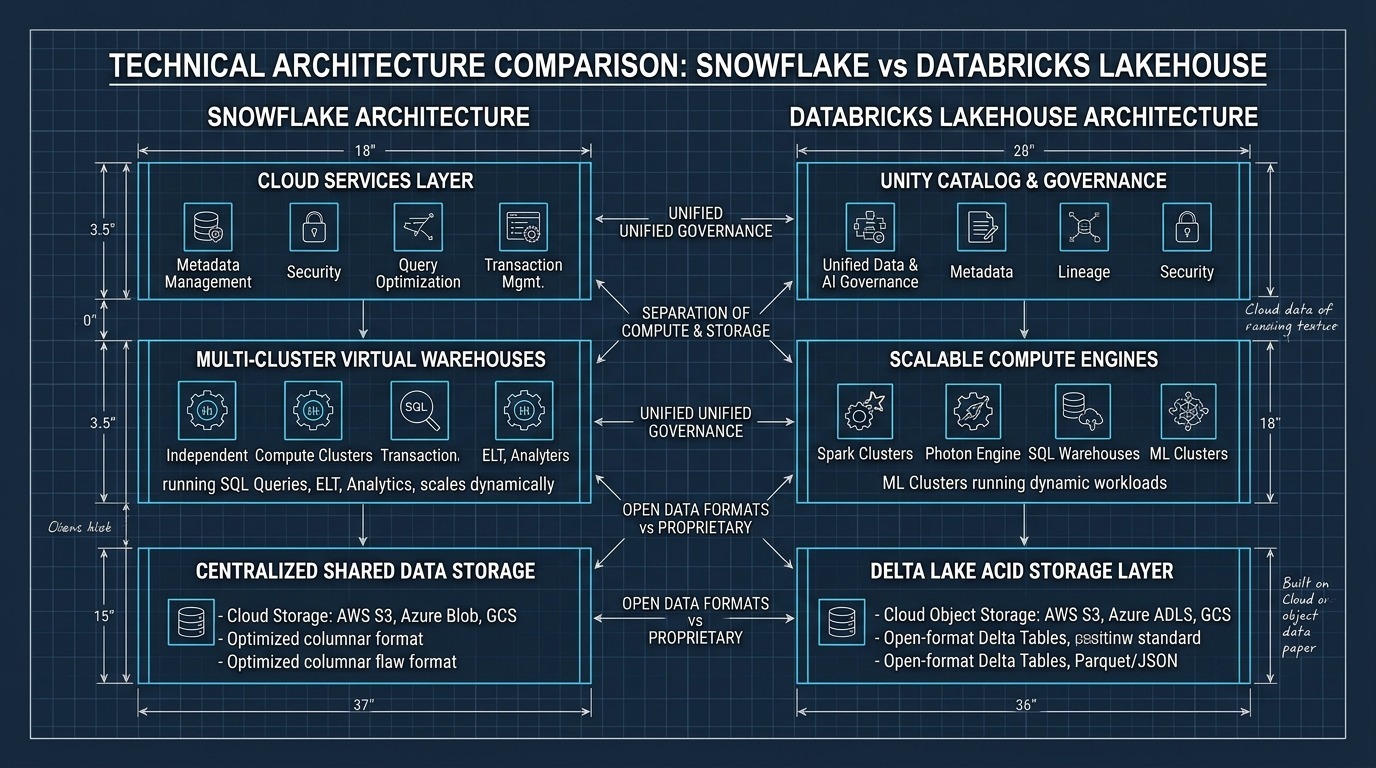
Snowflake: Multi-Cluster Shared Data Architecture
Snowflake separates storage, compute, and management into three independently scalable layers:
- Centralized Cloud Storage Layer: Tables are partitioned into immutable, proprietary compressed columnar files called micro-partitions (typically 50 MB to 500 MB uncompressed). Only the Snowflake engine can read and write these files directly, ensuring strict ACID consistency.
- Independent Virtual Warehouses (Compute Layer): Compute resources are organized as stateless clusters of virtual machine instances called Virtual Warehouses (ranging from T-Shirt sizes X-Small to 6X-Large). Multiple warehouses can read from the exact same underlying storage simultaneously without resource contention or locking. Each virtual warehouse maintains a local SSD cache for recently queried micro-partitions.
- Cloud Services Layer: The brain of Snowflake, coordinating authentication, session control, SQL compilation, cost attribution, and metadata cataloging. The metadata repository stores min/max statistics for every micro-partition column, enabling aggressive partition pruning before compute clusters execute queries.
Databricks: The Lakehouse Paradigm on Delta Lake
Databricks adopts an open-storage-first philosophy, constructing its lakehouse around three decoupled foundations:
- Open Storage with Delta Lake: Data files reside in the customer’s cloud object store as standard Apache Parquet files accompanied by a JSON-based transaction log (
_delta_log). This transaction log guarantees ACID transactions, versioned time travel, and snapshot isolation without proprietary storage lock-in. - Polyglot Distributed Compute: Compute runs on Apache Spark, Databricks Serverless, or Databricks SQL Warehouses powered by the Photon Engine—a high-performance, vectorized query engine rewritten entirely in C++ to bypass JVM memory overhead and garbage collection pauses.
- Unity Catalog (Governance Layer): A unified governance layer spanning tables, files, machine learning models, notebooks, and dashboards across multiple cloud regions and accounts.
Comprehensive Comparison Rubric: Snowflake vs. Databricks
When presenting architectural trade-offs to an interviewer, synthesizing differences into a clear comparative rubric shows clarity of thought.
| Architectural Dimension | Snowflake | Databricks Lakehouse | Interview Trade-Off Rationale |
|---|---|---|---|
| Primary Architectural Paradigm | Cloud Data Warehouse expanding toward Lakehouse capabilities | Open Data Lakehouse expanding toward Data Warehouse capabilities | Snowflake excels at curated enterprise SQL analytics; Databricks excels at end-to-end data science, streaming, and lake engineering. |
| Default Storage Format | Proprietary encrypted micro-partitions (Apache Iceberg supported via external catalog) | Open Apache Parquet wrapped with Delta Lake ACID transaction log | Delta Lake prevents storage vendor lock-in; Snowflake micro-partitions provide turnkey zero-maintenance optimization. |
| Compute Engine Mechanics | Stateless Virtual Warehouses with local SSD caching | Apache Spark clusters and vectorized C++ Photon SQL Warehouses | Snowflake isolates workloads via independent warehouse sizes; Databricks provides fine-grained Spark node tuning and serverless pools. |
| Supported Languages | SQL (native), Python, Java, Scala (via Snowpark runtime) | Python, SQL, Scala, R (native multi-language support in interactive notebooks) | Data teams prioritizing deep machine learning and feature stores prefer Databricks; teams centered on business intelligence prefer Snowflake SQL. |
| Data Ingestion & Pipelines | Snowpipe (event-driven), Dynamic Tables (declarative DAGs), Tasks & Streams | Delta Live Tables (DLT), Apache Spark Structured Streaming, Databricks Workflows | Snowflake emphasizes SQL-based declarative DAGs; Databricks provides unified streaming and batch primitives with automatic expectation validation. |
| Metadata & Governance | Snowflake Horizon (tag-based masking, row access policies, object tagging) | Unity Catalog (cross-workspace, multi-cloud catalog for tables, files, and ML models) | Unity Catalog governs raw files, notebooks, and models alongside tables; Horizon provides polished enterprise governance within the warehouse boundary. |
| Operational & Cost Model | Per-second credit consumption by warehouse size; near-zero administrative tuning | Databricks Units (DBU) + underlying cloud VM infrastructure costs; requires workload profiling | Snowflake minimizes DevOps operational headcount; Databricks offers lower raw compute cost for large petabyte workloads if expertly tuned. |
Data Modeling Paradigms: Star Schema vs. Medallion Architecture
Data modeling questions are central to system design discussions. When interviewers probe data modeling, candidates should contrast classic dimensional modeling against the lakehouse medallion structure.
Kimball Dimensional Modeling and Star Schema Optimization
In traditional analytics architectures, the Kimball methodology organizes data into a central fact table surrounded by denormalized dimension tables forming a star schema.
Snowflake is exceptionally well-suited for star schema querying. Because Snowflake automatically collects min/max statistics across micro-partitions for every column, queries that join large fact tables with selective dimension attributes leverage automatic partition pruning:
-- Dimensional query filtering sales by high-value dimension attributes
SELECT
    d.calendar_year,
    d.region_name,
    p.product_category,
    SUM(f.sales_amount) AS total_revenue,
    COUNT(DISTINCT f.customer_id) AS active_buyers
FROM analytics.fact_daily_sales f
JOIN analytics.dim_date d ON f.date_key = d.date_key
JOIN analytics.dim_product p ON f.product_key = p.product_key
WHERE d.calendar_year = 2026
  AND p.product_tier = 'Enterprise'
GROUP BY 1, 2, 3
ORDER BY total_revenue DESC;
In an interview, explain how Snowflake optimizes this join:
- Pruning via Cloud Services Metadata: Snowflake checks
dim_datewherecalendar_year = 2026, finds matching keys, and uses metadata to prune unneeded micro-partitions infact_daily_saleswithout reading them from disk. - Micro-Partition Clustering: While Snowflake requires no index maintenance, for petabyte-scale tables with severe query filtering patterns, specifying a clustering key (
CLUSTER BY (date_key, region_id)) co-locates related data.
For further exploration of database indexing and join strategies, review our dedicated guide on SQL interview questions for data engineers.
Medallion Architecture: Bronze, Silver, and Gold Layers
Databricks popularized the Medallion Architecture, which structures the entire lakehouse into three progressive data refinement tiers:
[Raw Event Ingestion]
        |
        v
+------------------+
|   Bronze Layer   |  Raw, unvalidated data preserved exactly as ingested
| (Raw Parquet/JSON) |  Append-only, historical audit trail
+------------------+
        |
        v  (Cleaning, deduplication, schema enforcement)
+------------------+
|   Silver Layer   |  Cleaned, conformed, filtered tables
| (Enriched Delta) |  Joins, lookup enrichment, standard formats
+------------------+
        |
        v  (Aggregations, business metrics, star schema dimensional marts)
+------------------+
|    Gold Layer    |  Business-ready analytics, executive reporting,
| (Aggregated Marts)|  Optimized for high-performance BI & ML features
+------------------+
When discussing this pattern in an interview, emphasize that the Gold layer can still adopt a classic star schema or Kimball model. The Medallion architecture describes the pipeline maturity lifecycle, not the final tabular structure.
Engineering Data Pipelines: Ingestion, Transformation, and Streaming
Enterprise systems rely on reliable, resilient data pipeline architectures. Interviewers frequently ask how each platform handles continuous streaming versus scheduled batch transformations.
Snowflake Ingestion: Snowpipe and Dynamic Tables
Snowflake offers two primary patterns for pipeline orchestration:
- Snowpipe and Snowpipe Streaming: Ingests micro-batches of files landing in cloud storage via automated cloud notifications (SNS, SQS, Event Grid), or writes data rows directly into micro-partitions via the Snowpipe Streaming SDK.
- Dynamic Tables: A declarative transformation construct where engineers define a SQL query and specify a target lag (e.g.,
TARGET_LAG = '5 minutes'). Snowflake automatically constructs the directed acyclic graph (DAG), computes incremental deltas, and schedules updates without external orchestration tools like Apache Airflow.
-- Declarative continuous aggregation using Snowflake Dynamic Tables
CREATE OR REPLACE DYNAMIC TABLE analytics.dt_customer_hourly_metrics
TARGET_LAG = '10 minutes'
WAREHOUSE = compute_etl_wh
AS
SELECT
    customer_id,
    DATE_TRUNC('hour', transaction_timestamp) AS window_hour,
    COUNT(transaction_id) AS total_events,
    SUM(transaction_value) AS aggregate_spend
FROM staging.raw_transactions
GROUP BY customer_id, window_hour;
Databricks Pipelines: Delta Live Tables and Structured Streaming
Databricks processes high-throughput real-time streaming natively through Apache Spark Structured Streaming and Delta Live Tables (DLT). DLT allows engineers to build reliable pipelines in Python or SQL with declarative expectations:
import dlt
from pyspark.sql.functions import col, expr

@dlt.table(
    comment="Raw streaming telemetry from device sensors",
    table_properties={"quality": "bronze"}
)
def sensor_telemetry_raw():
    return (
        spark.readStream.format("cloudFiles")
        .option("cloudFiles.format", "json")
        .load("s3://iot-telemetry-bucket/incoming/")
    )

@dlt.table(
    comment="Validated sensor telemetry with positive temperature readings",
    table_properties={"quality": "silver"}
)
@dlt.expect_or_drop("valid_temperature", "temperature_celsius IS NOT NULL AND temperature_celsius > -50")
def sensor_telemetry_clean():
    return (
        dlt.read_stream("sensor_telemetry_raw")
        .select(
            col("device_id"),
            col("timestamp").cast("timestamp"),
            col("temperature_celsius")
        )
    )
In an interview, highlight how DLT enforces data quality at runtime via @dlt.expect_or_drop or @dlt.expect_or_fail, quarantine corrupt records, and surfaces pipeline health metrics directly into Unity Catalog. For architects designing event-driven ingestion backbones, integrating these pipelines with distributed message buses is covered in our analysis of Kafka vs RabbitMQ system design interview.
SQL Interview Nuances: Query Engines, Tuning, and Performance
When answering questions in a data engineering sql interview, explaining the low-level query execution engines of both platforms sets senior engineers apart.
Query Optimization and Metadata Pruning in Snowflake
Snowflake’s SQL compiler relies on an advanced cost-based optimizer (CBO) built specifically for columnar storage:
- Vectorized Execution: Processes batches of rows in SIMD (Single Instruction, Multiple Data) CPU registers rather than row-by-row iteration.
- Zero-Index Philosophy: Snowflake intentionally omits indexes, B-Trees, and foreign key constraints. Instead, pruning relies on metadata boundaries stored for each micro-partition.
- Search Optimization Service (SOS): For high-concurrency point lookup queries (e.g., retrieving a single user account by UUID from a 10-billion-row audit table), Snowflake maintains an auxiliary search access path to minimize micro-partition scanning.
Photon Engine and Liquid Clustering in Databricks
Databricks historically executed Spark SQL queries on the JVM. In modern lakehouses, Databricks SQL runs on Photon:
- Native C++ Execution: Photon bypasses JVM garbage collection and JIT compilation overhead, implementing fully vectorized columnar execution directly against native CPU memory buffers.
- Liquid Clustering: Traditional Hive partitioning (
/year=2026/month=10/) suffers from partition skew and over-partitioning. Databricks replaced this with Liquid Clustering (CLUSTER BY (customer_id, event_date)), which dynamically organizes data along multi-dimensional space-filling Z-order curves without requiring manual repartitioning.
Governance, Security, and Total Cost of Ownership (TCO)
Architectural decisions inevitably encounter financial and compliance constraints. Interviewers evaluate whether an architect understands ongoing platform economics.
Unified Governance: Snowflake Horizon vs. Databricks Unity Catalog
Enterprise compliance demands fine-grained access control, column masking, and end-to-end data lineage:
- Databricks Unity Catalog: Operates as a centralized metastore across clouds (AWS, Azure, GCP). It uniquely governs not just relational tables, but also non-relational assets: raw files in object storage, MLflow machine learning models, notebooks, and Git repositories.
- Snowflake Horizon: Provides integrated data quality monitoring, tag-based dynamic data masking, row access policies, and data clean rooms. Horizon’s interface and policies are tightly bound to the SQL dialect, simplifying implementation for compliance officers and SQL administrators.
Cost Modeling: Warehouse Credits vs. DBUs and Compute Infrastructure
The cost dynamics of the two platforms differ substantially:
Cost Architecture Comparison:

Snowflake Billing Model:
[Snowflake Monthly Invoice] = (Credits Consumed x Credit Price) + (Raw Storage per TB/mo)
  * Simple, all-inclusive pricing (Compute hardware + software license bundled together).
  * Auto-suspend saves costs, but frequent spin-ups on short queries incur minimum billing intervals.

Databricks Billing Model:
[Databricks Monthly Cost] = [Databricks DBU License Invoice] + [Direct Cloud Provider VM/Disk Invoice]
  * Dual-invoice complexity (Databricks fee + AWS/Azure/GCP instance charges).
  * Highly economical for large-scale sustained batch jobs using spot instances, but requires engineering oversight.
In an interview, address the common misconception that one platform is uniformly cheaper than the other:
- Snowflake is frequently more cost-effective for sporadic, high-concurrency SQL analytics where auto-suspend drops compute costs to zero during idle periods.
- Databricks is frequently more cost-effective for large-scale 24/7 data processing, complex ML feature extraction, and continuous streaming, where dedicated spot clusters avoid the retail compute margins charged by SaaS data warehouses.
For a deeper dive into standard data pipeline questions and distributed storage trade-offs, explore our broader review of data engineering interview questions.
The 5-Step Architectural Decision Framework for Interviews
When an interviewer presents an open-ended scenario ("We are modernizing our data stack; should we pick Snowflake or Databricks?"), resist declaring an immediate winner. Instead, walk through this systematic 5-step decision framework:
Candidate Decision Rubric:
Step 1: Audit Workload Composition (% SQL/BI vs % Python/Spark/ML)
   |
Step 2: Assess Team Skillset & Operational Headcount (DBAs vs Platform SREs)
   |
Step 3: Evaluate Concurrency Patterns (1,000 BI dashboard users vs Batch ETL)
   |
Step 4: Establish Storage Openness & Multi-Engine Strategy (Delta/Iceberg vs SaaS)
   |
Step 5: Model Financial Predictability (All-inclusive credits vs Infrastructure DBU tuning)
- Workload Composition: If 80% of enterprise workloads consist of SQL queries, dashboards, and reporting for business analysts, Snowflake offers unmatched time-to-value. If workloads require distributed machine learning training, PySpark data wrangling, deep unstructured data processing, and LLM fine-tuning, Databricks provides a superior native environment.
- Team Profile and Engineering Overhead: Snowflake requires near-zero dedicated platform engineering. A small analytics team can maintain it without deep distributed systems expertise. Databricks provides deeper configurability, but extracting peak price-performance requires engineers who understand Spark partitions, memory management, and cluster configuration.
- Concurrency and SLA Profiles: Snowflake’s multi-cluster warehouses scale out seamlessly within seconds to absorb surges from hundreds of concurrent Tableau or PowerBI users without query queuing. Databricks Serverless SQL Warehouses have narrowed this gap, but Snowflake remains the gold standard for high-concurrency sub-second BI.
- Data Ownership and Vendor Lock-In: Organizations seeking open formats across their data estate lean toward Databricks Delta Lake or Snowflake with Apache Iceberg tables. Storing data in open formats allows other engines (Trino, DuckDB, ClickHouse) to query the storage layer directly.
- Budgetary Predictability: Snowflake’s credit model makes chargebacks by department straightforward. Databricks requires tracking both cloud VM spend and DBU consumption, demanding disciplined FinOps governance.
Candidates building distributed data platforms often connect these decisions to broader service architectures. For broader architectural context, see our breakdown of data persistence patterns in microservices interview questions.
Real-World Interview Scenarios and Model Solutions
Scenario 1: High-Concurrency Enterprise BI and Analytics
Interviewer Prompt: "Our company has 2,000 sales representatives and executives running interactive dashboards simultaneously at 9:00 AM on Monday mornings. Our source data arrives in batch overnight from Salesforce and PostgreSQL replicas. Which platform would you select?"
Candidate Response Strategy:
- Recommended Selection: Snowflake.
- Architectural Rationale: The primary challenge is sudden, massive read concurrency with strict query latency SLAs. Snowflake's Multi-Cluster Warehouses can automatically spin up additional cluster replicas (e.g., scaling from 1 to 5 clusters of Medium instances) to handle concurrent dashboard requests without queuing, then automatically spin down when traffic normalizes.
- Optimization Strategy: Construct an overnight dbt or Dynamic Table pipeline using a dedicated Large warehouse, materializing aggregated Gold mart tables formatted in a clean star schema. Direct all BI dashboards to point to these pre-computed tables rather than raw transactional data.
Scenario 2: Large-Scale Machine Learning and Streaming Feature Stores
Interviewer Prompt: "We are building a real-time fraud detection platform processing 50,000 financial transactions per second. The data science team must train graph neural networks and gradient-boosted trees on historical transaction logs while serving real-time feature lookups. Which platform do you recommend?"
Candidate Response Strategy:
- Recommended Selection: Databricks Lakehouse.
- Architectural Rationale: This workload combines high-throughput continuous streaming ingestion with native machine learning model lifecycle management. Apache Spark Structured Streaming with Delta Lake handles 50,000 events/second reliably with sub-second write latencies.
- Integration Workflow: Features computed from the stream can be registered directly into the Databricks Feature Store via Unity Catalog. Data scientists train models in Python notebooks using native GPU clusters, log experiment runs in MLflow, and deploy model endpoints without leaving the lakehouse boundary.
Scenario 3: The Hybrid Modern Data Stack Pattern
Interviewer Prompt: "Can an enterprise successfully run both platforms together without creating an unmanageable data silo?"
Candidate Response Strategy:
- Recommended Selection: A Unified Lakehouse using Apache Iceberg or Delta UniForm.
- Architectural Rationale: Leading enterprise architectures increasingly adopt an "open storage, specialized compute" strategy:
- Storage Layer: Data lands in cloud object storage formatted as Delta Lake with Universal Format (UniForm) or Apache Iceberg. UniForm automatically generates Iceberg and Hudi metadata alongside Delta transaction logs.
- Heavy Ingestion & ML on Databricks: Heavy PySpark ETL, streaming ingestion, feature engineering, and ML model training run on Databricks compute directly over the open lake.
- High-Concurrency BI on Snowflake: Snowflake registers the same storage location as an Iceberg External Table using Snowflake Horizon or an external catalog (such as AWS Glue or Apache Polaris). Business analysts query the data in Snowflake without duplicating petabytes of storage or executing slow egress transfers.
Mastering Your Data Architecture System Design Interview
Succeeding in a modern data engineering interview requires more than theoretical knowledge. Candidates must articulate complex architectural trade-offs under real-time constraints, explaining not just what a technology does, but why it serves a specific business scenario.
If you are preparing for upcoming technical loops, test your rapid-fire knowledge and scenario handling with our 60-Second Job Blitz—a free AI-powered evaluation tool designed to sharpen your architectural clarity across systems engineering and data domains.
To practice realistic system design whiteboard sessions, tackle full mock interview rounds, and receive instant, structured feedback on your communication style and technical depth, explore our comprehensive mock interview tiers on our pricing and plans page. Mastering the architectural nuances of Snowflake and Databricks turns an intimidating technical interview into a compelling showcase of your engineering leadership.
Practice Full Stack Engineer Questions Live with AI Mock Interviews
Turn any job description across Engineering, DevOps, Data, Marketing, Sales, Finance, or HR into a personalized test and live voice or text AI mock interview on totop.app, or test your speed right now in the 60-Second Full Stack Engineer Blitz.
Play 60s Full Stack Engineer Blitz (Free, No Login) | Start 14-Day Free Trial | Browse All Interview Guides