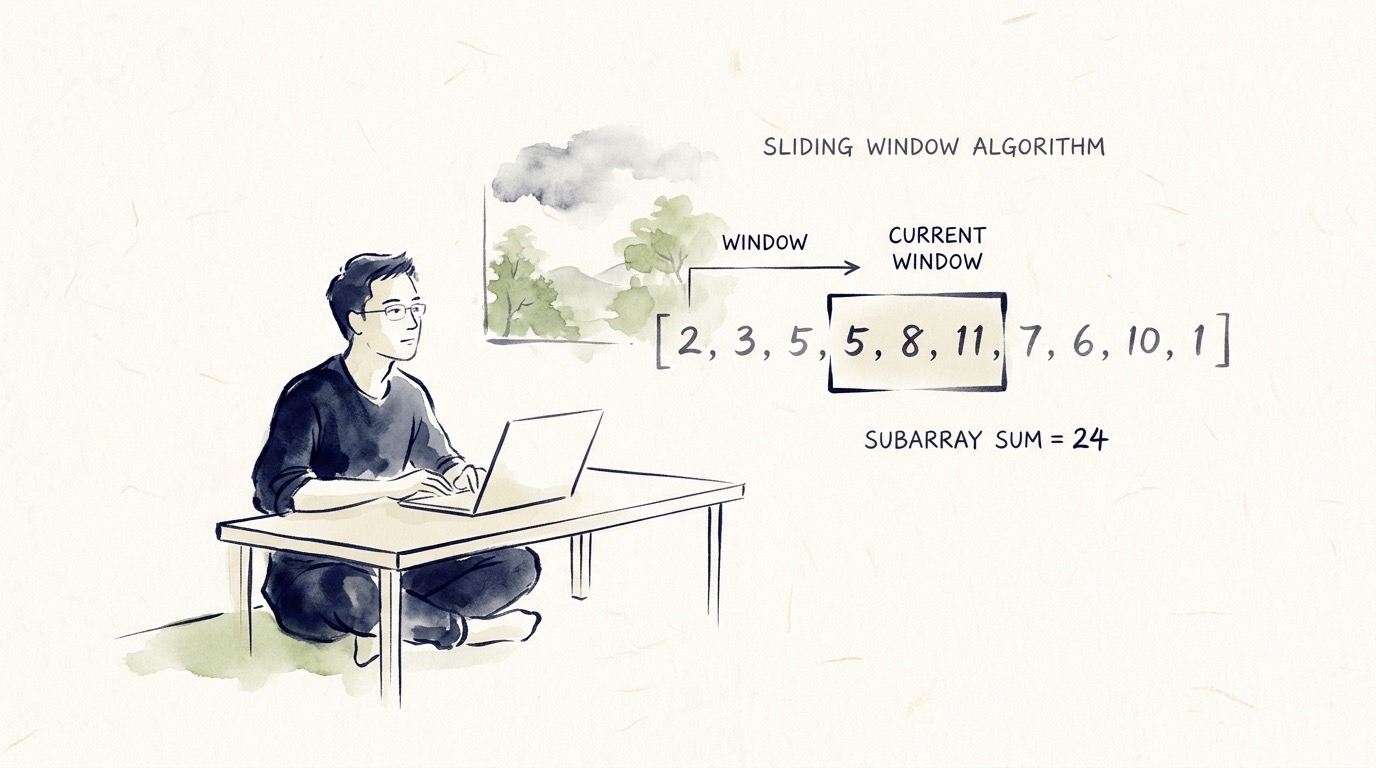
When evaluating candidates in data structure and algorithmic coding rounds, interviewers at leading tech companies consistently return to a foundational evaluation criteria: can the candidate identify and eliminate redundant computation?
A brute-force solution to an array or string problem almost always recalculates properties across overlapping ranges. If an interviewer asks you to evaluate every contiguous subarray of size K in an array of length N, a naive nested loop repeats K - 1 calculations for every single step, dragging performance down to O(N · K) or O(N^2).
When tackling sliding window algorithm interview questions, your objective is to maintain a running state across a contiguous range of elements using two pointers. By adding the incoming element at the right boundary and evicting the outgoing element at the left boundary, you transform polynomial bottlenecks into elegant, linear O(N) solutions.
Whether you are preparing for a software engineering screen at a high-growth startup or a multi-round FAANG technical loop, mastering both fixed-size and dynamic-size sliding windows is non-negotiable. This comprehensive guide breaks down the core mechanics, code templates, amortized complexity proofs, and canonical interview questions you will encounter.
The Anatomy of the Sliding Window Technique
The sliding window technique applies to sequential, iterable collections—principally contiguous subarrays in arrays or contiguous substrings in strings.
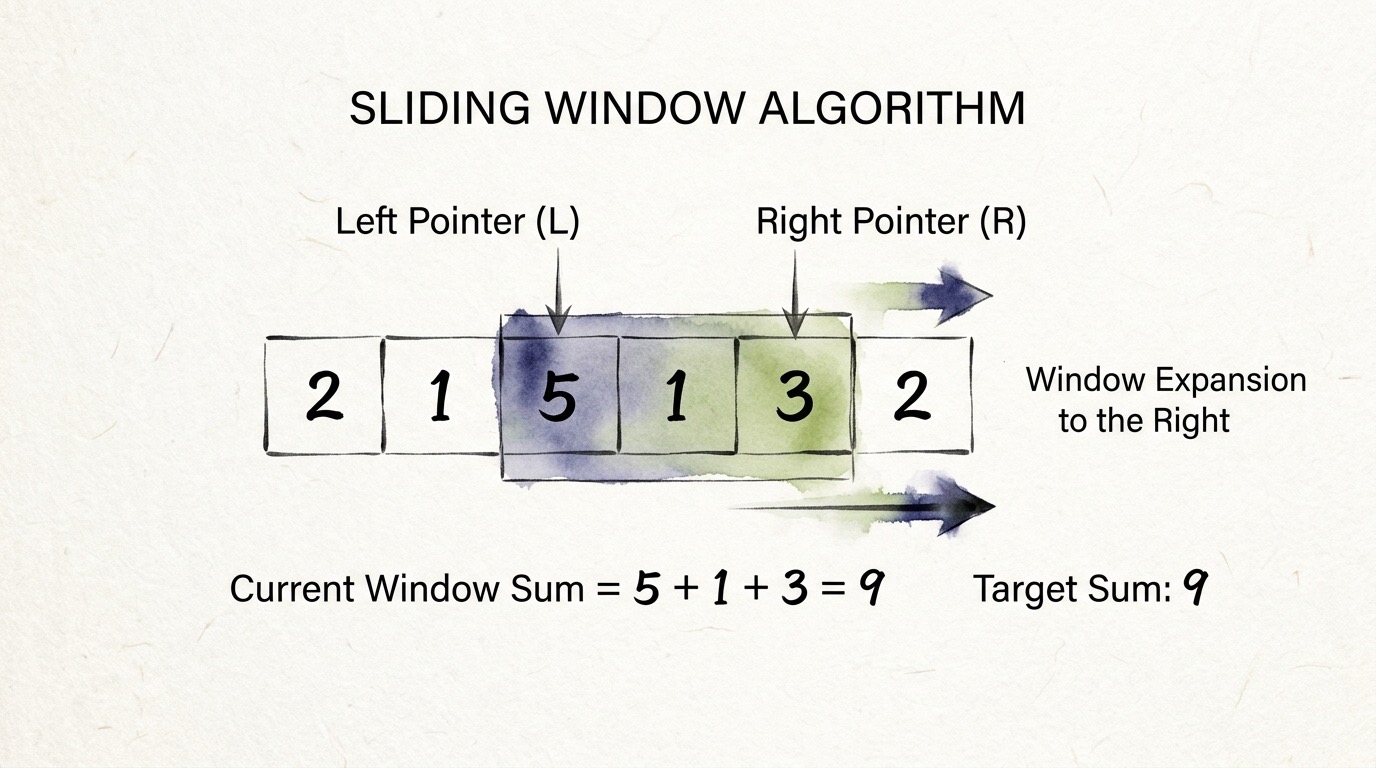
Instead of scanning sub-segments from scratch, we model a conceptual "window" defined by two indices:
- Left Pointer (
L): Marks the start boundary of the current valid window. - Right Pointer (
R): Marks the end boundary of the current valid window.
As R expands across the collection, the window incorporates new data. If the elements inside the window breach a problem constraint (such as exceeding a target sum or containing duplicate characters), L contracts from the left until the window invariants are restored.
Core Window State Variables
To achieve O(1) updates per step, the algorithm tracks an aggregate state rather than re-inspecting the window's contents:
- Running Sum or Product: In numeric arrays, updating the state requires adding
nums[R]and subtractingnums[L]. - Frequency Hash Map or Counter Array: In string problems (such as anagrams or distinct substrings), a hash map stores character counts, allowing
O(1)frequency updates. - Monotonic Deque: When tracking the running minimum or maximum within a sliding window, a double-ended queue maintains elements in sorted order of value, providing immediate
O(1)extrema access.
Fixed-Size vs. Dynamic-Size Sliding Windows
Almost all sliding window interview problems fall into one of two fundamental archetypes:
| Dimension | Fixed-Size Window | Dynamic-Size (Variable) Window |
|---|---|---|
| Window Length | Exactly K elements throughout execution. | Expands and contracts dynamically based on constraints. |
| Typical Problem Prompt | "Find the maximum sum of any contiguous subarray of size K." | "Find the shortest substring containing all target characters." |
| Pointer Motion | R advances by 1; L advances simultaneously once size K is reached. | R expands greedily; L catches up whenever an invariant is violated. |
| Condition Check | Triggered when (R - L + 1) == K. | Managed in a while (window_condition_broken): L += 1 loop. |
Fixed-Size Sliding Window Template (Python)
In a fixed window problem, we initialize the window by accumulating the first K elements, then slide both boundaries in unison across the remainder of the array:
def fixed_sliding_window(nums: list[int], k: int) -> int:
    if not nums or k <= 0 or k > len(nums):
        return 0

    # 1. Initialize state for the first window of size k
    window_sum = sum(nums[:k])
    max_sum = window_sum

    # 2. Slide the window from index k to the end of the array
    for right in range(k, len(nums)):
        left = right - k
        # Add incoming element, evict outgoing element
        window_sum += nums[right] - nums[left]
        max_sum = max(max_sum, window_sum)

    return max_sum
Dynamic-Size Sliding Window Template (Python)
In a dynamic window problem, the right pointer expands the window to find a valid state or satisfy a condition, while the left pointer contracts the window to either minimize length or restore validity:
def dynamic_sliding_window(nums: list[int], target: int) -> int:
    left = 0
    current_state = 0
    optimal_result = float('inf')  # or 0 if finding maximum length

    for right in range(len(nums)):
        # 1. Expand: include nums[right] into current state
        current_state += nums[right]

        # 2. Contract: shrink from the left while the condition holds
        while current_state >= target:
            current_window_len = right - left + 1
            optimal_result = min(optimal_result, current_window_len)

            # Evict nums[left] before incrementing left boundary
            current_state -= nums[left]
            left += 1

    return optimal_result if optimal_result != float('inf') else 0
Top 5 Sliding Window Interview Questions with Code Walkthroughs
Below are the 5 most frequently tested sliding window problems across top-tier engineering interviews, ordered from foundational to advanced.
1. Maximum Sum Subarray of Size K (Fixed Window)
The Problem: Given an array of integers nums and an integer k, find the maximum sum of any contiguous subarray of size k.
Interviewer Expectations: Interviewers use this question as a baseline warm-up to verify that you recognize the fixed window pattern immediately without reverting to an O(N · K) nested loop.
def max_sub_array_of_size_k(k: int, nums: list[int]) -> int:
    if k > len(nums):
        return 0

    max_sum = 0
    window_sum = 0
    window_start = 0

    for window_end in range(len(nums)):
        window_sum += nums[window_end]  # Add incoming element

        # Slide the window once we have reached size k
        if window_end >= k - 1:
            max_sum = max(max_sum, window_sum)
            window_sum -= nums[window_start]  # Evict outgoing element
            window_start += 1                 # Slide left boundary

    return max_sum
- Time Complexity:
O(N)because every element is visited once. - Space Complexity:
O(1)auxiliary memory.
2. Longest Substring Without Repeating Characters (Dynamic Window)
The Problem: Given a string s, find the length of the longest substring without repeating characters.
Interviewer Expectations: This is one of the all-time classic algorithm problems. We covered its line-by-line mechanics in our dedicated guide to longest substring without repeating characters, but in an interview context, the interviewer looks for the optimized index jump rather than a naive character-by-character eviction.
def length_of_longest_substring(s: str) -> int:
    char_index_map = {}
    max_length = 0
    left = 0

    for right, char in enumerate(s):
        # If character is seen and within current window, jump left pointer
        if char in char_index_map and char_index_map[char] >= left:
            left = char_index_map[char] + 1

        char_index_map[char] = right
        max_length = max(max_length, right - left + 1)

    return max_length
- Time Complexity:
O(N)single pass over strings. - Space Complexity:
O(min(N, M))whereMis the size of the character alphabet (e.g.,O(1)for standard ASCII).
3. Minimum Size Subarray Sum (Target Condition Shrinking)
The Problem: Given an array of positive integers nums and a positive integer target, return the minimal length of a contiguous subarray of which the sum is greater than or equal to target. If there is no such subarray, return 0.
Interviewer Expectations: Watch out for the positive integer constraint. When all values are positive, expanding R monotonically increases the sum, and advancing L monotonically decreases the sum. This mathematical property guarantees the correctness of the greedy sliding window.
def min_sub_array_len(target: int, nums: list[int]) -> int:
    left = 0
    current_sum = 0
    min_length = float('inf')

    for right in range(len(nums)):
        current_sum += nums[right]

        # Shrink the window as much as possible while sum >= target
        while current_sum >= target:
            min_length = min(min_length, right - left + 1)
            current_sum -= nums[left]
            left += 1

    return min_length if min_length != float('inf') else 0
- Time Complexity:
O(N)amortized. - Space Complexity:
O(1).
4. Minimum Window Substring (Hard Level - Frequency Counting)
The Problem: Given two strings s and t of lengths m and n respectively, return the minimum window substring of s such that every character in t (including duplicates) is included in the window.
Interviewer Expectations: In senior and staff engineering rounds, brute-force map comparisons fail performance checks. Candidates must track how many unique required characters meet their frequency targets using an integer counter formed compared against required_unique_chars.
from collections import Counter

def min_window(s: str, t: str) -> str:
    if not s or not t or len(s) < len(t):
        return ""

    target_counts = Counter(t)
    required = len(target_counts)

    window_counts = {}
    formed = 0
    left = 0
    ans = (float('inf'), None, None)  # (length, left, right)

    for right, char in enumerate(s):
        window_counts[char] = window_counts.get(char, 0) + 1

        # If the frequency of current char matches desired count in t
        if char in target_counts and window_counts[char] == target_counts[char]:
            formed += 1

        # Contract window from the left until condition is no longer satisfied
        while left <= right and formed == required:
            # Save the smallest window so far
            if (right - left + 1) < ans[0]:
                ans = (right - left + 1, left, right)

            left_char = s[left]
            window_counts[left_char] -= 1
            if left_char in target_counts and window_counts[left_char] < target_counts[left_char]:
                formed -= 1
            left += 1

    return "" if ans[0] == float('inf') else s[ans[1]:ans[2] + 1]
- Time Complexity:
O(|S| + |T|)since each character insis processed at most twice. - Space Complexity:
O(|S| + |T|)for the character frequency dictionaries.
5. Sliding Window Maximum (Monotonic Deque Optimization)
The Problem: You are given an array of integers nums, there is a sliding window of size k which is moving from the very left of the array to the very right. You can only see the k numbers in the window. Each time the sliding window moves right by one position, return the max sliding window.
Interviewer Expectations: Many candidates attempt to use a max-heap (priority queue), which yields O(N log K) time. Top candidates demonstrate mastery of data structures by using a monotonic decreasing deque to achieve true O(N) time.
from collections import deque

def max_sliding_window(nums: list[int], k: int) -> list[int]:
    if not nums or k <= 0:
        return []

    q = deque()  # Stores indices of candidate elements in decreasing value order
    result = []

    for i, num in enumerate(nums):
        # 1. Remove indices that are out of the current window boundary [i - k + 1, i]
        if q and q[0] < i - k + 1:
            q.popleft()

        # 2. Maintain monotonic decreasing order: pop smaller values from the right
        while q and nums[q[-1]] < num:
            q.pop()

        # 3. Append current index
        q.append(i)

        # 4. Once we have filled the first window of size k, record the maximum (q[0])
        if i >= k - 1:
            result.append(nums[q[0]])

    return result
- Time Complexity:
O(N)amortized. Each index is pushed into and popped fromqat most once. - Space Complexity:
O(K)auxiliary space for the deque.
For a broader taxonomy of array, stack, and queue patterns, explore our comprehensive data structure interview questions cheat sheet.
Mathematical Proof: Why the Two-Pointer Sliding Window is Strictly O(N)
A frequent hesitation candidates experience during technical screens is looking at a nested while loop inside an outer for loop and fearing their solution is O(N^2):
for right in range(n):        # Outer loop runs N times
    while condition_met:      # Inner loop: does this mean N * N?
        left += 1
The Amortized Token Accounting Argument
To confidently defend your time complexity to an interviewer, present the Amortized Analysis:
- Right Pointer Movements: The variable
rightstarts at0and increments by1on every iteration of the outer loop. It runs exactlyNtimes. - Left Pointer Movements: The variable
leftstarts at0. In the innerwhileloop,leftonly increments (left += 1). It never decrements or resets backwards. - Upper Bound on Left Pointer: Because
leftcannot exceedright, andright < N,leftcan move forward at mostNtimes over the entire lifetime of the function. - Total Pointer Operations:
Total Operations = Steps(R) + Steps(L) ≤ N + N = 2N
Since 2N ∈ O(N), the algorithm has strict linear runtime complexity. When you articulate this distinction clearly, you signal deep algorithmic maturity.
Critical Interview Pitfalls & How to Avoid Them
Even capable engineers stumble on subtle edge cases when implementing sliding windows under interview pressure. Here are the most common failure modes:
1. Off-by-One Window Size Calculations
The number of elements between indices left and right inclusive is:
Window Size = right - left + 1
Writing right - left without adding 1 is a pervasive bug that invalidates length comparisons.
2. Assuming Sliding Window Works with Negative Numbers
Greedy dynamic sliding windows fundamentally rely on monotonicity: expanding the window must increase the metric, and shrinking the window must decrease it.
If an array contains negative numbers, adding an element might decrease the subarray sum, and removing an element might increase it. In such problems (e.g., "Find subarray with sum equal to K" with negative values), a sliding window will fail. You must use a prefix sum hash map instead, as detailed in our guide to the classic two sum interview question and its array extensions.
3. Modifying Collections During Iteration
Avoid calling operations like list.pop(0) or string slicing s[left:right] inside your sliding window loop. In Python, slicing creates a new copy of the substring in O(K) time, turning your intended O(N) algorithm into an accidental O(N · K) bottleneck. Always track index boundaries with integers and slice only when extracting the final result.
Framework for Acing Sliding Window Questions in Interviews
To consistently solve these problems during live coding sessions, follow this 4-step execution framework:
- Clarify Constraints & Verify Monotonicity: Ask if values can be negative, if the input array can be empty, and whether the elements are sorted.
- Determine Window Type: Is the window size fixed (
K) or variable (driven by a target condition)? - State the Invariants Out Loud: Tell the interviewer: "I will maintain a window
[L, R]. My state will track the character counts in a dictionary, and my condition for validity is that all target frequencies are satisfied." - Walk Through an Edge Case: Before hitting 'Run', trace your pointers with a minimal test case (such as
[1],k = 1, or empty string"").
Understanding these mechanical patterns transforms technical interviews from stressful guesswork into structured problem solving. To build comprehensive interview readiness across system design, algorithms, and behavioral rounds, consult our full pillar roadmap on technical interview prep 2026, and learn how to avoid common candidate pitfalls in why 90 percent fail technical interviews.
Practice Algorithmic Interviews with AI Simulation
Reading about sliding window mechanics is an essential first step, but real interview performance requires verbalizing your thought process while coding under realistic time pressure.
On totop.app, you can practice live mock coding sessions with our conversational AI technical interviewer. You'll receive real-time feedback on your code efficiency, edge case handling, and communication clarity—ensuring you walk into your next technical interview fully prepared to land your target offer.
Practice Full Stack Engineer Questions Live with AI Mock Interviews
Turn any job description across Engineering, DevOps, Data, Marketing, Sales, Finance, or HR into a personalized test and live voice or text AI mock interview on totop.app, or test your speed right now in the 60-Second Full Stack Engineer Blitz.
Play 60s Full Stack Engineer Blitz (Free, No Login) | Start 14-Day Free Trial | Browse All Interview Guides