Sorting algorithms are the foundation of computer science. In a live technical interview—standing at a whiteboard or coding in a shared editor—it is easy to second-guess how Quick Sort partitions elements or why Merge Sort guarantees O(n log n) worst-case complexity while Quick Sort does not.
But here’s the thing: sorting doesn't have to be a purely abstract concept. Once you can visualize how the data moves, everything starts clicking into place. Today, we’re going to walk through the top 10 sorting algorithms. We won't just look at the code; we’ll visualize how they operate, compare their performance, and help you understand exactly when to use which.
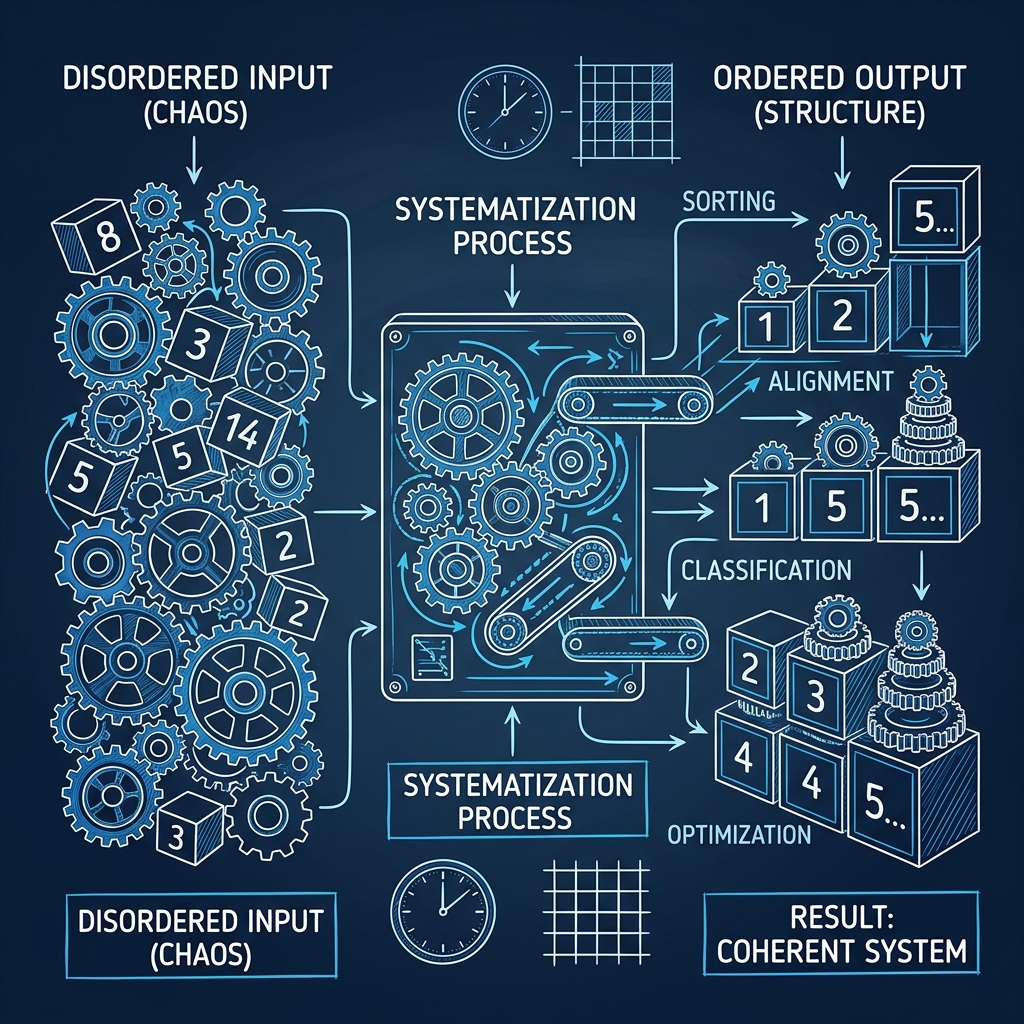
1. Bubble Sort: The Classic (and Slow) Start
Let's start with the one we all learn first. Bubble Sort repeatedly steps through the list, compares adjacent elements, and swaps them if they are in the wrong order.
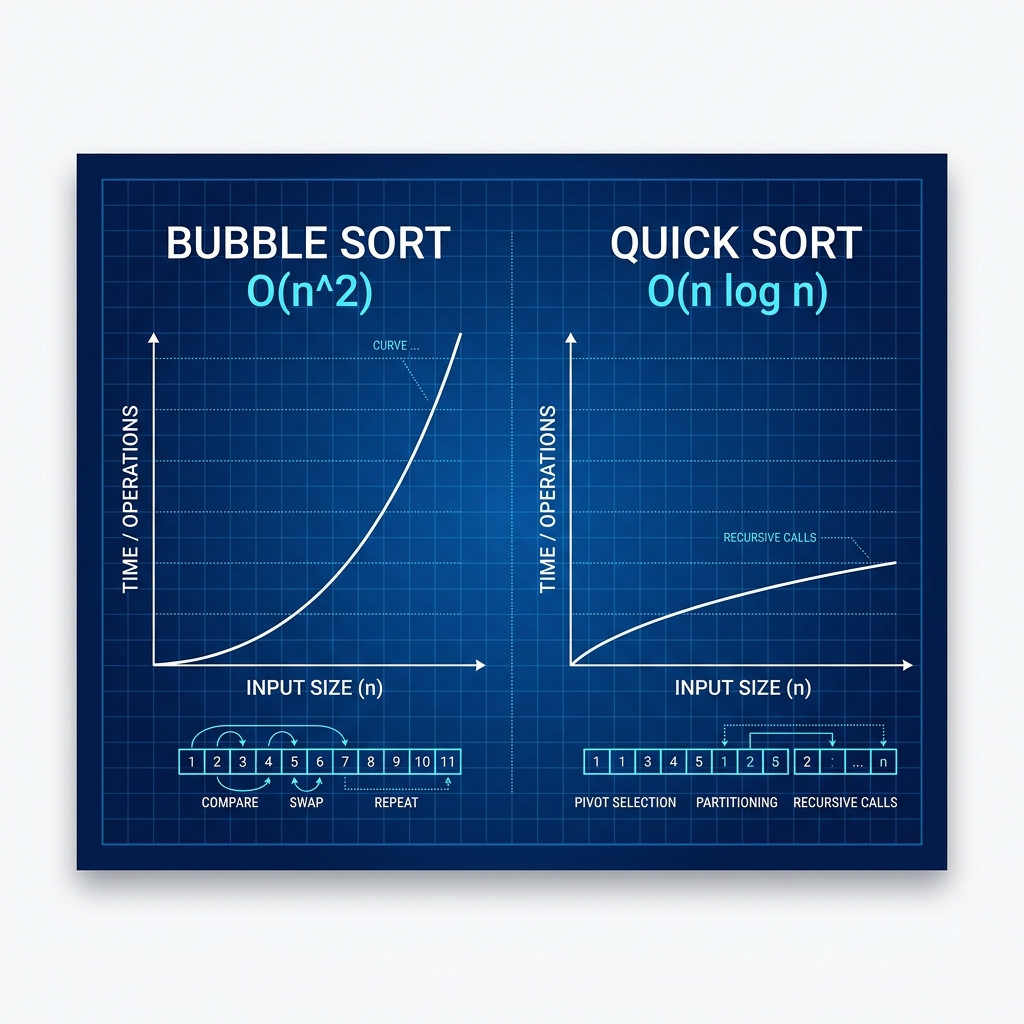
Have you ever noticed how the largest elements "bubble" up to the end of the list? It's intuitive, sure, but it’s painfully slow for large datasets. You almost never want to use this in production, but it’s a fantastic teaching tool.
Time Complexity: O(n²) average and worst-case.
2. Selection Sort: Picking the Smallest
Instead of bubbling, Selection Sort divides the input list into two parts: the sublist of items already sorted, and the sublist of items remaining to be sorted. It finds the smallest element in the unsorted sublist and swaps it with the leftmost unsorted element.
It’s straightforward, but like Bubble Sort, its performance degrades quickly as the array grows.
3. Insertion Sort: Sorting Your Hand of Cards
Think about how you sort a hand of playing cards. You pick up a card, look at it, and insert it into its correct position relative to the cards you're already holding. That's Insertion Sort.
It's highly efficient for small data sets or nearly sorted data. In fact, many advanced algorithms (like Timsort) switch to Insertion Sort for small subarrays!
4. Merge Sort: Divide and Conquer
Now we're getting to the heavy hitters. Merge Sort divides the unsorted list into n sublists, each containing one element (a list of one element is considered sorted). Then, it repeatedly merges sublists to produce new sorted sublists until there is only one sorted list remaining.
It's stable and guarantees O(n log n) performance, but it requires extra memory for the temporary arrays.
5. Quick Sort: The Practical Champion
Quick Sort is often the fastest sorting algorithm in practice. It picks an element as a "pivot" and partitions the given array around the picked pivot. The key is in the partitioning step.
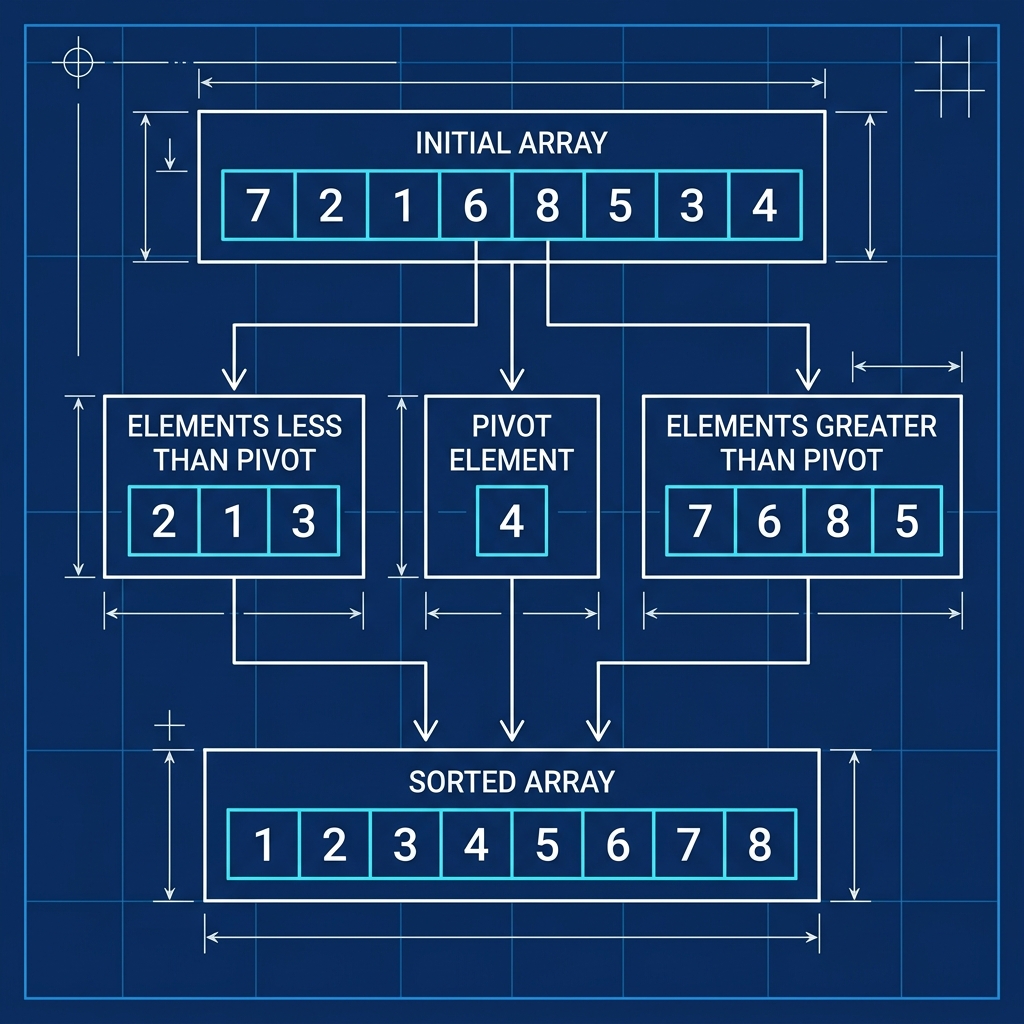
As you can see, Quick Sort divides the problem. Elements smaller than the pivot go to the left, and elements greater go to the right. It recursively applies this to the sub-arrays.
Time Complexity: O(n log n) average, but beware of the O(n²) worst-case if you pick a bad pivot!
6. Heap Sort: Leveraging Tree Structures
Heap Sort uses a binary heap data structure. It first builds a max heap from the input data, then repeatedly extracts the maximum element and places it at the end of the array. It's an in-place algorithm, making it very memory efficient, though it's typically slower in practice than Quick Sort.
7. Radix Sort: Sorting by Digits
Unlike the previous comparison-based algorithms, Radix Sort processes integer keys by grouping keys by the individual digits which share the same significant position and value. It's incredibly fast—O(nk) where k is the number of digits—but it's limited to specific types of data, like integers or strings.
8. Counting Sort: When the Range is Known
If you know your data consists of integers within a specific, small range, Counting Sort is magical. It counts the number of objects that have distinct key values, then calculates the positions of each object in the output sequence. It can achieve O(n + k) time complexity, which is phenomenal.
9. Bucket Sort: Scattering and Gathering
Bucket Sort distributes the elements of an array into a number of "buckets." Each bucket is then sorted individually, either using a different sorting algorithm or by recursively applying the bucket sorting algorithm. It's excellent when input is uniformly distributed over a range.
10. Timsort: The Real-World Workhorse
We couldn't finish this list without mentioning Timsort. It's a hybrid sorting algorithm derived from Merge Sort and Insertion Sort, designed to perform well on many kinds of real-world data. It's the standard sorting algorithm used in Python, Java, and many other languages. Timsort takes advantage of already sorted runs in the data, making it incredibly adaptive and efficient.
Choosing the Right Tool for the Job
There is no single "best" sorting algorithm. The right choice depends entirely on your data:
- Small arrays or mostly sorted data: Insertion Sort.
- General purpose, average case performance: Quick Sort.
- Guaranteed worst-case performance and stability: Merge Sort.
- Memory constraints: Heap Sort.
- Specific data types (like integers in a known range): Counting or Radix Sort.
Mastering these algorithms gives you the intuition to write faster, more efficient code. If you're preparing for interviews and want to practice identifying which algorithm fits best for a given problem, exploring real-world coding challenges on platforms like totop.app can really help cement these concepts.
Happy coding, and may your arrays always be perfectly sorted!
Sorting Algorithms Compared: Complete Complexity & Stability Matrix
When comparing sorting algorithms in coding interviews, interviewers evaluate three properties beyond raw Big-O time: in-place memory overhead, stability (whether equal keys preserve their original relative order), and adaptivity (whether already-sorted data runs in O(n) time):
| Sorting Algorithm | Best Time | Average Time | Worst Time | Extra Space | Stable? | Adaptive on Nearly-Sorted Data? |
|---|---|---|---|---|---|---|
| QuickSort (3-Way Partition) | O(n log n) | O(n log n) | O(n^2) | O(log n) stack | ❌ No | No (use randomized pivot or median-of-three) |
| MergeSort | O(n log n) | O(n log n) | O(n log n) | O(n) | ✅ Yes | No (always splits & merges all levels) |
| TimSort (Python / Java / V8) | O(n) | O(n log n) | O(n log n) | O(n) | ✅ Yes | Yes — detects natural monotonic runs & merges via galloping |
| HeapSort | O(n log n) | O(n log n) | O(n log n) | O(1) | ❌ No | No (poor CPU cache locality due to heap jumps) |
| Insertion Sort | O(n) | O(n^2) | O(n^2) | O(1) | ✅ Yes | Yes — O(n + d) where d is number of inversions; fastest for n ≤ 32 |
| Counting / Radix Sort | O(n + k) | O(n + k) | O(n + k) | O(n + k) | ✅ Yes | Non-comparative integer/fixed-key sort |
Why TimSort Is the Default Sorting Algorithm in Python, Java, and V8 JavaScript
If an interviewer asks "What is the most efficient sorting algorithm used by Array.prototype.sort() or Python's list.sort()?", the answer is TimSort (invented by Tim Peters):
- Real-world arrays are rarely uniformly random—they almost always contain pre-existing sorted subsequences (natural runs).
- TimSort scans the array to identify ascending or strictly descending runs. If a run is shorter than a minimum run length (
minrun, between 32 and 64 elements), it extends it using Binary Insertion Sort (which is ultra-fast inside L1 CPU cache). - It pushes runs onto a stack and merges adjacent runs using Galloping Mode (exponential search) when one run consistently beats another, achieving
O(n)best-case time on partially sorted data while guaranteeingO(n log n)worst-case stability.
Practice Full Stack Engineer Questions Live with AI Mock Interviews
Turn any job description across Engineering, DevOps, Data, Marketing, Sales, Finance, or HR into a personalized test and live voice or text AI mock interview on totop.app, or test your speed right now in the 60-Second Full Stack Engineer Blitz.
Play 60s Full Stack Engineer Blitz (Free, No Login) | Start 14-Day Free Trial | Browse All Interview Guides