Facing a dynamic programming (DP) problem in a live technical interview can feel like trying to solve a 10,000-piece puzzle without the picture on the box. Dynamic programming is notorious for being one of the toughest hurdles in coding interviews, but once you recognize overlapping subproblems and state transitions, it becomes highly systematic.
This guide walks through a step-by-step framework for mastering dynamic programming—stripping away confusing academic jargon and showing how to systematically dismantle DP problems.
What Even Is Dynamic Programming?
At its core, dynamic programming is just an optimization technique. That's it. It's a way to solve complex problems by breaking them down into simpler subproblems. If you can solve the smaller pieces, you can combine their solutions to crack the main problem.
Think of it this way: if I asked you what 1 + 1 + 1 + 1 + 1 is, you'd quickly say 5. If I then asked you what 1 + 1 + 1 + 1 + 1 + 1 is, you wouldn't recalculate the whole thing. You'd just add 1 to 5 and say 6. You remembered the previous result to save time. That is dynamic programming in a nutshell.
For a problem to be a good candidate for DP, it needs to have two key characteristics:
- Overlapping Subproblems: You find yourself solving the same small problems over and over again.
- Optimal Substructure: The optimal solution to the big problem can be built from the optimal solutions of its subproblems.

The Step-by-Step Approach
Whenever you're stuck on a DP problem, rely on this structured approach rather than trying to wing it.
Step 1: Start with the Recursive Solution (Brute Force)
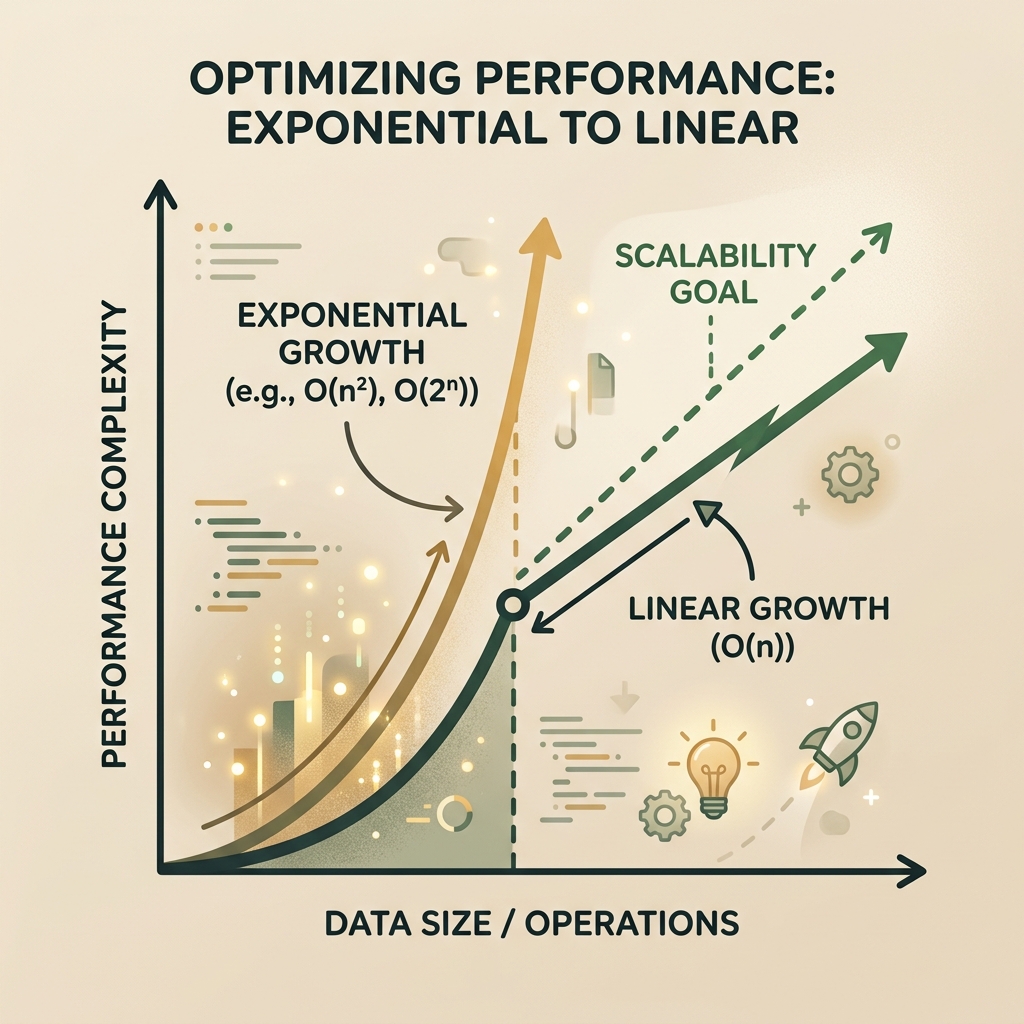
Don't jump straight into optimizing. First, write out the plain old recursive solution. It will probably be horribly slow—often exponential time complexity O(2^n)—but it ensures you understand the core logic.
Ask yourself: "How do I express the solution to this state in terms of smaller states?"
Step 2: Spot the Repeating Work
Once you have the recursive tree, trace it out on a whiteboard or paper. Do you notice the exact same function calls happening multiple times? If you're calculating fibonacci(4) three separate times in your tree, you've found your overlapping subproblems.
Step 3: Add Memoization (Top-Down)
This is where the magic happens. We're going to cache our results. Create an array or a hash map. Before you compute a state, check if it's already in the cache. If it is, return it immediately. If it isn't, compute it, store it in the cache, and then return it.
Just like that, your time complexity usually plummets from exponential to linear.
Step 4: Convert to Tabulation (Bottom-Up)
Memoization is great, but it relies on the call stack, which can lead to stack overflow errors for massive inputs. Tabulation flips the script. Instead of starting from the top and working down recursively, you start from the smallest base cases and iteratively build your way up using a table (usually an array).
Here's what that looks like in practice for the classic Fibonacci sequence:
function fibonacciBottomUp(n) {
  if (n <= 1) return n;

  const dp = new Array(n + 1);
  dp[0] = 0;
  dp[1] = 1;

  for (let i = 2; i <= n; i++) {
    dp[i] = dp[i - 1] + dp[i - 2];
  }

  return dp[n];
}
Notice how we just loop through, filling out our dp array based on the previous two answers? It's clean, efficient, and completely avoids deep recursion.
Practice Makes Pattern Recognition
The hard truth about DP is that there is no single magic trick that works for every problem. The real skill is pattern recognition. The more problems you solve, the more you'll start noticing common frameworks: the 0/1 Knapsack pattern, Longest Common Subsequence, or Palindromic substrings.
If you're gearing up for interviews, structured practice is everything. Platforms like totop.app are fantastic for this because they help you categorize problems by these exact patterns, ensuring you aren't just memorizing solutions, but actually internalizing the frameworks.
So next time you encounter a DP problem, take a deep breath. Write out the brute force, find the overlapping work, and cache it. You've got this.
The 5 Dynamic Programming Archetypes Tested in Coding Interviews
Instead of memorizing hundreds of individual LeetCode problems, map every Dynamic Programming question to one of five core state-transition archetypes during the first three minutes of the interview:
| DP Archetype | State Definition dp[...] | Classic Interview Examples | Space Optimization Trick |
|---|---|---|---|
| 1. 1D Linear Sequence DP | dp[i] = optimal result for prefix ending at index i | Climbing Stairs, House Robber, Decode Ways, Coin Change | Keep only prev1 and prev2 scalars (O(1) space). |
| 2. 0/1 & Unbounded Knapsack | dp[i][w] = best value using subset of first i items with capacity w | Partition Equal Subset Sum, Target Sum, Coin Change II | Iterate capacity w backward from W down to weight in a 1D array. |
| 3. Two-String / Grid Alignment | dp[i][j] = alignment of s1[0..i] and s2[0..j] | Longest Common Subsequence (LCS), Edit Distance, Unique Paths | Rolling 2-row array dp[2][m] reducing O(n*m) space to O(min(n, m)). |
| 4. Interval / Substring DP | dp[i][j] = optimal solution on subarray s[i..j] of length L | Longest Palindromic Substring, Burst Balloons, Matrix Chain Multiplication | Iterate outer loop by substring length L = 1..n rather than row index. |
| 5. State-Machine DP | dp[i][state] where state is held, sold, or cooldown | Best Time to Buy and Sell Stock with Cooldown / Transaction Fee | Track 2–3 state variables per day in O(1) memory. |
When to Choose Top-Down Memoization vs. Bottom-Up Tabulation in an Interview
- Start with Top-Down Recursion +
@cache/ Memo Hash Map when the state space is sparse (not all(i, j)states are reachable) or when the topological order of subproblems is tricky to write iteratively under time pressure. - Convert to Bottom-Up Tabulation when the interviewer asks to optimize space complexity (e.g., reducing
O(N × M)toO(M)via a rolling row) or when recursion depthO(N)risks a call-stack overflow on inputs whereN > 10^4. - Reconstructing the Actual Optimal Path (Not Just the Max/Min Value): If the interviewer asks you to return the actual items chosen in Knapsack or the actual string in Longest Common Subsequence, keep the full 2D table
dp[n + 1][m + 1]and backtrack from(n, m)to(0, 0)inO(n + m)time by checking which transition branch produceddp[i][j]. - How to Spot Greedy vs. Dynamic Programming Traps: Candidates often try a greedy choice on problems like Coin Change (e.g., coins of denomination 1, 3, and 4 with target 6—greedy picks 4+1+1=3 coins, whereas optimal DP picks 3+3=2 coins). Whenever a local greedy choice can block a globally better combination later, prove it with a 3-element counterexample and pivot immediately to Dynamic Programming.
Practice Full Stack Engineer Questions Live with AI Mock Interviews
Turn any job description across Engineering, DevOps, Data, Marketing, Sales, Finance, or HR into a personalized test and live voice or text AI mock interview on totop.app, or test your speed right now in the 60-Second Full Stack Engineer Blitz.
Play 60s Full Stack Engineer Blitz (Free, No Login) | Start 14-Day Free Trial | Browse All Interview Guides