Let's be completely honest: graph algorithms are the ultimate filters in technical interviews. You can glide through arrays, hash maps, and even binary trees, but the moment the interviewer says, "Imagine you have a set of courses with dependencies..." or "Find the shortest path in a network...", your pulse quickens. I remember my first time facing a graph problem. I drew a tangled mess of circles and lines on a whiteboard, feeling completely lost, trying to figure out how to traverse it without getting stuck in an infinite loop.
But once you realize that graphs are just a way of modeling relationships, and that a handful of core algorithms can solve 95% of these problems, they become your favorite type of question. From social networks to recommendation engines, and map routing to dependency resolution, graphs are everywhere.
Let’s demystify the essential graph algorithms you need to know to write cleaner code and ace your next coding interview.

1. Breadth-First Search (BFS) & Depth-First Search (DFS): The Foundations
Before you can run, you have to learn to walk. In graph terms, that means traversal. BFS and DFS are the twin pillars of graph exploration. They determine the order in which we visit the nodes (or vertices) of a graph.
Breadth-First Search (BFS)
Think of BFS as a ripple in a pond. You start at a node and explore all of its immediate neighbors first, then move to their neighbors, and so on. It explores the graph layer by layer.
- Best Used For: Finding the shortest path in an unweighted graph (since it explores closer nodes first).
- Data Structure: Queue (First-In, First-Out).
Depth-First Search (DFS)
Think of DFS as exploring a maze. You pick a path and go as deep as possible until you hit a dead end, then backtrack and try the next path.
- Best Used For: Visiting every node, exploring all possible paths, topological sorting, and solving puzzles (like mazes).
- Data Structure: Recursion (Call Stack) or an explicit Stack.
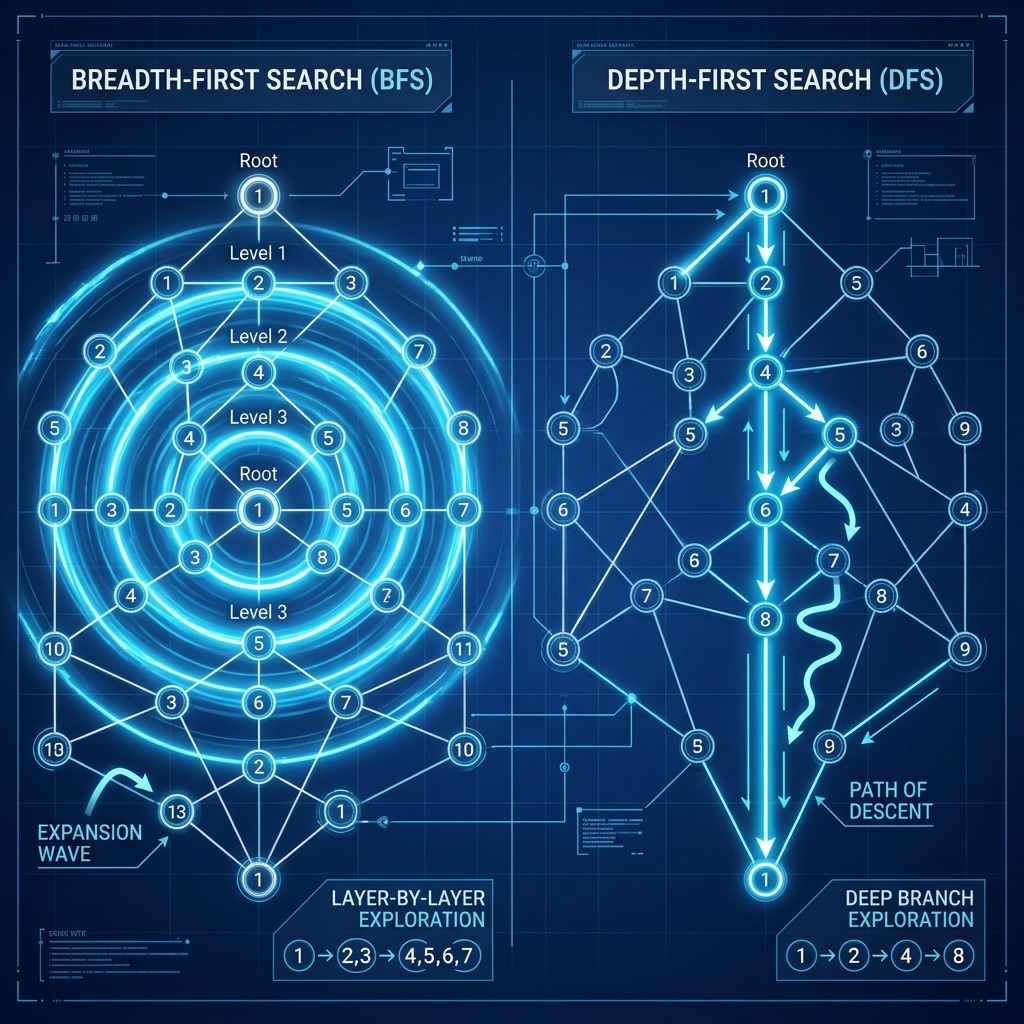
A technical comparison: BFS radiates outwards in concentric expansion waves, while DFS plunges straight down a single branch before backtracking.
Here is a clean Python snippet demonstrating how to implement BFS traversal using a queue:

from collections import deque

def bfs_traversal(graph, start_node):
    visited = set()
    queue = deque([start_node])
    visited.add(start_node)

    while queue:
        current_node = queue.popleft()
        print(f"Visiting node: {current_node}")

        for neighbor in graph[current_node]:
            if neighbor not in visited:
                visited.add(neighbor)
                queue.append(neighbor)
2. Dijkstra's Algorithm: The Shortest Path Champion
BFS is great for finding the shortest path if every edge has the same "cost" (weight = 1). But what if you are building a mapping tool, and some roads are highways while others are congested city streets?
Enter Dijkstra’s algorithm.
Dijkstra’s algorithm finds the shortest path from a starting node to all other nodes in a weighted graph (as long as weights are non-negative). It works by maintaining a set of "cheapest known distances" and using a Priority Queue (Min-Heap) to always explore the next closest node.
- Time Complexity: O((V + E) log V) with a Min-Heap.
- Pro-Tip: If the interviewer mentions negative edge weights, Dijkstra won't work. You’ll need the Bellman-Ford algorithm instead.
3. Topological Sort: Resolving Dependencies
Have you ever wondered how your build tool (like npm, Gradle, or CMake) figures out the exact order in which to compile files? Or how college courses have prerequisites that you must take in a specific sequence?
This is solved using Topological Sort.
Topological Sort takes a Directed Acyclic Graph (DAG) and returns a linear ordering of its vertices such that for every directed edge u -> v, node u comes before v in the ordering.
- How it works: You can implement it using DFS (recording nodes when backtracking finishes) or Kahn's Algorithm (which repeatedly removes nodes with an in-degree of 0).
- Key Constraint: It only works on graphs with no cycles. If there's a dependency cycle (e.g., A needs B, B needs C, C needs A), topological sorting is impossible.
4. Cycle Detection: Spotting the Loops
Speaking of cycles, finding them is a classic interview question. Cycles can cause infinite loops in routing protocols, deadlocks in database transactions, and broken build systems.
- In Directed Graphs: Use DFS with three states: unvisited, currently visiting (on the recursion stack), and fully visited. If you encounter a node that is "currently visiting," you’ve found a cycle (a back edge).
- In Unweighted/Undirected Graphs: You can use a Disjoint Set Union (DSU) or simple DFS/BFS keeping track of parent nodes.
5. Disjoint Set Union (DSU) / Union-Find: Grouping Elements
Union-Find is one of the most elegant data structures in computer science. It manages a partition of a set into disjoint subsets and supports two primary operations:
- Find: Determine which subset an element belongs to (used to check if two elements are in the same set).
- Union: Join two subsets into a single subset.
By applying optimizations like Path Compression and Union by Rank, these operations run in near-constant time—specifically, O(α(N)), where α is the inverse Ackermann function (which grows so slowly it is practically <= 4 for all realistic values).
- Common Use Cases: Detecting cycles in undirected graphs, finding connected components, and Kruskal's algorithm.
6. Minimum Spanning Trees (MST): Kruskal's & Prim's
Imagine you are a telecommunications company laying fiber-optic cables to connect a set of cities. You want to connect all cities together using the minimum total length of cable.
This is a Minimum Spanning Tree problem. An MST is a subset of the edges of a connected, weighted undirected graph that connects all the vertices together, without any cycles, and with the minimum possible total edge weight.
There are two primary ways to find an MST:
- Kruskal's Algorithm: Sort all edges by weight, and greedily add the cheapest edge to the tree as long as it doesn't create a cycle (perfect use case for Union-Find!).
- Prim's Algorithm: Start with a single node, and greedily grow the tree by adding the cheapest edge connecting a node inside the tree to a node outside it.
Wrapping Up
Graph algorithms might seem like a lot to absorb, but they share a lot of common DNA. If you understand BFS, DFS, and how a priority queue works, you can easily grasp Dijkstra's and Prim's algorithms.
When you're prepping for a coding interview, don't just memorize the code. Focus on the core intuition:
- Need to find the shortest path on a simple grid? Reach for BFS.
- Need to order tasks by prerequisites? Use Topological Sort.
- Need to connect network nodes efficiently? Build an MST.
If you want to practice these graph algorithms under realistic, high-pressure conditions, head over to totop.app. It provides AI-powered, interactive mock interviews that evaluate your code, structure, and communication in real-time. Practice a few graph sessions, and you'll find that traversing these complex structures starts to feel like second nature.
Happy coding!
Practice Full Stack Engineer Questions Live with AI Mock Interviews
Turn any job description across Engineering, DevOps, Data, Marketing, Sales, Finance, or HR into a personalized test and live voice or text AI mock interview on totop.app, or test your speed right now in the 60-Second Full Stack Engineer Blitz.
Play 60s Full Stack Engineer Blitz (Free, No Login) | Start 14-Day Free Trial | Browse All Interview Guides