Binary Search Trees: Implementation and Use Cases
Have you ever tried to find a specific word in a dictionary by starting from page one and reading every single entry? Probably not. You’d open it somewhere in the middle, see if the word you’re looking for comes before or after that page, and then halve your search space again. It’s natural, it’s fast, and guess what? That’s exactly how a Binary Search Tree (BST) operates under the hood.

When I first started diving into algorithms, I remember looking at trees and thinking, "Why can't I just use an array for everything?" It turns out, while arrays are great, inserting and deleting elements while maintaining order can be a nightmare. This is where BSTs step in as a game-changer. They offer a sweet spot between the fast search times of a sorted array and the dynamic resizing capabilities of a linked list.
Let's break down how they work, how to implement them, and when you should actually use them in your projects.
The Core Concept
At its heart, a Binary Search Tree is a node-based data structure where each node has at most two child nodes—commonly referred to as the left child and the right child.
But here is the golden rule that makes it a Search Tree:
- The left child must always contain a value less than its parent's value.
- The right child must always contain a value greater than its parent's value.
Because of this property, every time you make a decision to go left or right, you are effectively cutting your search space in half.
Implementing a Basic BST
Let's look at how we might write a simple insertion method.
class Node {
  constructor(value) {
    this.value = value;
    this.left = null;
    this.right = null;
  }
}

class BinarySearchTree {
  constructor() {
    this.root = null;
  }

  insert(value) {
    const newNode = new Node(value);
    if (this.root === null) {
      this.root = newNode;
      return this;
    }

    let current = this.root;
    while (true) {
      if (value === current.value) return undefined; // No duplicates allowed

      if (value < current.value) {
        if (current.left === null) {
          current.left = newNode;
          return this;
        }
        current = current.left;
      } else {
        if (current.right === null) {
          current.right = newNode;
          return this;
        }
        current = current.right;
      }
    }
  }
}
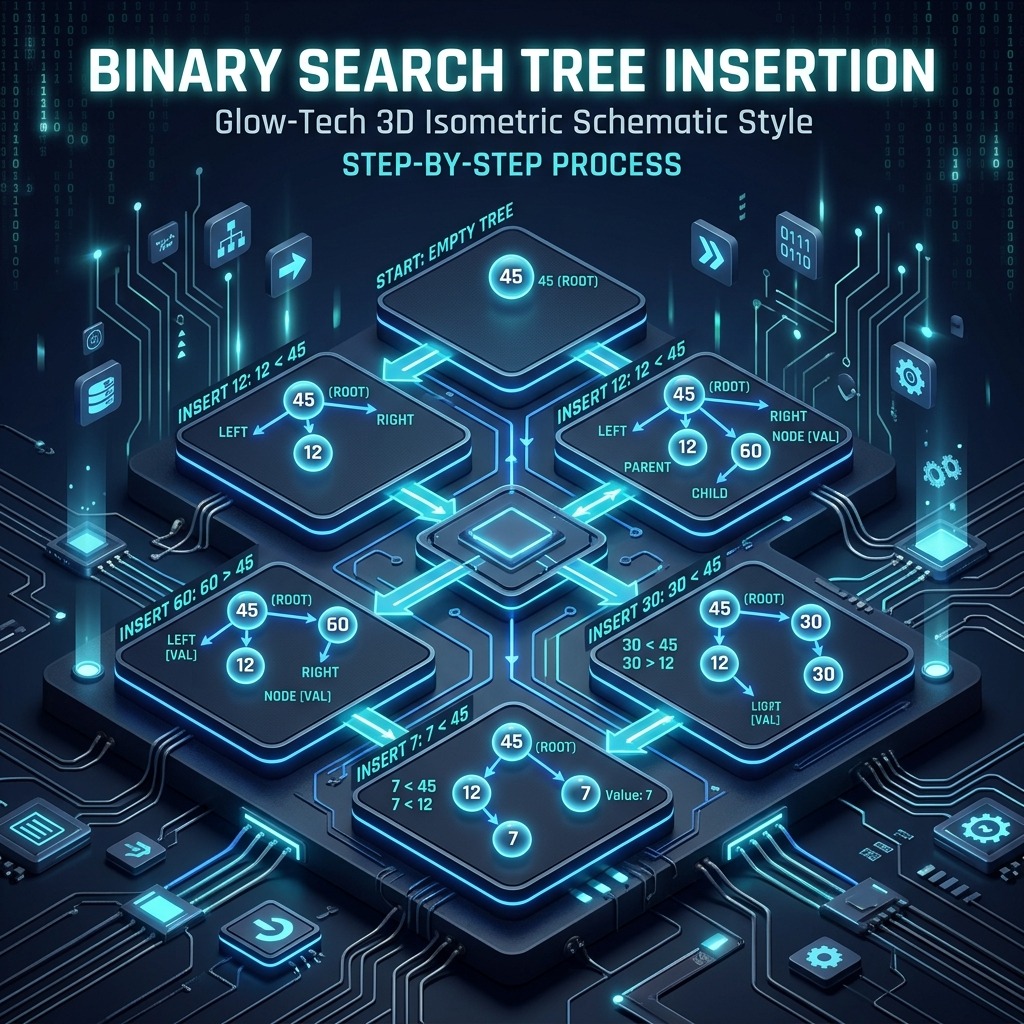
When you look at this code, you can see the logic flowing exactly like our dictionary example. We start at the top (the root) and just keep asking, "Are you bigger or smaller?" until we find an empty spot to drop our new node.
The Catch: When Trees Go Bad
This all sounds perfect, right? $O(\log n)$ time complexity for search, insertion, and deletion. But there's a hidden trap.
What happens if you insert data that is already sorted? Let's say you insert 1, then 2, then 3, and so on. Every single node goes to the right. Suddenly, your beautiful, efficient tree just turned into a glorified Linked List.
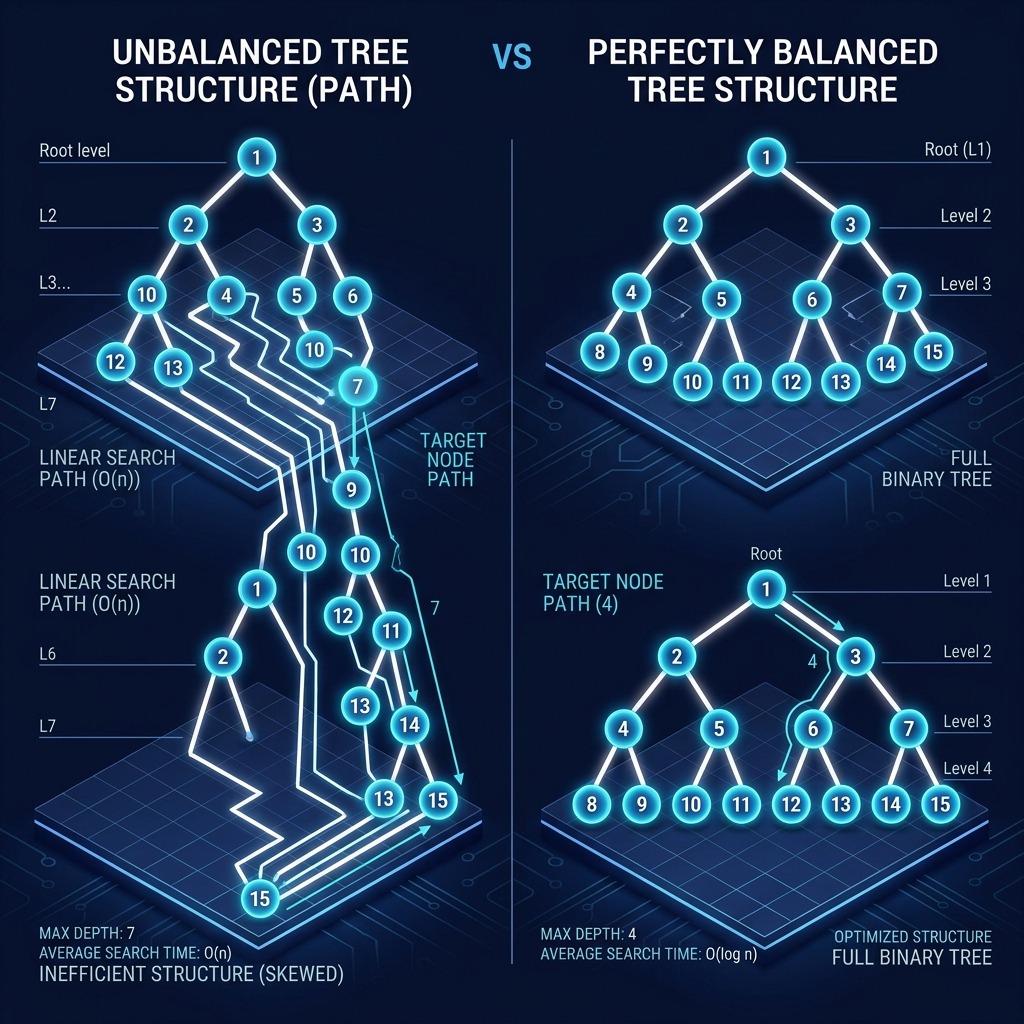
Instead of cutting your search space in half, you're back to searching one by one. Your time complexity degrades to $O(n)$.
To fix this, we use self-balancing trees like AVL Trees or Red-Black Trees. These structures automatically rotate themselves during insertions and deletions to guarantee that the tree remains balanced and operations stay strictly $O(\log n)$.
Real-World Use Cases
So, when should you actually reach for a BST in a real-world scenario?
- Databases and Indexing: Many databases use a variation of BSTs (like B-Trees or B+ Trees) to index data. They allow for fast retrieval, range queries, and sequential access.
- Auto-Complete and Dictionaries: Tries (a type of search tree) are incredible for prefix matching. When you start typing in a search bar, a tree structure is often what's rapidly finding the suggestions.
- Routing Tables: Network routers often use variations of search trees to quickly find the longest matching prefix for IP routing.
Wrapping Up
Binary Search Trees are one of those foundational concepts that pop up everywhere once you know what to look for. Whether you're preparing for technical interviews or building a high-performance system, understanding the trade-offs between BSTs and other data structures is a crucial tool in your engineering belt.
If you're gearing up for your next big interview and want to practice implementing these data structures under pressure, check out totop.app. We've built an AI-driven platform that simulates realistic technical interviews, helping you tackle these algorithms before the real deal. Keep coding, and keep your trees balanced!