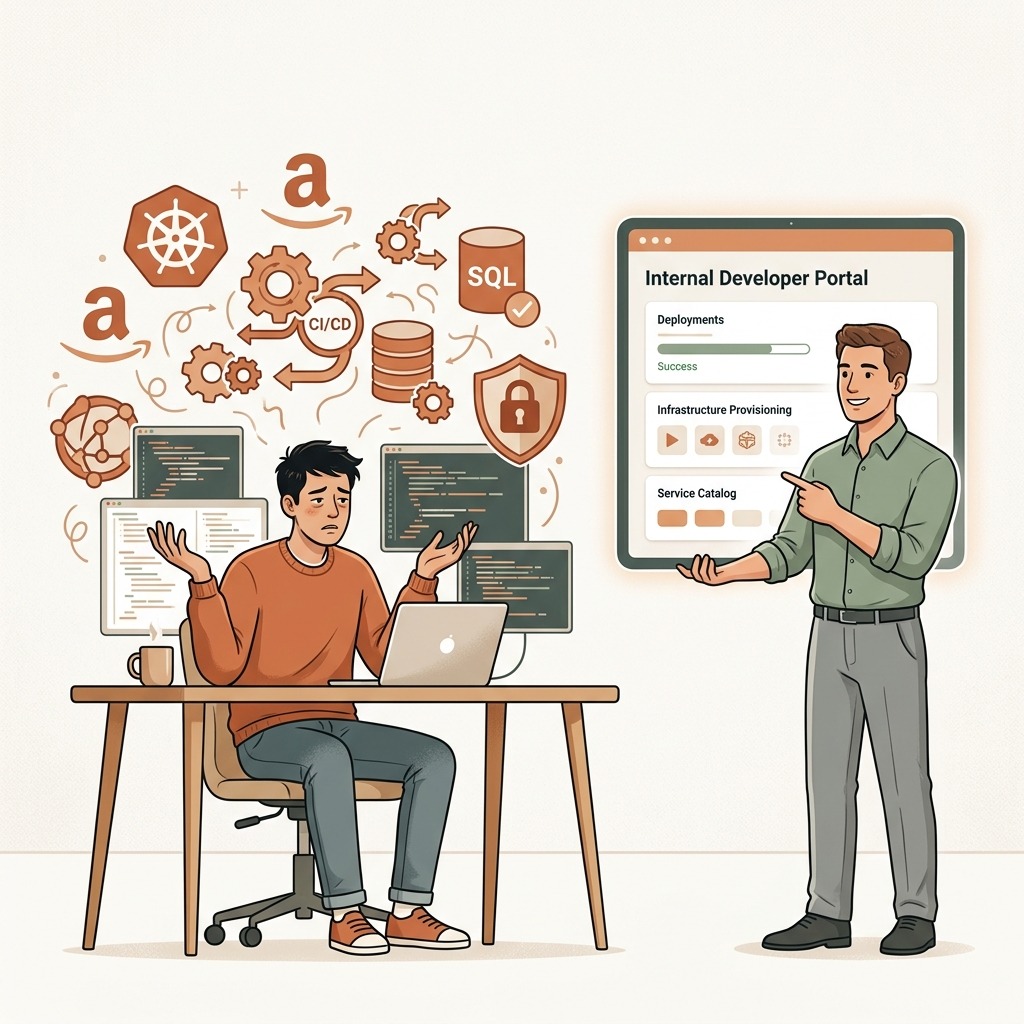
A few years ago, calling yourself a "Full-Stack Developer" was the ultimate badge of honor in tech. It meant you were the swiss-army knife of engineering. You could whip up a slick frontend interface, design the relational schema in PostgreSQL, spin up a Node.js REST API, and deploy it all to an EC2 instance before lunch.
Fast forward to 2026, and the scope of software development has exploded.
Today, a job description for a "Senior Full-Stack Engineer" often asks for deep expertise in React 19, Server Actions, TypeScript, GraphQL, PostgreSQL tuning, Redis caching, Docker containerization, Kubernetes helm charts, Terraform IaC, AWS IAM role policies, Datadog observability, eBPF network tracing, and GitHub Actions CI/CD workflows.
Let's be honest with ourselves: nobody can master all of that.
Trying to hold the entire modern software stack inside a single developer's head has reached a breaking point. Cognitive overload is at an all-time high, developer velocity is plummeting under infrastructure maintenance, and burnout is rife.
Does this mean full-stack development is dead? Or are we witnessing a massive structural shift in how software teams operate? Enter Platform Engineering—the discipline reshaping software delivery in 2026.
The Myth of the Omniscient Full-Stack Engineer
To understand why the traditional full-stack model is fracturing, we have to look back at how the stack expanded over the past decade.
Around 2015, full-stack was manageable. The frontend was HTML, CSS, and jQuery or early React. The backend was Rails, Express, or Django. Infrastructure meant pushing code to Heroku or configuring an Nginx web server on a single Linux server.
Then came the modern cloud explosion:
- Microservices Architecture: Monoliths split into dozens of microservices, each needing its own deployment pipeline, service mesh, and secret management.
- Cloud-Native Complexity: AWS alone now has over 200 service offerings. Configuring networking, VPC peering, KMS keys, and IAM policies requires dedicated cloud expertise.
- DevOps "You Build It, You Run It" Mandate: While DevOps aimed to remove silos, in practice it dumped complex infrastructure, monitoring, and security operations directly onto application developers.
+-----------------------------------------------------------------------+
|                       THE 2026 FULL-STACK TRAP                        |
|                                                                       |
|  [ Frontend UI ] ---> [ Microservice APIs ] ---> [ DB / Caching ]     |
|          |                     |                      |               |
|          v                     v                      v               |
|   Tailwind/React 19     gRPC / GraphQL         Postgres / Redis       |
|                                                                       |
|  +-----------------------------------------------------------------+  |
|  | EXTRA COGNITIVE LOAD:                                           |  |
|  | K8s Manifests, Helm Charts, Terraform, IAM Security, Prometheus,|  |
|  | OpenTelemetry, CI/CD Actions, Cloud Cost Optimization...        |  |
|  +-----------------------------------------------------------------+  |
+-----------------------------------------------------------------------+
When a full-stack engineer spends 60% of their week debugging Terraform plan lockouts, fixing Kubernetes OOMKilled pods, and patching CI/CD runner pipelines, they aren't spending time building features for users.
Enter Platform Engineering & Golden Paths
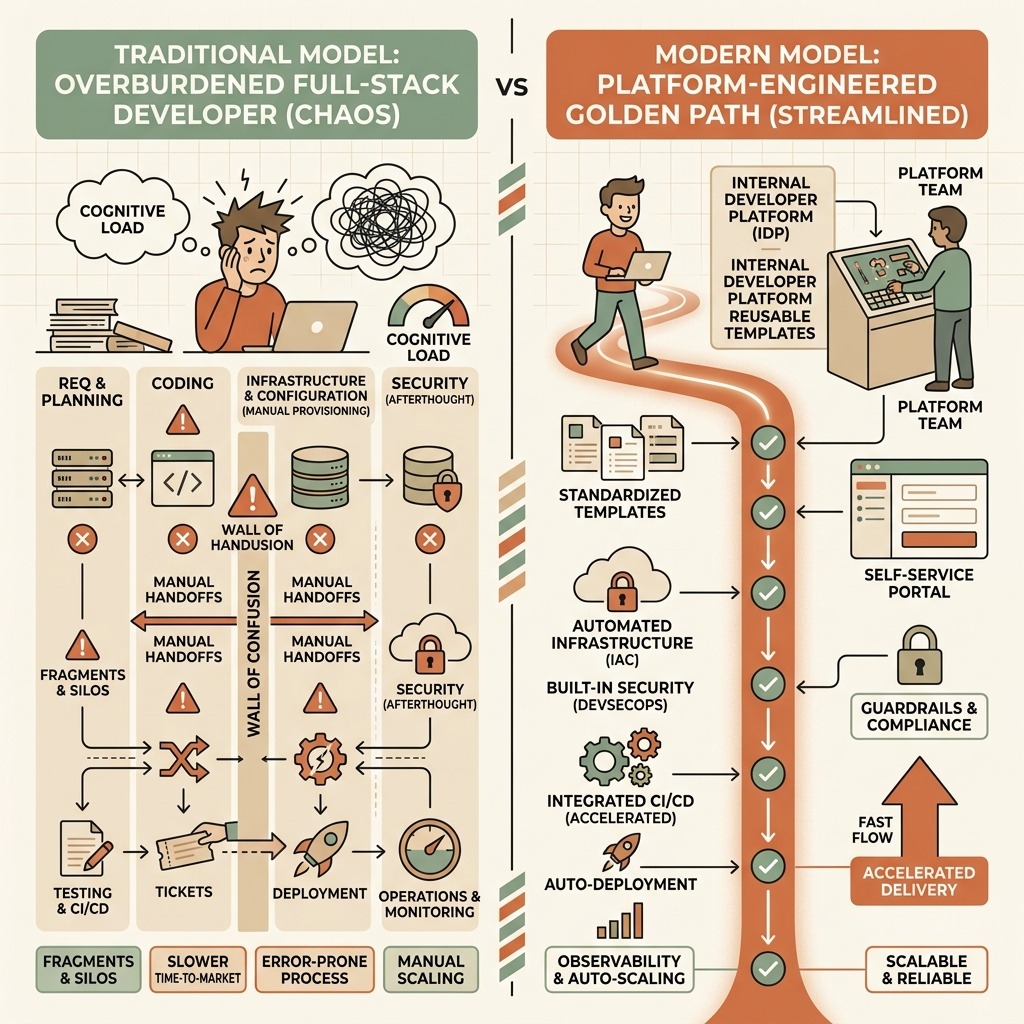
Platform Engineering emerged as a direct response to this cognitive overload. Instead of requiring every developer to become a DevOps expert, platform engineering teams treat developer experience (DX) as a product.
Their primary objective? Build an Internal Developer Platform (IDP) that encapsulates cloud infrastructure, security guardrails, and compliance into self-service "Golden Paths."
What is a "Golden Path"?
A Golden Path (or Golden Road) is an automated, self-service, pre-architected workflow provided by the platform team.
Instead of an application developer writing 400 lines of YAML manifests and configuring AWS resources manually, they execute a simple command or use a developer portal UI:
# Example: Provisioning a production-ready microservice with a Golden Path CLI
platform-cli create service \
  --name payment-gateway \
  --runtime nodejs-20 \
  --database postgres-managed \
  --environment production
Under the hood, the IDP automatically provisions:
- A secure, isolated PostgreSQL database with automated backups and rotation.
- A Kubernetes deployment spec with automatic scaling rules and health probes.
- A GitOps CI/CD pipeline integrated with vulnerability scanning.
- Default Datadog/Prometheus dashboards and alerting rules.
The developer gets a production-grade service running in minutes without ever writing a line of Terraform or managing IAM policies.
Architecture of an Internal Developer Platform (IDP)
Modern platform teams build IDPs by layering internal abstractions over complex cloud infrastructure. Here is how a typical 2026 IDP is structured:
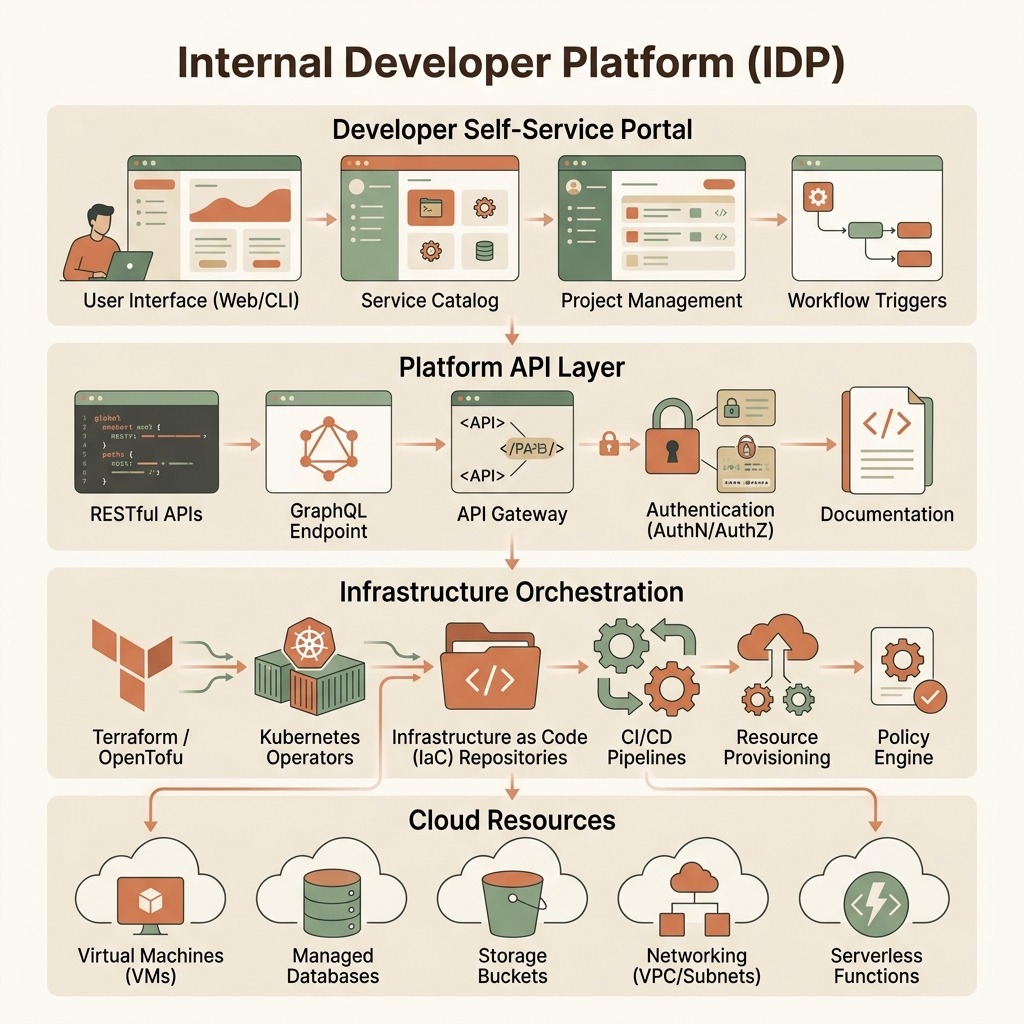
An IDP typically consists of four main operational layers:
1. Developer Self-Service Portal (Interface Layer)
Tools like Spotify Backstage, Port, or custom internal web consoles give developers a single pane of glass. Engineers can view service catalogs, API documentation, deployment status, and provision new resources with one click.
2. Platform API & Control Plane (Integration Layer)
This layer translates developer requests into infrastructure configurations. It handles authentication, role-based access control (RBAC), and policy enforcement (e.g., ensuring no public S3 buckets are ever created).
3. Infrastructure Orchestration (Execution Layer)
Tools like Terraform, OpenTofu, Crossplane, and Kubernetes Operators dynamically create and manage physical or cloud resources based on platform templates.
4. Cloud Infrastructure & Service Mesh (Foundation Layer)
The underlying cloud providers (AWS, GCP, Azure), bare-metal servers, database clusters, and networking backbones (Istio, Linkerd, Cilium eBPF).
Is Full-Stack Really Dead? The Rise of Product Engineering
So, is full-stack development dead?
Not quite. Instead of dying, full-stack is splitting and evolving into two specialized, highly valued disciplines:
| Dimension | Product Engineer | Platform Engineer |
|---|---|---|
| Primary Focus | User experience, business logic, feature delivery | Internal developer tooling, infrastructure, reliability |
| Primary Customers | External end-users and customers | Internal software developers and engineering teams |
| Core Skillsets | React/Vue, Next.js, Web APIs, DB querying, UX design | Kubernetes, Terraform, Go/Python, CI/CD, eBPF, IAM |
| Key Metric | Product engagement, feature velocity, conversion rate | Lead time to production, deployment frequency, MTTR |
| Cognitive Surface | Application domain and user flows | Infrastructure scalability and platform abstractions |
Product Engineers still work across the frontend and backend domain logic, but they are freed from managing infrastructure pipelines. Platform Engineers build the internal tools, APIs, and guardrails that make Product Engineers 10x more productive.
What This Shift Means for Engineering Job Interviews in 2026
If you are preparing for software engineering interviews, this industry shift changes what interviewers look for:
- System Design is Evolving: Senior system design interviews no longer stop at "draw a load balancer and a database." Candidates are evaluated on how they design clean API contracts, manage service boundaries, enforce security guardrails, and build resilient microservice architectures.
- Emphasis on Developer Velocity & Tooling: Companies value engineers who understand developer experience, automation, and operational hygiene.
- Clarity on Role Specialization: When interviewing, ask clarifying questions about team structure. Is the team expecting you to manage raw Kubernetes clusters yourself, or do they have an established platform engineering group?
Navigating these modern architectural discussions in high-stakes technical interviews can be intimidating. That is why practicing realistic scenarios is essential.
At totop.app, engineers use interactive AI-driven mock interviews to practice system design, platform engineering concepts, and full-stack coding challenges with real-time feedback from persona-driven AI interviewers. Whether you are aiming for a Senior Product Engineer or Platform Architect role, honing your verbal explanations and architectural trade-offs builds the confidence needed to stand out.
Conclusion: Embrace the Golden Path
Full-stack development isn't dead—it's finally scaling up.
By offloading cloud complexity to Platform Engineers and Internal Developer Platforms, software organizations are enabling Product Engineers to do what they do best: solve business problems and deliver incredible software experiences to users.
If you're currently overwhelmed trying to master every cloud tool under the sun, take a step back. Focus deeply on core software design principles, master your domain, and embrace the golden paths paved by platform engineering.
Preparing for your next tech interview? Practice system design, coding algorithms, and behavioral scenarios with realistic AI interviewers at totop.app.
Practice DevOps Specialist Questions Live with AI Mock Interviews
Turn any job description across Engineering, DevOps, Data, Marketing, Sales, Finance, or HR into a personalized test and live voice or text AI mock interview on totop.app, or test your speed right now in the 60-Second DevOps Specialist Blitz.
Play 60s DevOps Specialist Blitz (Free, No Login) | Start 14-Day Free Trial | Browse All Interview Guides