Dealing With Interview Anxiety: A Developer's Guide
Have you ever sat in front of your screen, watching the cursor blink in a blank CoderPad, while your heart hammered against your ribs like a drum?
You look at the prompt. It asks you to invert a binary tree or find the longest palindromic substring—something you solved on LeetCode just two nights ago without breaking a sweat. But right now, with two engineers quietly watching your every keystroke through a webcam, your mind is a complete void. Your palms feel cold, your vision narrows, and the only thought looping in your head is: I forgot how a for-loop works. They know I'm a fraud.
If this sounds uncomfortably familiar, take a deep breath. You are not broken, you are not a bad programmer, and you are definitely not alone.
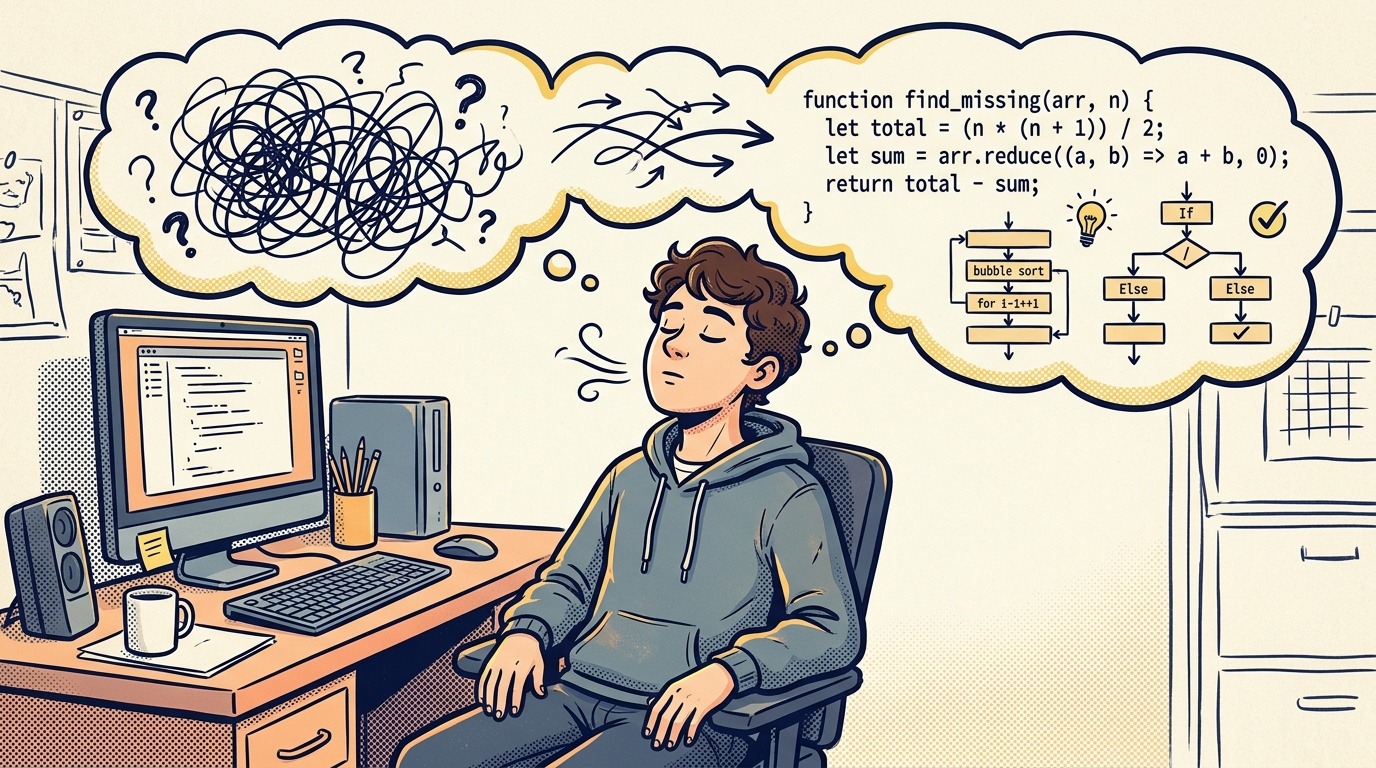
Interview anxiety is one of the best-kept secrets in tech. We celebrate offer letters on LinkedIn and swap stories about clever system design optimizations, but rarely do we talk about the paralyzing panic that strikes even senior engineers when put on the spot.
Technical interviews are an artificial pressure cooker. They take a solitary, highly iterative craft—writing code with Google, docs, and stack traces—and turn it into a high-stakes live performance.
The good news? Anxiety isn't a character flaw you have to eliminate. It is a predictable physiological reaction that you can manage, hack, and deconstruct using structured engineering tools.
1. The Neuroscience of Going Blank: The Amygdala Hijack
To defeat interview anxiety, you first need to understand what is happening under the hood of your nervous system.
When you enter a high-pressure technical screen, your brain perceives the evaluation as a threat to your social standing, livelihood, and self-worth. In response, an almond-shaped cluster of nuclei called the amygdala sounds the alarm, triggering an evolutionary fight-or-flight response.
[Threat: Live Technical Evaluation]
              │
              ▼
    [Amygdala Triggers Alarm]
              │
              ▼
   [Adrenaline & Cortisol Surge]
              │
   ┌──────────┴────────────────┐
   ▼                           ▼
[Heart Rate Spikes]   [Working Memory (Prefrontal Cortex) Drops ~50%]
   │                           │
   └──────────┬────────────────┘
              ▼
    ["Brain Freeze" / Blanking Out]
When adrenaline and cortisol flood your system:
- Your blood moves to your large muscle groups (preparing you to run), leaving your hands cold and stiff on the keyboard.
- Your prefrontal cortex slows down. This is the exact brain region responsible for logical reasoning, working memory, and algorithmic problem-solving.
- Your working memory capacity drops by up to 50%. You literally have fewer mental "registers" available to hold variable states and loop conditions.
You aren't forgetting how to code; your brain is simply prioritizing physical survival over syntax. Understanding this biological fact is your first superpower: when your heart starts racing, don't interpret it as proof that you are failing. It's just your biology revving up for high performance.
2. The Two Paths: Panic Spiral vs. The Grounded Engineer
When interview anxiety hits, developers typically split into two distinct behavioral patterns. Recognizing these tendencies is the first step toward correcting them.
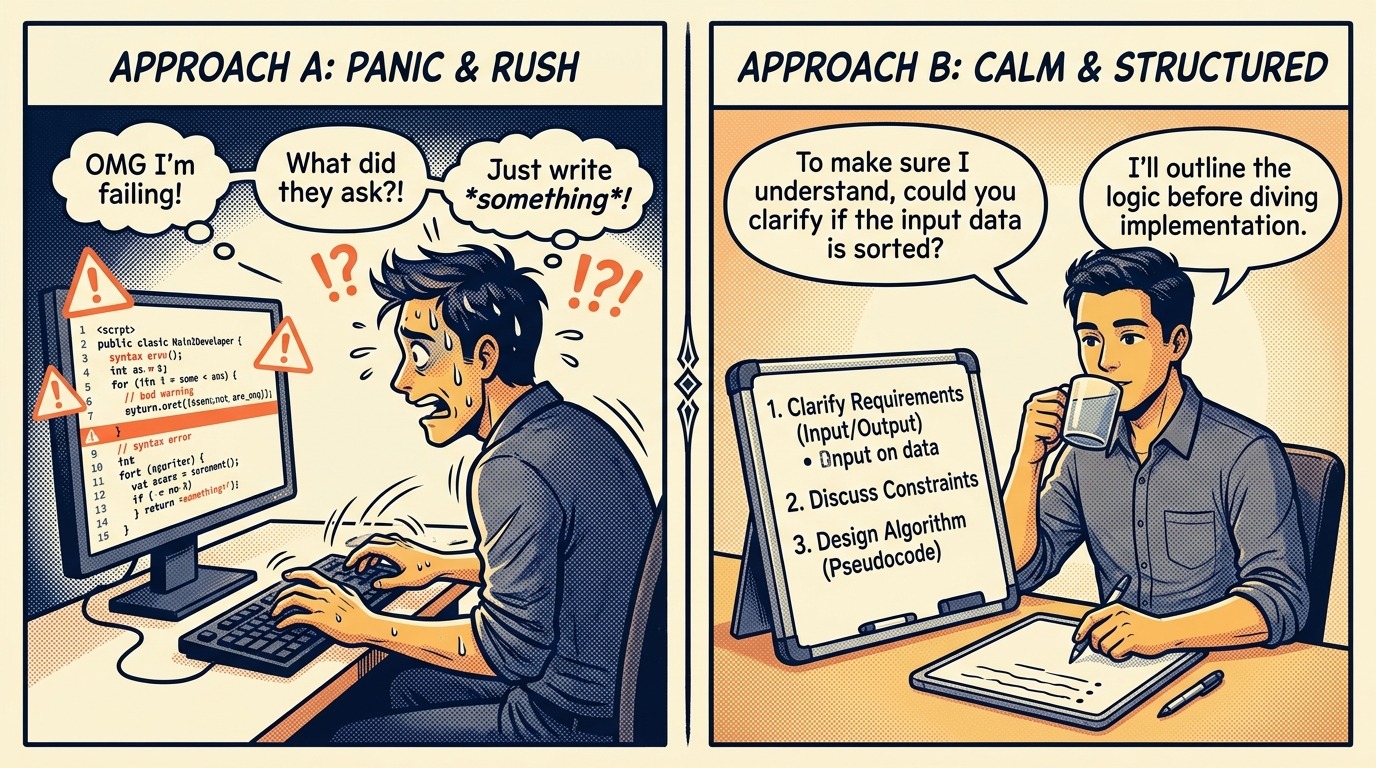
Approach A: The Panic Spiral
When anxiety takes the wheel, candidates make predictable panic-induced errors:
- Rushing into code: Driven by the urge to prove competence immediately, they start typing functions before fully understanding the problem constraints.
- Falling into uncomfortable silence: When they get stuck, they go quiet for 5–10 minutes, frantically staring at the screen while the interviewer wonders if the call dropped.
- Syntax paralysis: They obsess over whether a language helper is
Array.prototype.sliceorsplice, losing track of high-level algorithmic architecture. - Catastrophizing: A single compiler error feels like total disqualification, triggering an internal spiral of self-doubt.
Approach B: The Grounded Engineer
The grounded engineer feels the exact same adrenaline surge, but they redirect that energy into deliberate, structured communication:
- Pausing to regulate: They take a sip of water and a slow breath before saying a word.
- Buying cognitive bandwidth: They ask clarifying questions to give their prefrontal cortex time to reboot.
- Externalizing thought onto scratchpads: Instead of juggling five variables in their head, they write down sample test cases and ASCII diagrams.
- Treating the interviewer as a collaborator: They treat the interview as an architectural brainstorm with a peer rather than an oral exam.
3. The Developer's 4-Step Emergency Grounding Protocol
When you feel panic creeping in mid-interview, you don't need vague motivational quotes—you need a deterministic algorithm. Here is the 4-step emergency grounding protocol you can execute in real time.
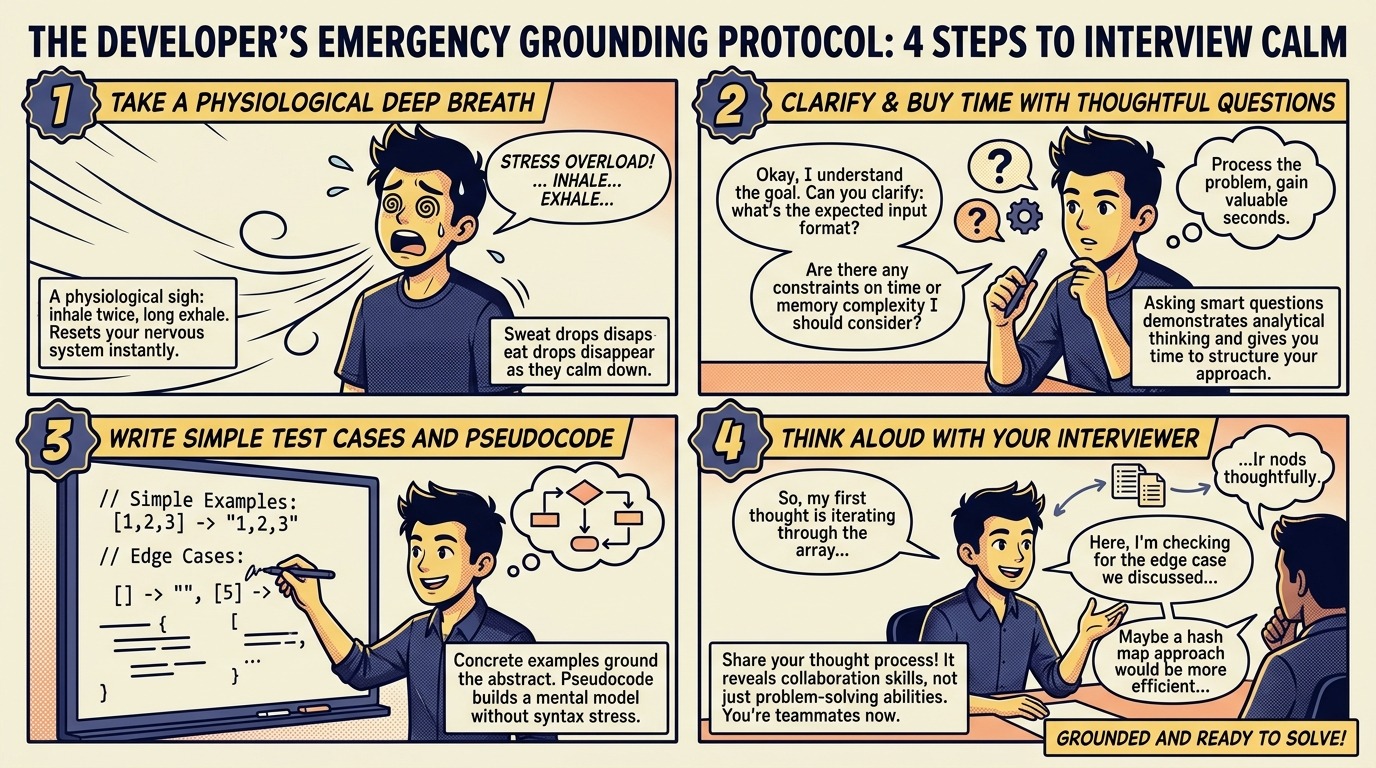
Step 1: The Physiological Reset (The Double-Inhale Sigh)
Before you touch the keyboard, activate your parasympathetic nervous system using what neuroscientists call the physiological sigh:
- Take two quick, consecutive inhales through your nose (one deep breath in, followed immediately by a short top-off sniff).
- Release a long, slow exhale through your mouth.
- Repeat twice.
This rapid breathing mechanic collapses and reinflates the alveoli in your lungs, expelling carbon dioxide and triggering an immediate drop in heart rate within 10 to 15 seconds. You can do this subtly while looking at the prompt without the interviewer noticing.
Step 2: The Cognitive Buffer (Scripted Pauses)
Silence during an interview feels agonizingly long—ten seconds of thinking feels like ten minutes of failure. Overcome this by using pre-scripted phrases that buy you 30–60 seconds of processing time while making you sound methodical and senior:
"That's a fascinating problem. Let me take 30 seconds to write down our input types, expected output, and edge cases so we are completely aligned before diving into code."
"Before I write any logic, I want to clarify a few constraints: is the input stream bounded in memory, or should we optimize for streaming performance?"
These questions do double duty: they reassure the interviewer that you are thorough, and they give your working memory the buffer it needs to come back online.
Step 3: Scaffold with Pseudocode and Test Cases
Never jump straight into raw syntax when your anxiety is elevated. Abstract syntax errors only amplify stress. Instead, ground your thoughts in concrete test cases:
// Step 1: Define concrete input and expected output
// Input:  [2, 7, 11, 15], target = 9
// Output: [0, 1] (indices of 2 and 7)

// Step 2: Identify edge cases
// - Empty array or single element -> return empty array
// - Negative numbers -> can target be negative?
// - No valid pair found -> return null or []

// Step 3: Write plain English pseudocode
// 1. Initialize a hash map to store: { value: index }
// 2. Iterate through each number in the array
// 3. Calculate complement = target - current_number
// 4. If complement exists in map, return [map[complement], current_index]
// 5. Otherwise, record current_number and its index in map
By writing plain-English comments first, you decouple logic design from syntax execution. If your mind stumbles on syntax later, the entire blueprint is already staring back at you in the editor.
Step 4: Narrate Your Thought Process Out Loud
When anxiety peaks, our instinct is to retreat inside our heads. Force yourself to externalize your internal monologue:
- "Right now, my first instinct is a brute-force nested loop, which would take O(n²) time. Let's see if we can bring that down to O(n) by using extra memory."
- "I'm considering whether a two-pointer approach works here, but since the array isn't sorted, sorting would cost O(n log n). Let's explore a hash table lookup first."
Interviewers are not evaluating whether you are an omniscient compiler; they are evaluating what it is like to debug a critical production incident with you on a Tuesday afternoon. When you think aloud, you give them the opportunity to steer you back on track if you make a wrong turn.
4. Pre-Interview Conditioning: Building Psychological Armor
Managing anxiety during the interview is crucial, but lowering your baseline anxiety before the call begins is where long-term confidence is built.
The 24-Hour Cramming Ban
One of the most common mistakes engineers make is grinding 15 LeetCode hard problems until 2:00 AM the night before a final round. Cramming does not teach you new algorithms at the eleventh hour; it only inflates cortisol and signals to your brain that you are under-prepared.
- 24 hours before: Stop solving new problems. Review a one-page cheat sheet of core patterns (Two Pointers, Sliding Window, BFS/DFS, Hash Maps).
- Morning of the interview: Do not solve challenging algorithmic puzzles. Instead, warm up your fingers by typing out a simple, familiar function (like reversing a linked list or binary search) in 5 minutes just to get into the physical rhythm.
De-Catastrophize the Outcome
Ask yourself: What is the absolute worst realistic outcome of this interview?
- You don't know the answer.
- You get rejected.
- You feel embarrassed for 24 hours.
- You wake up tomorrow, make coffee, and apply to three other companies.
An interview rejection is not a referendum on your intelligence, your career trajectory, or your worth as an engineer. It is merely a noisy 45-minute sample of performance on a specific problem under artificial conditions.
       [45-Minute Coding Interview]
                   │
                   ▼
       [High Variance / Noise]
 ┌─────────────────┴─────────────────┐
 ▼                                   ▼
[Offers & Praise]            [Rejections & Mismatches]
 │                                   │
 └─────────────────┬─────────────────┘
                   ▼
 [Consistent Long-Term Engineering Growth]
Low-Stakes Simulation Practice
Anxiety thrives on the unknown. If the only time you practice speaking out loud under time pressure is during real, high-stakes company interviews, your nervous system will always default to fight-or-flight.
To inoculate yourself against panic, you need low-stakes practice environments. Platforms like totop.app allow you to simulate realistic, role-specific technical and behavioral interviews using adaptive AI agents. Practicing with an interactive agent lets you build genuine muscle memory—making mistakes, practicing physiological resets, and articulating architectural trade-offs without the fear of burning real job opportunities.
5. What to Do When You Truly Don't Know the Answer
Even with great preparation, you will eventually encounter a question that completely stumps you. Here is how to navigate that moment gracefully:
- Be honest without being helpless: Never say "I don't know this, I give up." Instead, say: "I haven't implemented this specific algorithm in production recently, but let me reason through the core constraints and see how we can construct a reasonable approach."
- Break it down into what you do know: If asked to design a distributed rate limiter and you don't know Token Bucket internals, start with a simple in-memory counter with timestamps, then discuss the challenges of distributing it across multiple nodes.
- Ask for hints strategically: Asking for a hint isn't failure—it's collaboration. Try: "I'm weighing between using a heap or a balanced BST for priority ordering here. Is there a particular constraint on update frequency I should optimize for?"
Summary Checklist: Your Pre-Interview Routine
Before your next technical interview, run through this quick pre-flight checklist:
| Timing | Action Item | Goal |
|---|---|---|
| 24h Prior | Close LeetCode & stop cramming | Lower cortisol & rest working memory |
| 1h Prior | Hydrate, step away from screens, do 5 min of light stretching | Release physical tension |
| 15m Prior | 3 rounds of physiological sighs (double inhale, long exhale) | Activate parasympathetic state |
| 0m (Start) | Have water, notebook, and pen ready at your desk | Externalize memory & buy time |
| During | Clarify constraints → Pseudocode → Think aloud | Turn interrogator into collaborator |
Anxiety does not mean you cannot succeed. In fact, caring deeply about your craft is what makes you a great engineer in the first place. Tame the physiology, trust your preparation, and remember: it's just two engineers talking about code. You've got this.