Concurrency represents the hallmark differentiator of Go. While traditional systems languages treat multi-threading as an OS abstraction wrapped in heavy kernel threads and lock hierarchies, Go builds concurrency primitives directly into its runtime. When engineering teams interview backend candidates, Go concurrency serves as a decisive technical filter. Interviewers test whether an engineer understands runtime mechanics, memory footprints, scheduling internals, and failure modes under production load.
A successful golang concurrency goroutines channels interview requires balancing theoretical elegance with real-world failure analysis. This guide examines how the Go runtime coordinates execution, outlines the architectural trade-offs between channels and traditional synchronization primitives, walks through common debugging scenarios, and provides the rubric engineering hiring committees use to evaluate candidates.
1. The Core Philosophy: CSP vs Shared-Memory Concurrency
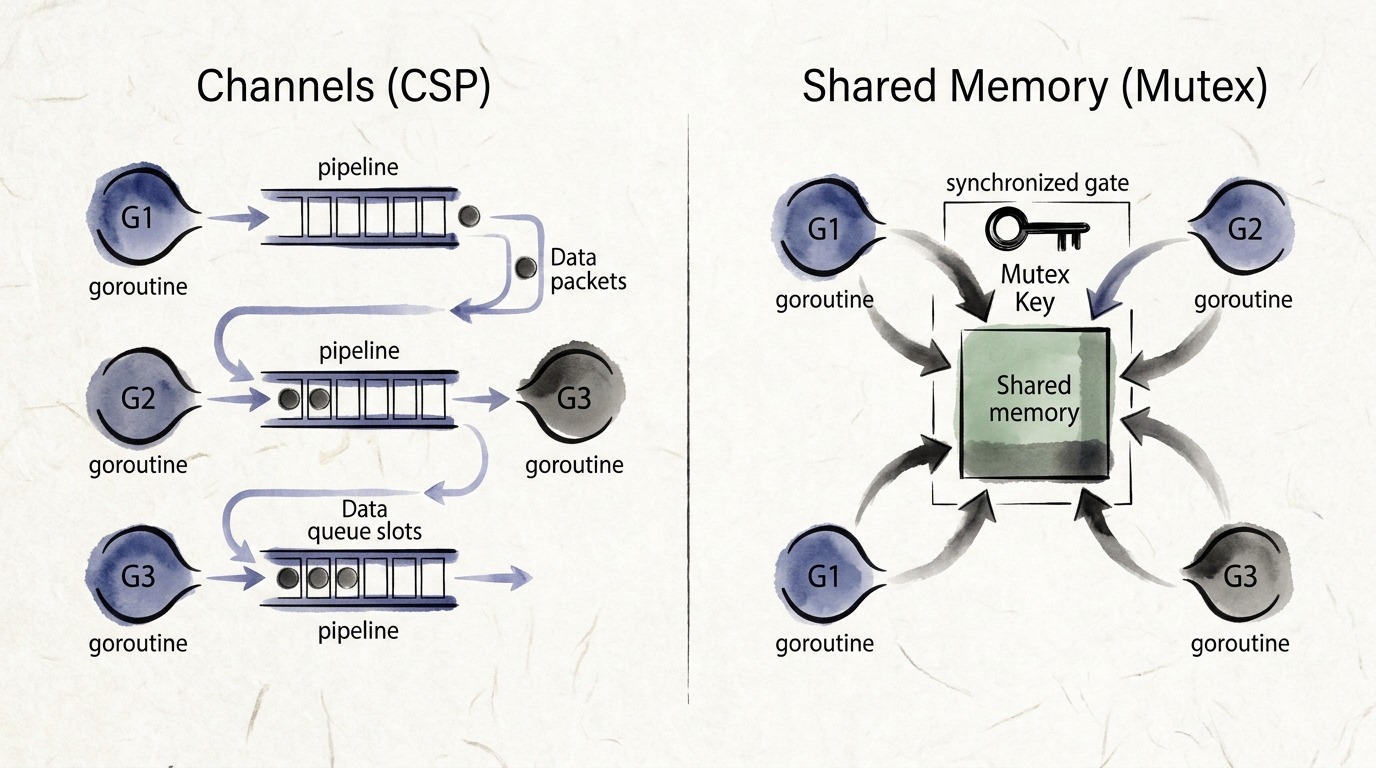
Go adopts Tony Hoare’s formal model of Communicating Sequential Processes (CSP). The foundational aphorism embedded within the Go community summarizes this approach:
"Do not communicate by sharing memory; instead, share memory by communicating."
Traditional multi-threaded environments rely on shared-memory synchronization, using mutual exclusion locks (sync.Mutex), read-write locks (sync.RWMutex), or atomic instructions (sync/atomic) to prevent data races. While performant for localized state mutations, shared-memory models place the burden of correctness entirely on the engineer: forgotten locks corrupt state, while nested locking risks deadlocks.
In contrast, CSP models treat concurrency as independent sequential computational routines that communicate strictly via typed conduits known as channels. When one goroutine passes data across a channel, it transfers operational ownership of that data. This structural isolation minimizes shared state and eliminates large classes of data races.
Senior interviewers expect candidates to avoid dogmatic answers. Go provides both communication primitives (channels) and shared-memory synchronization primitives (sync.Mutex, sync.WaitGroup, sync/atomic). A seasoned engineer knows precisely when to apply each model.
2. Under the Hood: Goroutines and the GMP Scheduler
When an interviewer asks "What happens when you spawn a goroutine?", they are testing knowledge of memory footprints and scheduling architecture.
Memory Overhead: Stack Allocation
Operating system threads typically allocate a fixed, contiguous stack between 1 MB and 8 MB. Spawning 10,000 OS threads would consume tens of gigabytes of virtual memory, triggering OS thrashing.
A goroutine begins with a compact 2 KB stack. As call stacks deepen, the runtime automatically doubles stack allocation, copying existing frames and releasing the previous block. During garbage collection, the runtime shrinks unused stacks, allowing a single process to execute hundreds of thousands of concurrent goroutines concurrently.
The M:N Work-Stealing Scheduler (The GMP Model)
Go multiplexes M user-space goroutines across N kernel threads using its GMP scheduler:
- G (Goroutine): Contains the call stack, instruction pointer, and scheduling state (runnable, running, waiting).
- M (Machine): An operating system thread created and managed by the OS kernel.
- P (Processor): A logical execution context representing resources required to execute Go code. The count of active
Pstructures defaults toruntime.GOMAXPROCS, matching the available CPU cores.
Each processor (P) maintains a Local Run Queue holding up to 256 runnable goroutines. The scheduler executes without global lock contention by allowing each OS thread (M) associated with a processor (P) to pop tasks directly from its local queue.
When a local run queue empties, the scheduler initiates work-stealing:
- It checks the Global Run Queue (polled every 61 ticks to prevent starvation).
- If empty,
Pattempts to steal half the runnable goroutines from another processor's local queue. - If no work exists,
Mdisassociates fromPand enters a sleeping thread pool to conserve CPU resources.
When a goroutine executes a blocking system call (such as file I/O or network reads), the runtime detaches the blocked thread (M) from its processor (P). The processor binds to an idle thread from the pool, continuing the execution of remaining goroutines uninterrupted.
3. Channels: Architecture, Mechanics, and State Truth Table
Channels provide the typed synchronization conduits connecting goroutines. In the Go runtime, a channel is a pointer to an hchan struct allocated on the heap.
Internal Anatomy of the hchan Struct
Underneath make(chan T, bufferSize), hchan coordinates thread-safe queuing:
buf: A circular ring buffer array storing buffered elements.qcount&dataqsiz: Current item count and total buffer capacity.sendx&recvx: Buffer indices tracking enqueue and dequeue positions.recvq&sendq: Doubly linked lists of blocked goroutines waiting to receive or send, stored assudogstructs.lock: An internal mutex protecting all fields insidehchan.
Because channel operations internally acquire a spinlock, channels are not lock-free data structures. They provide synchronization semantics wrapped around thread-safe queue management.
The Channel State Matrix
A common interview question examines the behavior of channel operations across different lifecycle states:
| Channel State | Operation | Runtime Behavior |
|---|---|---|
nil | Send (ch <- x) | Blocks forever (goroutine hangs indefinitely) |
nil | Receive (<-ch) | Blocks forever (goroutine hangs indefinitely) |
nil | Close (close(ch)) | Panics (panic: close of nil channel) |
| Open (Unbuffered) | Send | Blocks until a paired goroutine executes receive |
| Open (Unbuffered) | Receive | Blocks until a paired goroutine executes send |
| Open (Buffered) | Send (Full) | Blocks until another routine reads an element |
| Open (Buffered) | Send (Available) | Enqueues element immediately without blocking |
| Open (Buffered) | Receive (Empty) | Blocks until an element is sent |
| Open (Buffered) | Receive (Available) | Dequeues element immediately without blocking |
| Closed | Send (ch <- x) | Panics (panic: send on closed channel) |
| Closed | Receive (Buffered items) | Yields remaining items; then zero-value, ok == false |
| Closed | Close (close(ch)) | Panics (panic: close of closed channel) |
Reading from a closed channel never blocks. Once buffered elements are exhausted, it returns the typed zero-value with ok == false (val, ok := <-ch). This mechanic provides a reliable broadcast shutdown signal across multiple consumer goroutines.
4. Architectural Trade-Offs: Channels vs sync.Mutex
One of the most frequent backend interview questions focuses on choosing between channels and mutexes:
| Dimension | Channels (chan T) | Mutexes (sync.Mutex, sync.RWMutex) |
|---|---|---|
| Primary Use Case | Streaming data pipelines, event dispatching, task delegation | In-memory cache updates, counter increments, internal struct state |
| Ownership Model | Explicit transfer of data ownership | Shared access guarded by temporal locks |
| Performance Overhead | Allocations, hchan lock, memory copying, sudog suspension | Minimal overhead via hardware atomic CAS instructions |
| Coordination | Native support via select, timeouts, fan-in/fan-out | Manual coordination requiring multiple mutexes or sync.Cond |
| Backpressure | Built-in via bounded buffer limits | Requires custom signaling logic |
| Shutdown Signal | Broadcast notification via close(ch) | Requires external atomic boolean flags |
Pragmatic Decision Rules
- Choose channels when passing data ownership between independent stages, building producer-consumer worker pools, or managing operation timeouts alongside
context.Done(). - Choose mutexes when protecting internal struct fields, updating shared caches, or aggregating metrics where nanosecond latency is paramount.
Balancing these primitives mirrors broader distributed systems trade-offs explored in REST vs gRPC vs GraphQL system design and rate limiting algorithms for system design.
5. Production Failure Scenarios & Debugging Walkthroughs
Technical interviewers frequently ask candidates to diagnose concurrency bugs in production code snippets.
Scenario 1: The Silent Goroutine Leak
Consider an HTTP handler querying multiple upstream mirrors concurrently to return the fastest response:
// ANTI-PATTERN: Leaks goroutines on early return
func QueryFastestMirror(ctx context.Context, mirrors []string) string {
    resultCh := make(chan string) // Unbuffered channel

    for _, mirror := range mirrors {
        go func(m string) {
            resp, err := http.Get(m)
            if err == nil && resp.StatusCode == http.StatusOK {
                resultCh <- m // Blocks indefinitely for losing routines!
            }
        }(mirror)
    }

    return <-resultCh // Reads first response and returns
}
Production Impact
Because resultCh is unbuffered, the main goroutine reads the first response and exits. The remaining goroutines finish their network calls and block indefinitely on resultCh with no receiver listening. They retain their memory stacks and socket descriptors until the host suffers an out-of-memory crash.
Production Resolution
Sizing the buffer to the number of workers ensures non-blocking sends:
// PRODUCTION-READY: Bounded buffer prevents goroutine blocking
func QueryFastestMirrorSafe(ctx context.Context, mirrors []string) string {
    if len(mirrors) == 0 {
        return ""
    }
    resultCh := make(chan string, len(mirrors))

    for _, mirror := range mirrors {
        go func(m string) {
            req, err := http.NewRequestWithContext(ctx, http.MethodGet, m, nil)
            if err != nil {
                return
            }
            resp, err := http.DefaultClient.Do(req)
            if err == nil && resp.StatusCode == http.StatusOK {
                resp.Body.Close()
                resultCh <- m
            }
        }(mirror)
    }

    select {
    case res := <-resultCh:
        return res
    case <-ctx.Done():
        return ""
    }
}
Scenario 2: Resilient Worker Pool with Graceful Cancellation
Senior candidates should readily implement a worker pool that handles task streams, respects context timeouts, and avoids data loss during shutdown:
package main

import (
	"context"
	"fmt"
	"sync"
)

type Job struct {
	ID    int
	Input string
}

type Result struct {
	JobID  int
	Output string
}

func Worker(ctx context.Context, id int, jobs <-chan Job, results chan<- Result, wg *sync.WaitGroup) {
	defer wg.Done()
	for {
		select {
		case <-ctx.Done():
			return
		case job, ok := <-jobs:
			if !ok {
				return
			}
			res := Result{JobID: job.ID, Output: fmt.Sprintf("Worker %d finished job %d", id, job.ID)}
			select {
			case results <- res:
			case <-ctx.Done():
				return
			}
		}
	}
}

func RunWorkerPool(ctx context.Context, numWorkers, taskCount int) []Result {
	jobs := make(chan Job, taskCount)
	results := make(chan Result, taskCount)
	var wg sync.WaitGroup

	for w := 1; w <= numWorkers; w++ {
		wg.Add(1)
		go Worker(ctx, w, jobs, results, &wg)
	}

	for j := 1; j <= taskCount; j++ {
		jobs <- Job{ID: j, Input: fmt.Sprintf("task-%d", j)}
	}
	close(jobs) // Signal workers that no new jobs will arrive

	go func() {
		wg.Wait()
		close(results) // Close results once all workers exit
	}()

	var outputs []Result
	for res := range results {
		outputs = append(outputs, res)
	}
	return outputs
}
This pattern demonstrates key principles: producer-owned channel closure, consumer loop termination via ok == false, and coordinated result channel closure via sync.WaitGroup. Similar synchronization patterns are common across ecosystems, as seen in Java multithreading interviews and Python data structures and algorithms.
6. Senior Interview Scoring Rubric
Hiring committees score concurrency competencies against structured levels:
| Competency Area | Junior / Mid-Level Answer (L3/L4) | Senior Answer (L5) | Staff / Principal Answer (L6+) |
|---|---|---|---|
| Runtime Mechanics | Explains goroutines as lightweight threads with small stacks. | Details the 2 KB initial stack, dynamic growth, and GMP scheduler run queues. | Explains work-stealing heuristics, sysmon preemption, syscall detachment, and network poller integration. |
| Channels vs Mutexes | Recites general aphorisms; defaults exclusively to channels. | Compares cache locality and throughput; applies mutexes for local state and channels for pipelines. | Evaluates memory allocations in hchan, spinlock contention, and hardware cache coherence impacts. |
| Failure Modes | Identifies simple single-channel deadlocks. | Identifies goroutine leaks caused by unbuffered sends and missing cancellation checks. | Diagnoses subtle race conditions and leak patterns using -race testing and pprof heap and routine dumps. |
| Pipeline Architecture | Spawns unmanaged goroutines in open loops. | Builds bounded worker pools with sync.WaitGroup and buffered channels. | Architects end-to-end backpressure pipelines with graceful OS signal handling and cross-boundary context propagation. |
7. Strategic Interview Questions & Model Answers
Question 1: "Why does sending to a closed channel panic, but receiving succeeds?"
Model Answer:
Sending to a closed channel indicates an architectural fault: multiple actors are attempting to publish to a terminated pipeline, violating the single-producer contract. Panic enforces strict ownership.
Receiving from a closed channel succeeds because channels are FIFO queues. Consumers must be allowed to drain existing buffered items. Once empty, receiving returns the zero-value with ok == false. This behavior enables a single close(ch) call to cleanly broadcast a termination signal to thousands of listening goroutines.
Question 2: "How do you detect and profile a goroutine leak in production?"
Model Answer:
In production, a goroutine leak presents as a steady upward climb in resident memory and active goroutine counts. Diagnosis follows three steps:
- Prometheus Monitoring: Track the
go_goroutinesgauge. Leaks show a persistent upward trend rather than normal workload oscillations. - pprof Live Dumps: Expose
net/http/pprofinternally and retrieve a goroutine stack snapshot viacurl http://localhost:6060/debug/pprof/goroutine?debug=2. - Stack Analysis: Identify stacks blocked at identical execution points (such as
runtime.goparkorruntime.chansend), highlighting unbuffered channels lacking receivers.
If an unexpected problem emerges during a live session, applying the systematic techniques in our guide on handling unknown interview questions gracefully ensures you articulate your problem-solving logic clearly.
8. Summary Checklist for Candidates
Verify your command of these fundamental concepts before interview day:
- Stack Allocation: Explain how Go dynamically expands 2 KB stacks using contiguous stack allocation.
- GMP Work-Stealing: Describe how logical processors (
P) steal runnable tasks from peer queues. - Channel State Table: State immediately the outcome of sending, receiving, or closing open, closed, or
nilchannels. - Data Ownership: Articulate when to use
sync.Mutexversuschanbased on memory mutation and pipeline flow. - Deterministic Teardown: Ensure every spawned goroutine has an exit condition tied to a bounded buffer or
context.Done(). - Race Detection: Explain how the Go race detector (
go test -race) identifies data races during test execution.
Systematic preparation requires verbalizing trade-offs in structured settings. Review our complete technical interview preparation roadmap for comprehensive round-by-round strategies.
Master Concurrency with Realistic AI Mock Interviews
Explaining concurrency trade-offs clearly to a hiring manager requires deliberate vocal practice.
Evaluate your technical reflexes with the 60-Second Job Blitz—test your real-time readiness across algorithmic and systems engineering questions in rapid-fire rounds.
When preparing for full-length technical rounds, explore totop.app's AI Mock Interview Plans to practice explaining concurrency models, system trade-offs, and production debugging scenarios with adaptive AI personas tailored to top-tier engineering standards.
Practice Staff Backend Engineer Questions Live with AI Mock Interviews
Turn any job description across Engineering, DevOps, Data, Marketing, Sales, Finance, or HR into a personalized test and live voice or text AI mock interview on totop.app, or test your speed right now in the 60-Second Staff Backend Engineer Blitz.
Play 60s Staff Backend Engineer Blitz (Free, No Login) | Start 14-Day Free Trial | Browse All Interview Guides