A Quick Interview Tip: The 5-Minute Rule That Doubles Your Success Rate
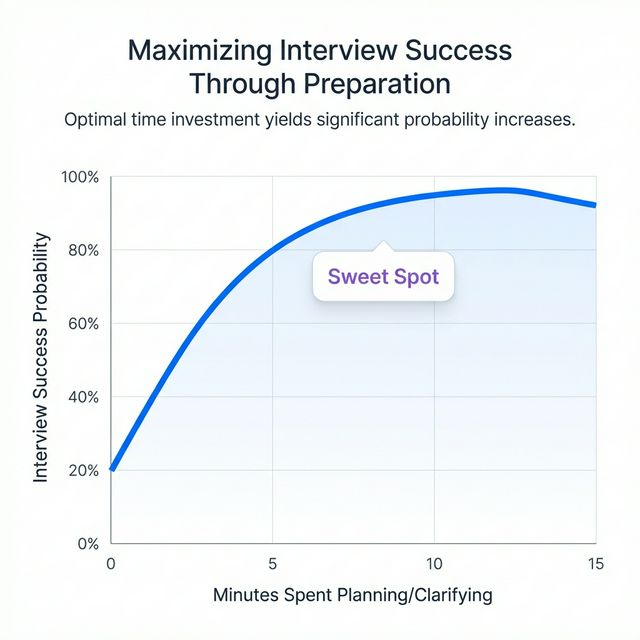
The Most Underrated Coding Interview Hack? Asking Questions.
I've seen hundreds of candidates jump straight into coding the moment they hear the problem. It feels productive, but it's often a trap. You run into a corner case 15 minutes in, realize your data structure choice was wrong, and have to start over with half the time remaining.
Top performers do something different. They spend the first 5-10 minutes just planning.
The 5-Minute Planning Phase
This isn't "wasted" time. It's an investment that pays off exponentially in your success rate. Here is what you should be doing instead of typing:
1. Clarify Constraints
Never assume. Ask specifically about the input:
- Input Size: Will it fit in memory? Is it a stream?
- Data Types: Are numbers integers or floats? Can they be negative?
- Uniqueness: Can the input contain duplicates?
2. Discuss Edge Cases
Show that you think about where code breaks.
- What happens if the input is empty or null?
- What if all elements are the same?
- What is the maximum possible value?
3. Agree on an Approach
Don't just start coding the first solution that comes to mind.
- "I could solve this with a brute force O(N^2) approach, but we can probably do better with a hash map."
- Agree with your interviewer on the algorithm before writing a single line of code.
Why This Works
It feels scary to not code for the first few minutes. But as the graph above shows, candidates who plan have a significantly higher success rate.
It is better to write the right code in 20 minutes than the wrong code in 40.
Next time you're in an interview, take a breath. Ask questions. Plan your attack. Then, and only then, start coding.
Want to practice this? Try a mock interview on totop.app today.