15 Essential TypeScript Interview Questions and Best Answers
Preparing for a frontend or full-stack interview? If the position involves modern web development, you are almost guaranteed to face TypeScript interview questions. TypeScript has become the standard for writing scalable, robust JavaScript applications, and employers want to know you understand its core features, not just how to append : any to variables.
In this guide, we dive into the most common and tricky TypeScript interview questions you might encounter, along with clear, actionable answers to help you ace your next technical interview on totop.app!
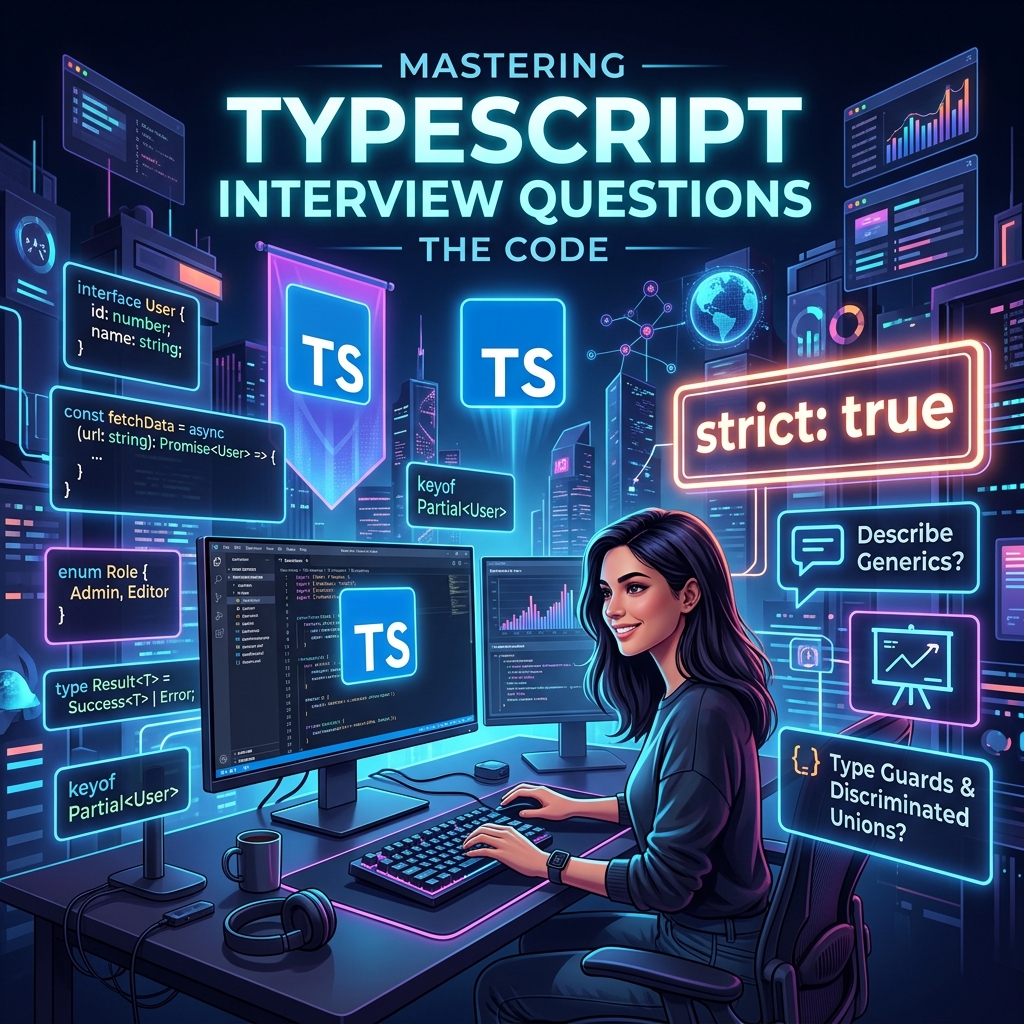
Why TypeScript?
Before jumping into specifics, let's understand why interviewers care about TypeScript. TypeScript is a superset of JavaScript that adds static typing. This helps catch errors at compile-time rather than runtime, improves code readability, and enhances IDE support (autocompletion, refactoring). Understanding the why is just as important as the how.
Beginner to Intermediate Questions
1. What are the key differences between interface and type in TypeScript?
Answer: Both interface and type can describe the shape of an object or a function signature. However, there are subtle differences:
- Extensibility: Interfaces are better suited for inheritance. They can be extended using the
extendskeyword. Types use intersections (&) to achieve similar merging. - Declaration Merging: Interfaces support declaration merging (typing the same interface multiple times merges them). Types do not.
- Primitives/Unions/Tuples: Types can represent primitive values, union types (
string | number), and tuples. Interfaces are strictly for object shapes.
Pro Tip: Use interface by default for object shapes and type for unions, intersections, and primitive aliases.
2. Can you explain what Generics are and why they are useful?
Answer: Generics allow you to write reusable, type-safe code that works with a variety of data types rather than a single one. It’s like a variable for types.
function identity<T>(arg: T): T {
    return arg;
}
let output1 = identity<string>("myString");
let output2 = identity<number>(100);
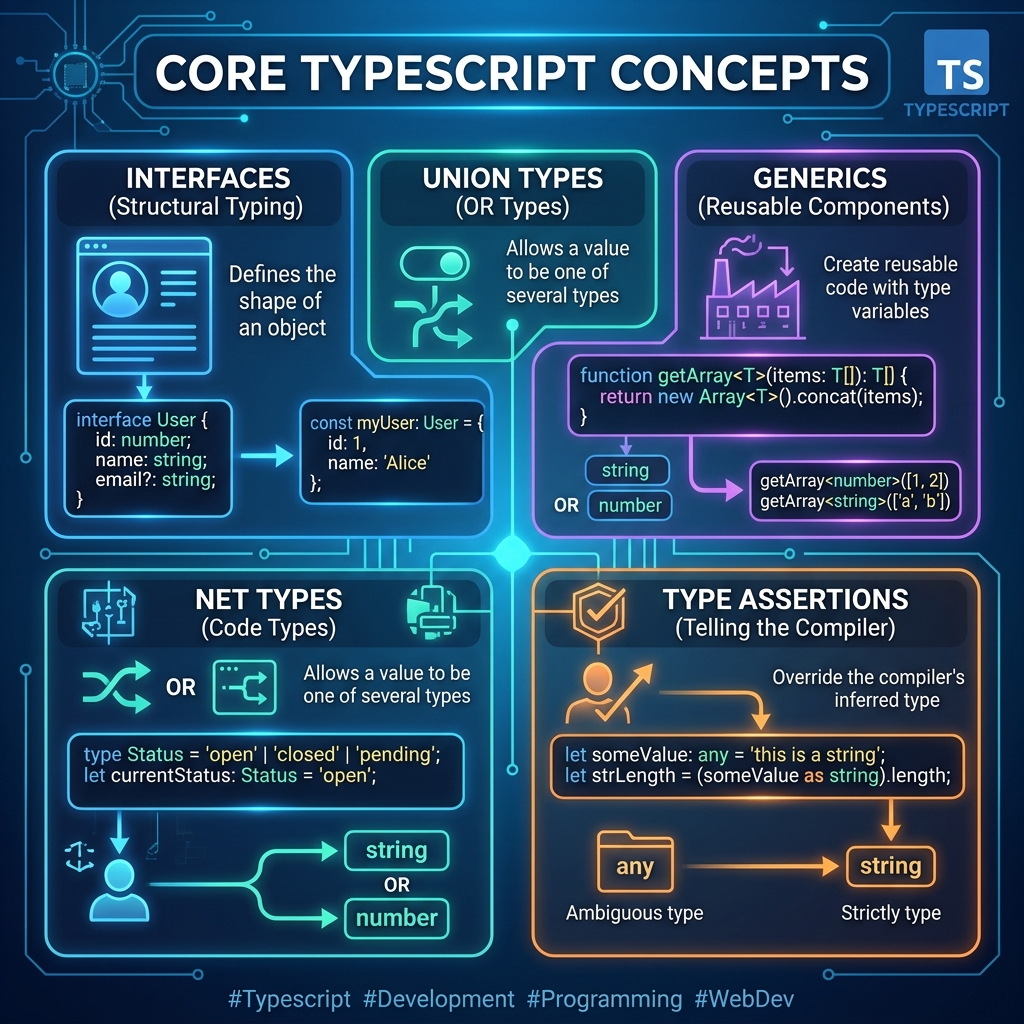
3. What is a Union Type?
Answer: A union type describes a value that can be one of several types. We use the vertical bar (|) to separate each type.
function printId(id: number | string) {
  console.log(`Your ID is: ${id}`);
}
4. What are Type Guards?
Answer: Type guards are mechanisms that allow you to narrow down the type of an object within a conditional block. TypeScript uses type guards to understand the specific type at runtime. Common type guards include typeof, instanceof, and custom type guard functions using value is Type.
function isNumber(x: any): x is number {
  return typeof x === "number";
}
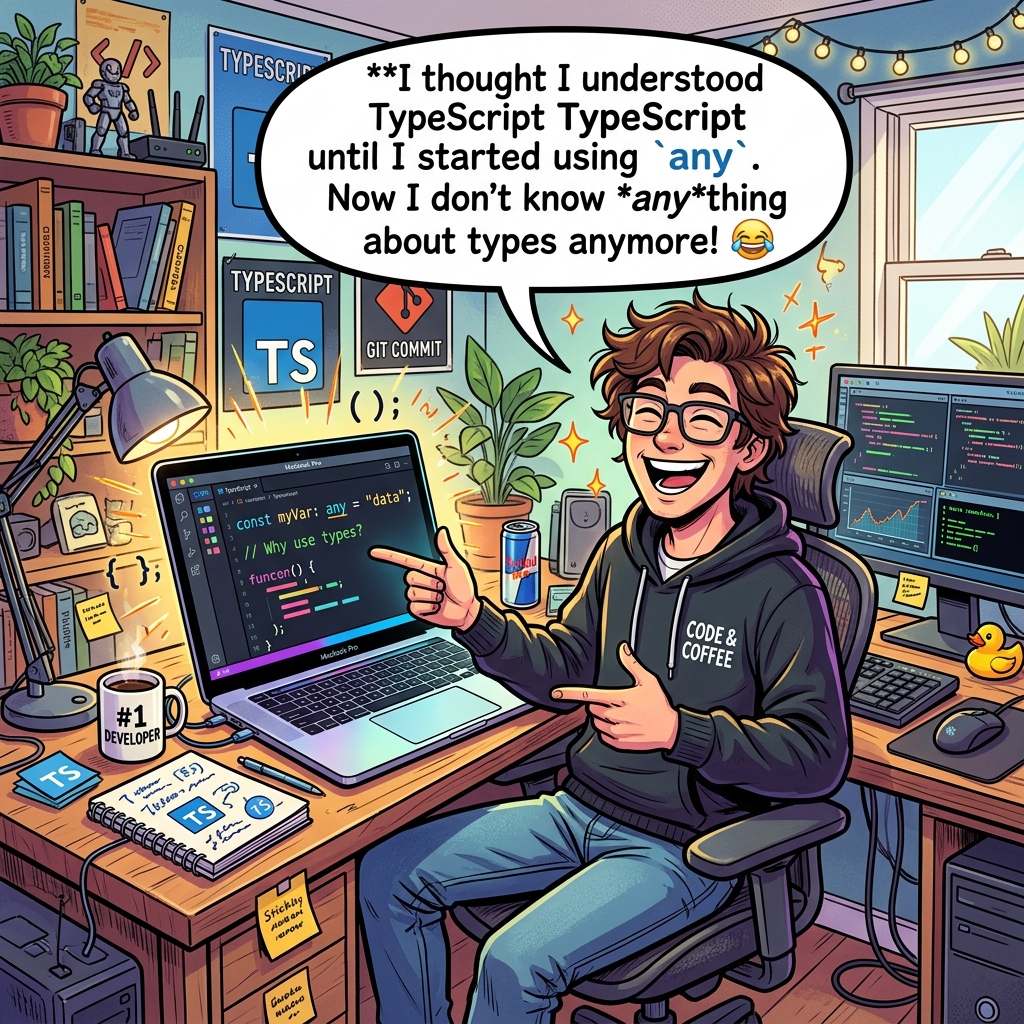 (Even the best of us rely on
 any when things get messy... but try not to do this in an interview!)
Advanced TypeScript Questions
5. What are Utility Types? Can you name a few?
To manipulate types globally without writing from scratch, TypeScript provides several built-in utility types:
Partial<T>: Makes all properties inToptional.Required<T>: Makes all properties inTrequired.Readonly<T>: Makes all properties inTread-only.Pick<T, K>: Creates a type by picking the set of propertiesKfromT.Omit<T, K>: Creates a type by removing propertiesKfromT.
6. What is the any type vs. the unknown type?
any: Turns off type checking for heavily dynamic or un-typed scenarios. It can be assigned to anything, and anything can be assigned to it. It destroys the benefits of TypeScript.unknown: It is the type-safe counterpart ofany. You can assign anything tounknown, but you cannot assignunknownto anything else (exceptanyandunknown) without a type assertion or type guard. It forces you to check the type before using it.
7. What is a conditional type in TypeScript?
Answer: Conditional types help describe the relationship between types, acting somewhat like an if statement for type definitions. They take the form T extends U ? X : Y.
type NonNullable<T> = T extends null | undefined ? never : T;
8. Explain the never type.
Answer: The never type represents the type of values that never occur. It's the return type for a function that always throws an exception or one that never returns (e.g., an infinite loop). It is useful for exhaustive type checking in switch statements.
Mastering Your Next Interview with totop.app
Knowing the syntax of TypeScript is one thing, but explaining it clearly and writing it flawlessly under pressure is another. That's where totop.app shines.
Our platform provides hyper-realistic, AI-driven mock interviews that challenge your theoretical knowledge and your practical coding skills. Practice these exact TypeScript questions, get instant, constructive feedback, and build the confidence you need to land your dream job!
Happy coding!